
|
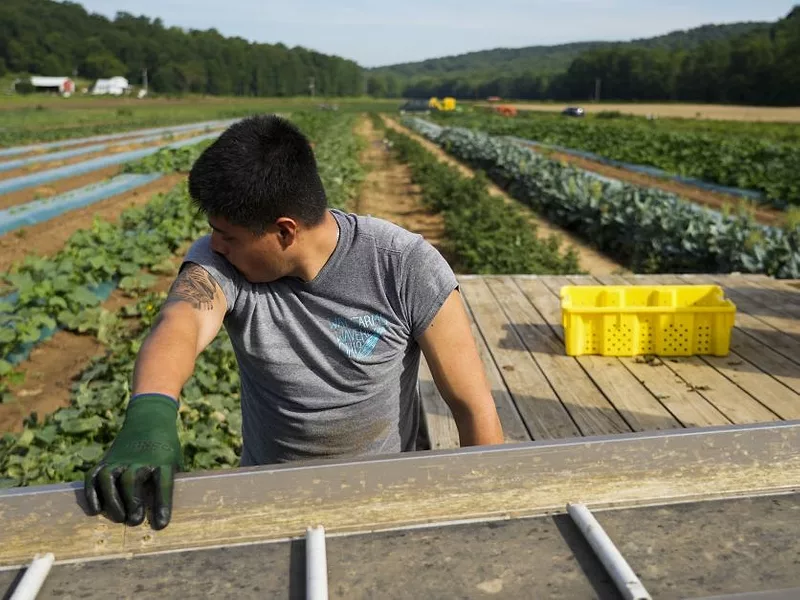
In a case that could influence the scope of federal agencies’ enforcement authority, the Supreme Court will review a federal appeals court decision that found the Constitution barred the Labor Department from penalizing a New Jersey farm for H-2A violations.
The same day the court heard arguments in a case against Monsanto concerning the reach of the federal pesticide law, the court granted the Labor Department’s petition asserting that the 3rd Circuit Court of Appeals got it wrong last July.
The appeals court found that Article III of the Constitution required the department to go to federal court when it sought to order the payment of back wages and fines against Sun Valley Orchards in Swedesboro, New Jersey.
The Supreme Court has recognized that there are “certain areas of regulation” where it’s appropriate for federal agencies to enforce federal law without going to the federal courts, says Pacific Legal Foundation attorney Josh Robbins. “It's called the public rights exception.”
Immigration is one such area, but the 3rd Circuit said the Sun Valley case doesn’t fit into the public rights exception because it involves an employment matter.
 Josh Robbins (PLF photo)
“What the court will consider now is how far Congress can take that exception in the immigration context,” Robbins said in an email. “Can it extend beyond rules for who is permitted to enter the United States into labor regulations that apply to both immigrants and domestic workers?”
The case, he said, “has the potential to narrow the enforcement schemes Congress can establish that allow the government to sanction individuals and businesses without the involvement of a federal court."
The Supreme Court granted the petition limited to two questions:
- "Whether Article III of the Constitution precludes the Department of Labor from adjudicating proceedings to collect monetary remedies from employers who have allegedly violated the terms and conditions of employment of H-2A workers and domestic workers in corresponding employment.
- "Whether [the Immigration Reform and Control Act] authorizes the Department of Labor to adjudicate proceedings to collect monetary remedies from employers who have allegedly violated the terms and conditions of employment of H-2A workers and domestic workers in corresponding employment."
In its petition, the Labor Department – represented by the Office of the Solicitor General – noted that the appeals court had said “immigration is traditionally a matter of public rights” subject to adjudication by the Executive Branch.
That court, however, “concluded that this case falls outside the public-rights doctrine because it concerns ‘employment law’ rather than ‘the admission and exclusion of aliens.’”
But that distinction is “illusory,” the petition said.
“The public-rights doctrine encompasses not only the admission and exclusion of aliens, but also the enforcement of conditions of admission,” the petition said. “And when the government grants an employer the privilege of bringing aliens to the United States to perform certain work, the government may impose and enforce conditions concerning the nature of that employment.”
"Public rights doctrine" and "public rights exception" are often used interchangeably, but Robbins said "it is more accurately described as an exception to Article III jurisdiction."
Interested in more news on farm programs, trade and rural issues? Sign up for a four-week free trial to Agri-Pulse. You’ll receive our content - absolutely free - during the trial period.
In its response, where it argued that there was no need for the court to take the case for review, Sun Valley said “there is no precedent or history supporting agency adjudication of such employment-related issues. The government’s contrary argument would vastly expand the public rights exception for immigration-related claims to encompass myriad issues involving temporary workers.”
ALJ fines Sun Valley for myriad violations
In 2019, a Labor Department administrative law judge found Sun Valley in violation of provisions in the H-2A program, which allows ag producers to bring foreign workers to the U.S. to work temporarily on their farms. The program, authorized in the 1986 Immigration and Nationality Act, has grown consistently over the past few years, with 398,258 positions certified in fiscal year 2025 – up more than 13,000 positions, or 3.3%, from FY2024.
The ALJ found numerous violations, including the firing of more than 20 employees in the middle of harvest season, failure to provide workers with sanitary housing, and transportation of workers from their housing to the fields each day using unlicensed drivers and unsafe vehicles. Sun Valley was ultimately ordered to pay about $370,000 in back wages and $212,000 in fines. An Administrative Review Board affirmed, and Sun Valley went to court.
At first, a federal district judge found in favor of the government. But Sun Valley had more luck in the appeals court in Philadelphia, which determined that the government’s action was barred by Article III.
PLF’s Robbins says the case “represents another step … in the Supreme Court's review of whether Congress can allow federal agencies to enforce federal law without federal courts.”
The most recent decision came in 2024, when the court decided in SEC v. Jarkesy that when the Securities and Exchange Commission “seeks civil penalties against a defendant for securities fraud, the Seventh Amendment entitles the defendant to a jury trial,” according to the court’s summary of the decision.
PLF is involved in the debate over the reach of administrative enforcement, “challenging the constitutionality of the USDA’s adjudication process in two cases on behalf of an owner and a trainer of Tennessee walking horses accused of violating the Horse Protection Act,” Robbins noted in a January opinion piece.

