
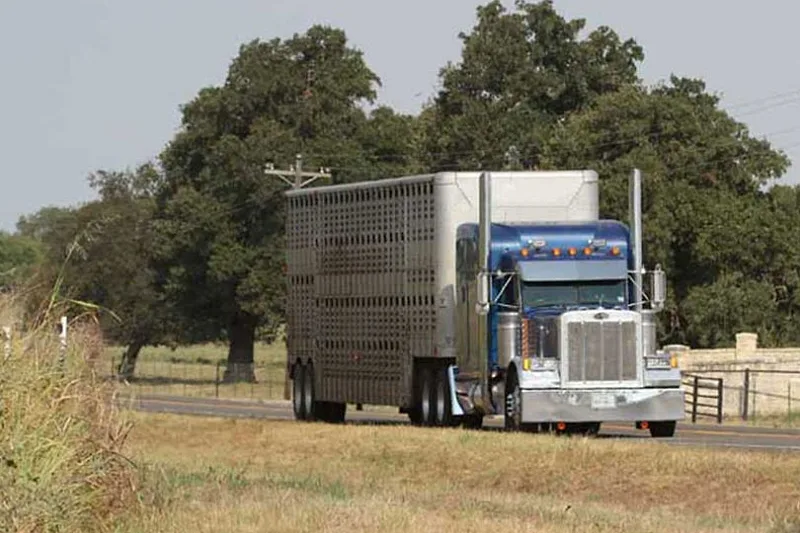
The Government Accountability Office is recommending Congress tighten a law designed to protect livestock while they are being transported.
In a new report, GAO recommends the Twenty-Eight Hour Law be updated to consider whether animals are healthy enough to be transported and if vehicles or equipment are unsanitary. The current law – which originated in 1873 – says that animals cannot travel for more than 28 consecutive hours without being unloaded for at least five consecutive hours for food, water and rest.
The law applies to cattle, sheep, swine and other mammals, but notably does not apply to poultry.
GAO identified six factors that would prevent animal cruelty and ensure safety during transport: the duration of confinement; environmental conditions; the animals’ fitness to travel; adequate driver training, and safe and sanitary vehicles and equipment. The law only addresses duration of confinement, GAO says.
These factors have been integrated into USDA guidance, industry best practices and international standards.
The report said USDA has done little monitoring of interstate transport for animals, and the Department of Transportation has never taken action because it does not have jurisdiction over animal health. Between 2013 and 2025, 23 cases were investigated for potential violations of the Twenty-Eight Hour Law, but only one case was referred to the Department of Justice. No action was taken.
"In general, the penalties are too low to incentivize enforcement, according to DOJ officials," the report said.
USDA has been known to take enforcement actions, including issuing warning letters to transporters about compliance, but in 2022, USDA and DOJ found that the Twenty-Eight Hour law did not authorize agencies to take administrative enforcement actions.
The report says USDA told Congress in 2025 that it is difficult to find violations of the law because there is a lack of documentation required for livestock transportation.
GAO urged Congress to consider amending the legislation or passing new legislation to prevent cruelty to livestock, clarify the role of federal agencies in interstate transport, and increase penalties for violations of the law.
The Twenty-Eight Hour law was created in 1873, but it has been repealed and reenacted twice since then, once in 1906 and once in 1994. The only exceptions to the law are if there is an unavoidable issue preventing the animals from being unloaded, such as an accident.
The fine for violations is between $206 and $1,055, as of April; except for adjustments for inflation, the levels have not been changed since 1873. The Twenty-Eight Hour law has civil penalties, which can be collected if the transporter knowingly violates the law.
"It appears that government agencies have failed to adapt to the modernization of animal transport and have resisted investing in the infrastructure needed to detect and prove violations," said the Animal Welfare Institute. The original law was created before cars and trucks were invented, and it was intended for railroads. It was 2003 before USDA included trucks as part of the law's regulations.
