
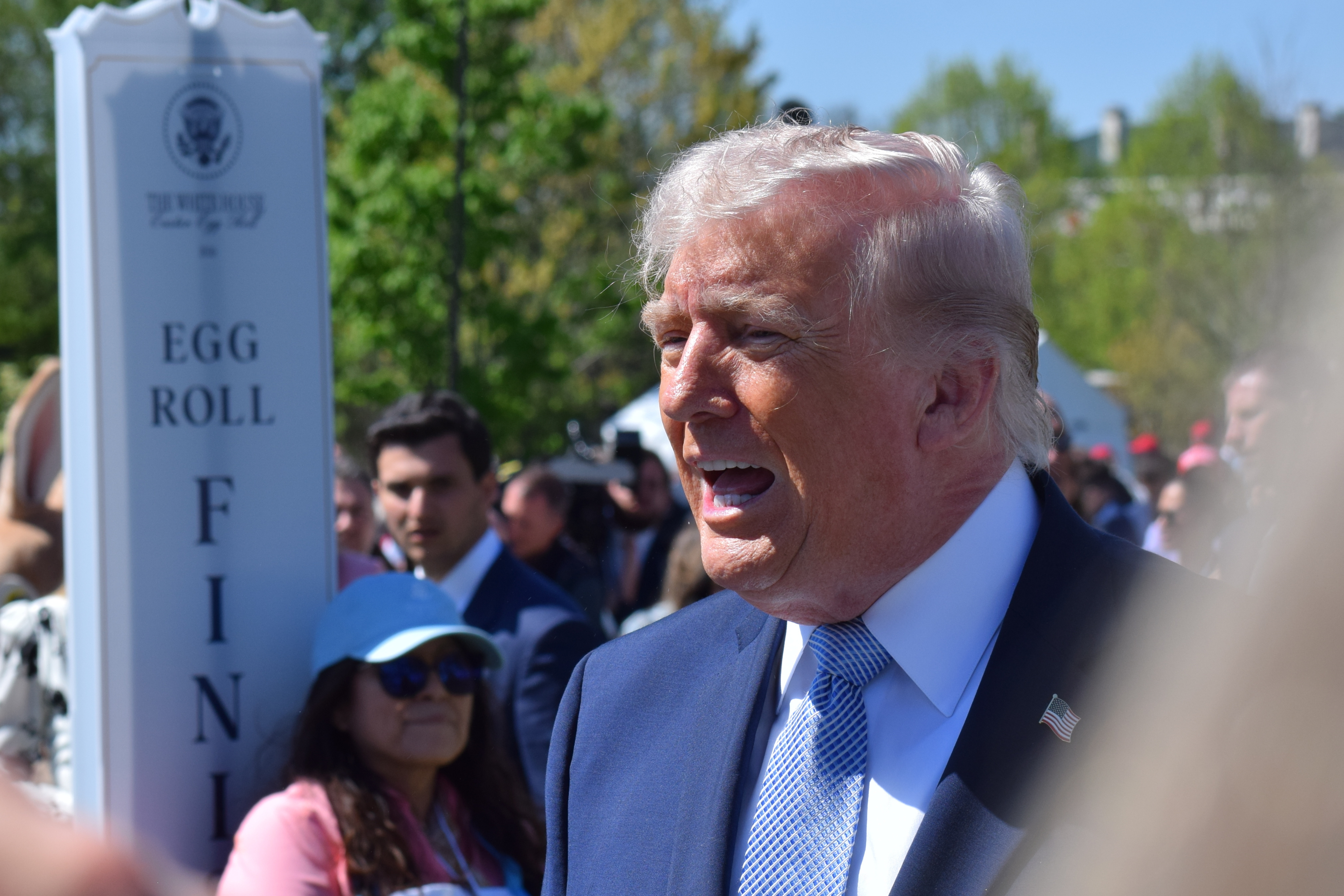
President Donald Trump on Wednesday said he wasn't sure whether he would renew the U.S.-Mexico-Canada agreement, which is up for reconsideration this year.
"I don't know that I'm going to renew it," Trump told reporters at the White House, also saying he wasn't "looking to renew it."
"We don't need anything that Canada has," Trump continued. "We don't need anything that Mexico has. But they need everything that we have, and they have to treat us better."
He went on to say that the U.S. should have trade surpluses with both Mexico and Canada, not deficits. He added that he believes USMCA was a "much better deal than NAFTA," but he added that "it was a great deal for one reason — it gave the right to terminate."
However, he said of Canada and Mexico, "We're talking to them. We'll see if we do something."
USMCA was signed in 2020 during Trump's first term to replace its predecessor, the North American Free Trade Agreement. Among the terms U.S. officials pushed for was a five-year sunset clause allowing the U.S. to weigh whether the agreement should be continued, according to the Congressional Research Service.
A joint review of the deal will take place next month, where participants will weigh whether to renew it for a 16-year term.
Some farm groups have previously called for the Trump administration to use the review to address trade issues with both countries, and tighten enforcement. However, 156 agricultural groups signed a letter earlier this year supporting the agreement's renewal, noting that trade cooperation between the three countries "affords massive economic benefits."
In a statement responding to Trump's comments, Farmers for Free Trade Board Chairman Bob Hemesath, a corn and hog farmer from northeast Iowa, said, "Failing to extend and strengthen this agreement would be a self-inflicted wound for American agriculture at the worst possible moment. U.S. agricultural exports to Canada and Mexico have grown by $20 billion since USMCA took effect, reaching $60 billion in 2024, and those two markets now buy roughly one-third of everything American farmers sell abroad. That trade supports nearly half a million American jobs and $149 billion in economic output here at home. While the agreement is not perfect, the venue for improving it is through this negotiation."
Cut through the clutter! We deliver the news you need to stay informed about farm, food and rural issues. Sign up for a FREE month of Agri-Pulse here.
Hemesath also said that "the notion that America does not need anything from Canada does not match the reality on my farm or any farm I know." The U.S., he noted, imports about 90% of its potash, with more than 80 percent of that coming from Canada.
"There is no substitute and no domestic supply that can replace it," Hemesath said in a news release.
At a House Ag Committee hearing Wednesday focused on USMCA, a panel of farmers and ag group representatives generally expressed support for the agreement's renewal, though some called for negotiators to iron out disagreements on dairy and specialty crops in upcoming negotiations.
"Failure to renew USMCA would be catastrophic," Jamie Beyer, a Minnesota farmer and American Soybean Association executive committee member, said during the hearing.
Beyer, who testified on behalf of the ASA, said USMCA has been a source of "stability and predictability for integration of North American agricultural markets, especially through the guarantee of duty-free treatment for soy and soy products." She said that in the last complete marketing year, Canada and Mexico accounted for $4 billion, or just over 13%, of total soy complex exports.
However, she did say the soybean industry would support some "minor" adjustments to the agreement, including changes to maximum residue limits for pesticides and the harmonization of grain inspection across the three countries "to minimize transportation delays and support efficient agricultural shipping.
Dave Puglia, president and CEO of Western Growers, also said his organization supports the continuation of the agreement. However, he called for measures to address a "labor cost gap" between the U.S. and Mexico, a commitment from Mexico to adopt a trust mechanism to protect fresh producer growers and shippers from non-payment due to bankruptcies or insolvencies, and standards and oversight to ensure the safety of Mexican produce.
Michael Lichte, chief insights and optimization officer for Dairy Farmers of America, said Canada's implementation of dairy market access and pricing provisions "has fallen well short of the negotiated intent."
He said that since the agreement's implementation, Canada "has administered its dairy tariff-rate quotas in a manner that prevents full use of the market access concessions secured under USMCA." He also noted that retailers and foodservice operators "remain completely excluded from access to the quota system despite representing entities with actual commercial demand for competitively priced U.S. dairy products."
Lichte called for the upcoming USMCA joint review to "address these issues head on." He said Canada's TRQ allocation system "requires structural reform to ensure quota volumes are fully usable by U.S. dairy exporters – irrespective of their end destination, not just Canadian processors."
"Stronger utilization requirements and more effective quota return provisions are needed to discourage chronic underfill," he said.
He also said the review must "comprehensively address" Canada's pricing of nonfat milk solids by "evaluating evaluating the efficacy and conditions of the pricing formula, reconsidering the export thresholds for Canadian nonfat milk solids, and requiring Canada’s full partnership in any pricing or quota policies it may change."
Still, he said for the U.S. dairy industry, USMCA "remains one of the most consequential trade agreements affecting long-term competitiveness, manufacturing investment, and the economic stability of dairy farm families."
With appropriate enforcement and modernization, the agreement "can continue supporting investment, export growth, and economic opportunity for America’s dairy farm families for generations to come," Lichte said.
Michael Schumpp, senior director of international affairs for the Meat Institute, called USMCA "the world's gold-standard trade agreement" and urged officials to avoid "a disruptive renegotiation." He said during the hearing the agreement has "underpinned the growth of an extremely integrated North American meat and livestock industry that's valued at over $16 billion."
He said live cattle and hog imports often cross borders between the three nations and said if USMCA were disrupted, it could disrupt those flows.
For more news, go to Agri-Pulse.com.

