
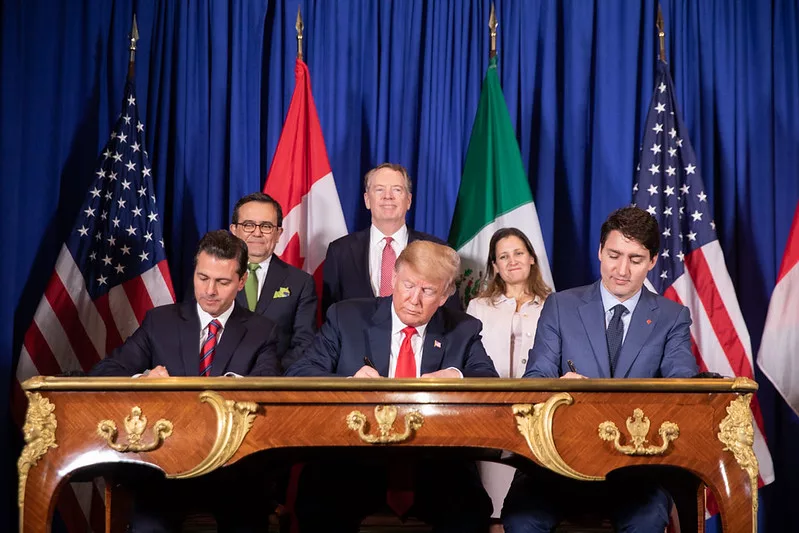
Some farmers and ranchers are appealing to the Trump administration to use the upcoming review of the North American free-trade deal to address longstanding trade issues with Mexico and Canada and step up efforts to protect growers from lower-priced imports and tighten enforcement.
However, a coalition of more than 100 industry groups has filed a joint comment with the Office of the U.S. Trade Representative favoring a full 16-year renewal of the U.S.-Mexico-Canada Agreement and cautioning against overhauling the agreement.
Among the signatories were groups representing soybean, corn, fertilizer, pork, dairy, rice, sorghum and fruit producers, among others.
“Any adjustment should be carefully considered in order to avoid negative impacts on agriculture, especially any measure that weakens the agreement and thereby lessens the strength and value of U.S. agricultural exports, at a time when U.S. farmers and ranchers are at risk of losing other export markets,” the coalition wrote.
As of Tuesday, USTR had published more than 90 comments from farmers and ranchers responding to its request for public comments on the USMCA, with dozens more from industry groups representing commodity growers across U.S. agriculture.
A joint review of the deal is slated for next July, when participants can decide to extend it for another 16-year term, or meet annually for negotiations until the end of the current agreement’s term in 2036. All three countries have launched internal processes for collecting feedback from domestic industries.
A portion of the farmers and ranchers that filed written comments were acting at the request of Farm Action, a nonpartisan advocacy group.
Farm Action wants the Trump administration to reinstate mandatory country of origin labeling for beef and pork products and sees the USMCA review as an opportunity to quash Canada's and Mexico’s opposition. Both countries challenged the U.S. policy at the World Trade Organization, prompting Congress to repeal the measure in 2015 to avert further trade disputes.
The USMCA review, Farm Action argues in its own submission to USTR, represents a rare opportunity “for the United States to reset its trade agenda and revisit commitments made under the agreement.” It also provides a moment of heightened leverage, the group says, as Mexico and Canada are hoping to preserve stability in the North American market.
The “U.S. can use this moment to negotiate adjustments that accommodate MCOOL while preserving broader trade flows,” Farm Action writes.
Multiple farmers reiterated Farm Action’s push to use the review to revive MCOOL.
“For too long, multinational meatpackers have been allowed to pass off imported beef and pork as if it were raised in the U.S.,” reads one response from Missouri-based K&M Stock Farm, although many others included similar sentiments.
Reinstating MCOOL, K&M President Kent Bradshaw writes, would give consumers clear information, help grow domestic cattle herds, bolster domestic food security and align with President Donald Trump’s professed “America First” trade policy focus.
Don’t miss a beat! It’s easy to sign up for a FREE month of Agri-Pulse news! For the latest on what’s happening in Washington, D.C. and around the country in agriculture, just click here.
“We’re thrilled to see such a strong response from farmers, ranchers, and consumers across the country who echoed Farm Action’s call to reinstate MCOOL for beef and pork,” Farm Action’s President Angela Huffman told Agri-Pulse in an email. “The message is clear: People want transparent labels so consumers can choose American-raised meat and U.S. farmers can finally compete on a level playing field again.”
The cattle industry, however, is not aligned on whether MCOOL would be a net positive for U.S. ranchers. The National Cattlemen's Beef Association has long questioned the benefits of the policy, arguing that consumers pay little attention to labeling and that the move would incur significant costs to implement.
Another chunk of the submissions was from ranchers in the southwestern U.S. calling for the administration to use USMCA to press Mexico on its failure to live up to its obligations under a 1944 water treaty.
Under the terms of the deal, Mexico is expected to deliver 1.75 million acre-feet of Rio Grande water to the United States over a five-year period. But when the most recent 5-year cycle ended on Oct. 25, it had only delivered around half of that. The treaty lets Mexico repay its debt with surplus purchases in the next cycle, but the lag in deliveries has been hard on Texan producers, who have been forced to cut back on irrigated acreage in recent years.
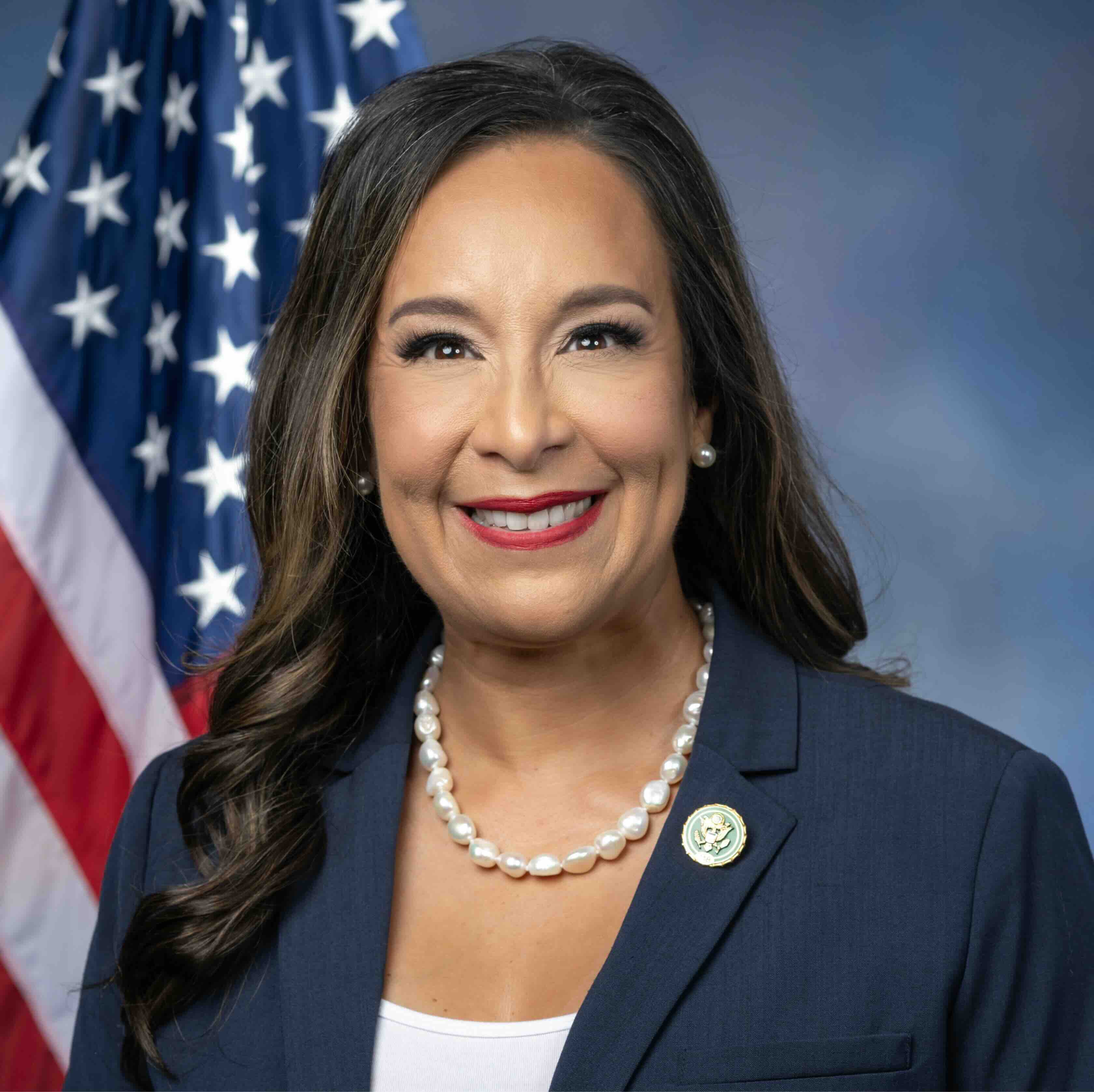 Monica De La Cruz, R-Texas (Official photo)
Incorporating the treaty’s obligations into USMCA would allow the U.S. to use the agreement’s dispute resolution framework to penalize Mexico for missed deliveries, a submission from Hidalgo County Farm Bureau reads.
Texas Republican Rep. Monica De La Cruz advocates for using USMCA to hold Mexico to its commitments. In recent comments to the Texas Farm Bureau, she urged Texas farmers and ranchers to follow her lead and lodge comments to USTR in support of the proposal.
“The current framework for addressing these water issues, primarily through the International Boundary and Water Commission (IBWC), has not proven sufficient to ensure timely and predictable water deliveries,” she wrote in her own USTR submission. Meanwhile, USMCA’s “robust dispute settlement mechanisms,” she said, would provide stronger enforcement options.
The art of (enforcing) the deal
Several groups identified areas where Mexico and Canada had failed to live up to the terms, or spirit, of the original agreement, and urged the administration to step up enforcement and take steps to eliminate loopholes.
For example, Sheppard Grain Enterprises (SGE), a New York-based soybean processer, warned that organic Canadian soybean oil and meal made from beans imported from third-party countries are being sent to the U.S. tariff-free under the deal.
“SGE cannot compete with Canadian organic soybean meal priced $50-80 lower per ton than the production costs of SGE meal,” company President John Sheppard said in the submission. Accordingly, he wrote, SGE has been forced to stop producing organic soybean meal.
U.S. dairy producers, including the National Milk Producers Federation, repeated their call to press Canada to reform its tariff-rate quota allocation to meet its original market access commitments for U.S. dairy products.
The U.S. Chamber of Commerce also repeated concerns that Mexico’s constitutional reform – most notably, a decision to make federal judges electable – could violate its USMCA commitments.
“Mexico’s constitutional reform poses significant challenges to judicial independence and regulatory autonomy, directly conflicting with critical provisions of the USMCA,” the Chamber writes.
Bitter fruit?
Respondents from across the fresh produce sector raised concerns around Mexican imports that, if the administration chooses to prioritize them, could become a fresh thorn in the U.S.-Mexico trade relationship.
Avocado, onion and blueberry producers, among others, complained that Mexican products are increasingly eating into their domestic market share.
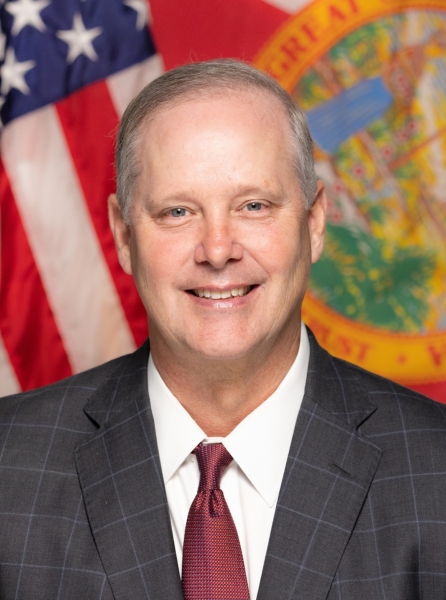 (Wilton Simpson (Official photo)
“[F]oreign fruits and vegetables flood the U.S. market, often at same time U.S. crops are reaching their peak in-season period, with imports priced at or below the cost of production,” the Georgia Fruit and Vegetable Growers Association complained in a submission. “These import dynamics contribute to a growing U.S. agricultural trade deficit and raise concerns about the long-term viability of domestic fruit and vegetable production.”
The group urged the administration to use any trade tools at its disposal to protect U.S. fruit and vegetable growers.
The Trump administration has already demonstrated its willingness to support domestic fruit producers that feel undercut by Mexican exports. This summer, it pulled the U.S. out of a decades-old tomato suspension agreement with Mexico and placed new tariffs on imports. The move was heralded by Florida tomato growers at the time.
There is also support in Democratic circles for using the review to address imports undercutting U.S. producers. A group of more than 100 Democrats, including Agriculture Committee ranking member Angie Craig of Minnesota, are calling on the administration to undertake a "significant renegotiation" of the deal.
"Under the 2020 USMCA, big agriculture corporations have raked in enormous profits while family farmers and working people in rural communities suffered," the lawmakers write. Accordingly, they argue the agreement needs retooling to protect farmers and prevent imports from undercutting U.S. producers.
A submission from Florida’s Agriculture Commissioner Wilton Simpson to USTR describes the state’s ag industry as being “at a pivotal crossroads.” Simpson says Florida producers have had to grapple with lower-cost Mexican imports for over two decades, putting the U.S. supply at risk.
“Food security is national security,” Simpson argues in the filing, “maintaining a strong, competitive American agriculture sector is essential to both.”
Noah Wicks contributed to this report.

