
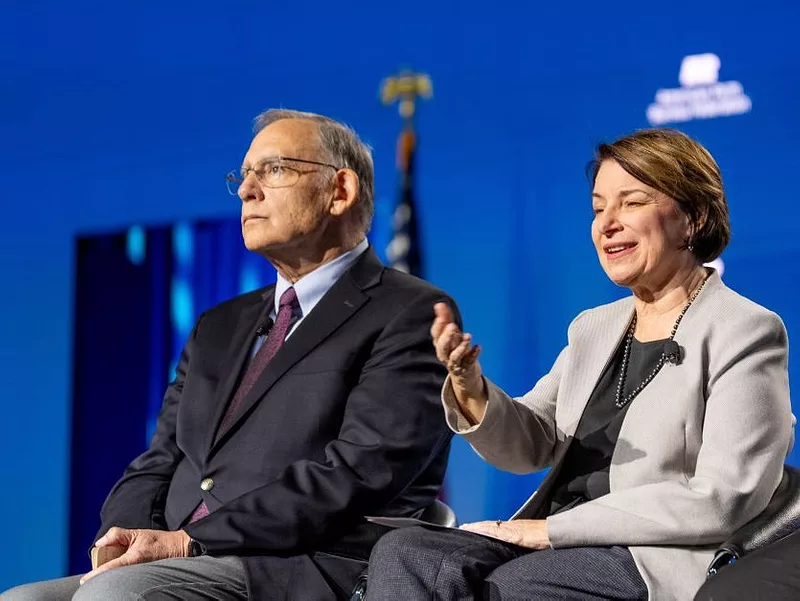
Senate Agriculture Committee Chairman John Boozman unveiled a “farm bill 2.0” discussion draft that would boost support for a wide range of ag producers, enhance transparency of fertilizer markets and foreign land ownership, and strengthen healthcare access for rural Americans.
The legislation would reauthorize certain ag programs through 2031 and build on provisions enacted through last year’s One Big Beautiful Bill Act. Republican members of the committee are pitching the draft as an effort to update federal initiatives focused on giving producers more certainty while expanding support for rural communities, agricultural trade and national food security.
What’s not included in the text are the most controversial issues that bogged down the House’s crafting of a farm bill last spring. At the top of the list – also not addressed in the House bill – are upcoming costs certain states must start paying for the Supplemental Nutrition Assistance Program. Democrats are pushing for a delay to study the costs they say don’t appear fair and could financially burden some states to the point of having to cut crucial food aid.
How the partisan disagreement plays out in expected farm bill negotiations or in a possible conference with the House could determine whether five-year ag legislation is passed this year.
Boozman on Tuesday said talks with Democrats on nutrition policy were occurring, though he declined to provide details. "We're negotiating in private," he said. "The good news is that everybody's working in good faith to get a farm bill."
Democratic members of the Senate Agriculture Committee said the draft falls short, while also signaling openness to a compromise.
"This bill does not address the devastating cuts to SNAP or the shift to state taxpayers," the Democrats said in an emailed statement. "We appreciate that bipartisan provisions have been included in the discussion draft and stand ready to work with Republicans to negotiate a bipartisan farm bill that both meets the moment and can be successful on the Senate Floor.”
'Long overdue'
Congress hasn’t completed a comprehensive farm bill since 2018, largely due to political logjams over food aid.
Cut through the clutter! We deliver the news you need to stay informed about farm, food and rural issues. Sign up for a FREE month of Agri-Pulse here.
“An updated farm bill is long overdue. Economic conditions have changed dramatically since 2018 when we did the last farm bill, which was actually based on 2012 data," Boozman said to reporters on Tuesday. "If you feed America, this bill is for you."
The Senate Ag chairman emphasized that the proposed bill would modernize USDA loan limits so producers can access needed capital based on today's economy. The draft pulled in more than 100 bipartisan bills and priorities, he said.
Last year, through a fast-tracked legislative process used to pass the One Big Beautiful Bill Act, lawmakers made crucial updates to farm programs. Outstanding key items in the Senate draft deal with issues such as crop insurance, rural broadband, specialty crops, trade, conservation and increased loan limits.
Sen. Chuck Grassley, R-Iowa, a member of the ag committee, said he’s hopeful provisions in the House farm bill ultimately make their way into final legislation.
“It would be better for us to take up the House bill, but I’m not going to argue with Chairman Boozman,” Grassley told reporters on Tuesday.
The Iowa Republican, though, said he’s pleased that his fertilizer research bill with Sen. Tammy Baldwin, D-Wis., is in the draft, as well as parts of his legislation with Baldwin aimed at better tracking foreign ownership of U.S. agricultural land.
Grassley said he’s especially disappointed that the Senate draft text doesn’t include a provision in the House bill that would nullify animal-welfare state laws like California's Prop. 12, which opponents say are overly stringent and raise meat prices. He’d also like to see language to allow year-round, voluntary sales of higher ethanol-gasoline blends, known as E15.
After a tumultuous process, a stand-alone ethanol measure eventually passed the chamber last month; Senate Majority Leader John Thune, R-S.D., has said he’s looking at crafting a new version of the legislation to bring to the floor for a vote.
Language to establish federal supremacy on pesticide labeling also isn’t in the Senate text. The provision was ultimately stripped from the House farm bill amid opposition that’s divided Republicans on the issue.
Another thorny matter not addressed in the Senate bill draft or House legislation is the push by lawmakers including Sen. Rand Paul, R-Ky., to delay the implementation of a federal ban on certain intoxicating hemp products, like beverages and gummies.
The budget-neutral draft also doesn’t include additional economic aid to agriculture producers struggling with low prices for their products on top of soaring production costs and uncertain demand.
Boozman, Minnesota Sen. Amy Klobuchar, the top Democrat on the Ag Committee, and Sen. John Hoeven, R-N.D., chair of the Senate Appropriations Committee's subcommittee on agriculture, are among lawmakers pushing for more aid to get to farmers ahead of updated farm safety net programs taking force in October. Dollar figures ranging roughly from $15 billion to $17 billion have been proposed to add to the $12 billion the Trump administration is providing to crop growers.
The American Farm Bureau Federation’s John Newton said he’s hopeful there will be a chance to add farmer economic assistance in an upcoming supplemental funding measure to respond to recent natural disasters. The aid needs to come before October because many growers will need to start working with lenders soon and making investment decisions, like fall fertilizer applications, for next season.
“The clock is ticking and midterms are right around the corner,” Newton, AFBF’s vice president of public policy and economic analysis, told Agri-Pulse. “There’s a lot of things that this Congress needs to do to show agriculture in rural America that they're paying attention.”
Here are some highlights from the draft farm bill.
Specialty crop disaster aid
As farm-state lawmakers have emphasized the need for more support for growers of specialty crops, one of the most significant such provisions in the draft would establish a permanent framework for USDA to administer future disaster assistance programs for fruit, vegetable, tree nut and nursery producers when Congress provides funding.
That structure, which would base payments on a producers’ sales in the year before a disaster, would guide USDA in coordinating and distributing funding for future disasters, limiting rule reworks in later aid efforts overseen by the agency.
Specialty crop growers have often relied on ad hoc disaster packages approved by Congress after hurricanes, freezes, droughts and other catastrophic natural events, rather than benefiting from the more structured safety net programs available to many commodity producers.
Multiple iterations of aid programs with different requirements over the last decade have led specialty crop groups to push for a standardized structure based on a producers’ prior-year sales, and supporters of the idea say such a framework would help speed up assistance efforts.
The bill also would expand several existing disaster programs that many specialty crop producers utilize: the Tree Assistance Program, expanded livestock and forage disaster assistance, and greater flexibility for USDA to deliver assistance through state block grants.
Additionally, the bill authorizes USDA to administer natural disaster relief funding via block grants to states to provide quicker and more regionally suited assistance.
Nutrition
In what’s likely to be the biggest partisan fight around the proposed legislation, the text doesn’t address Democrats' goal of rolling back or delaying state SNAP cost-share provisions.
The bill does include “Buy American” school lunch requirements; a broadening of produce purchasing options under federally funded nutrition programs; and authorization of online SNAP purchasing.
While Boozman has made clear the farm bill needs to stay clear of the most divisive issues to pass a full Senate vote, committee aides stressed that some issues not included in the discussion draft are merely still under review for specific wording or consulting with committee members.
Such matters could potentially include initiatives like inclusion of hot rotisserie chicken in SNAP, according to an aide. The provision is in the House-passed bill but not the Senate draft.
One of the most significant proposed changes in nutrition policy would strengthen domestic purchasing requirements for school meal programs. The legislation directs USDA to require school food authorities to source at least 95% of food products and commodities domestically in each category during a school year.
Current USDA regulations require schools to purchase domestic products "to the maximum extent practicable" and allow exceptions when U.S. products are unavailable or significantly more expensive. Supporters say the change would create a more predictable market for U.S. farmers while increasing the amount of domestically produced food served in schools.
The bill also expands eligible purchases under the Gus Schumacher Nutrition Incentive Program, or GusNIP, by allowing incentives to apply to all forms of fruits, vegetables and legumes rather than exclusively fresh produce.
In addition, the draft legislation would make USDA's SNAP online purchasing initiative permanent, ending its status as a pilot program and ensuring participants can continue using benefits for online grocery purchases.
Conservation
The bill would reauthorize the Conservation Reserve Program through 2031.
The overall program would retain its current 27-million acre cap, with the limit for its grasslands signup set at 12 million acres. Additionally, it would up CRP payment limitations to $125,000 — the program's first-ever payment limitation increase — and would also update CRP haying and grazing authorities during emergency conditions, allow cost-sharing for grazing and water infrastructure, and adjust rental rate calculations to attract a greater share of marginal lands into the program.
The bill stands up two new conservation programs, including a Forest Conservation Easement Program, which aims to help pay for easements to protect forestland, which would be funded at $240 million over a five-year window. Meanwhile, a new State Conservation Assistance Program, which seeks to help states and tribes pay for their own agricultural conservation programs, would be funded at $250 million over five years.
However, under the preliminary bill, the baseline of the highly-popular Environmental Quality Incentives Program — which was set to rise to $2.85 billion in fiscal 2027 under the One Big Beautiful Bill Act — would instead be set at $2.5 billion for that year. It would then rise over the next few years until it settles at $3.25 billion in FY31, instead of reaching the $3.25 billion figure in FY28 as established in the OBBBA.
The House’s farm bill similarly included near-term reductions to EQIP’s budget authority, which were used to help fund other priorities while still allowing the program’s overall baseline to hit its eventual growth target in 2031 and following years.
Trade
Unlike the House-passed farm bill, the text does not authorize moving the Food for Peace bill from the U.S. Agency for International Development to the Agriculture Department. Committee aides said Boozman supports the program and its omission merely reflects the working out of technical jurisdiction issues.
The measure would double funding for agricultural trade promotion and facilitation programs. Market Access Program funding rises from $200 million to $421 million for fiscal 2027, and then to $437 million for fiscal years 2028 through 2031. The Foreign Market Development program funding jumps from $34.5 million to $73.5 million for fiscal year 2027, and then to $75.5 million for each of fiscal years 2028 through 2031.
The bill would also establish an interagency working group led by USDA and including the Office of the U.S. Trade Representative, the Commerce Department and other federal agencies to monitor seasonal and perishable produce imports and evaluate their effects on U.S. producers. Under the proposal, the working group would regularly review trade data, consult directly with domestic fruit and vegetable growers and coordinate potential trade responses when imports are found to be harming U.S. industries.
Credit
The bill's credit title focuses heavily on modernizing USDA loan programs so lending authorities can keep pace with rising production costs facing farmers, ranchers, and rural communities. The legislation would significantly increase Farm Service Agency loan limits while indexing those caps to inflation going forward.
Under the proposal, direct farm ownership loan limits would rise from $600,000 to $850,000, while guaranteed farm ownership loan limits would increase from roughly $2.25 million to $3.5 million. Direct operating loan limits would climb from $400,000 to $750,000 and guaranteed operating loan limits would rise from about $2.25 million to $3 million. The bill also would double the cap on FSA microloans from $50,000 to $100,000.
The legislation includes several provisions aimed at beginning farmers and ranchers, including a pilot program that would allow producers to receive pre-approval for direct farm ownership loans before purchasing land.
Rural development
The bill would increase access to healthcare and childcare and allow resources to be used flexibly to meet local needs. It also would provide temporary zero-interest loans through the Community Facilities Direct Loan Program to support new construction and renovation of existing rural hospital facilities to improve services.
The bill also would enshrine into law the USDA’s ReConnect broadband program; create a new “last mile” initiative focused on connecting farms and ranches; expand opportunities for small meat and poultry processors and renderers; ensure access to clean drinking water and wastewater services; and establish a cybersecurity circuit ride program to improve the ability of rural water systems to fight cyber threats.
Also of note
- Creation of a new Office of Biotechnology Policy at USDA, aimed at coordinating biotechnology policy and regulatory issues affecting agriculture.
- Creation of a USDA crop input economist tasked with monitoring fertilizer and other input markets and improving market transparency.
- Establishes the Specialty Crop Advisory Committee to assist and encourage the Federal
Crop Insurance Corporation (FCIC) Board to research and improve policies for specialty crops.
Updates the FCIC Board of Directors to include more types of producers, better reflecting the diversity of agriculture across the nation. The new members include the chair of the Specialty Crop Advisory Committee, a livestock and crop producer, and a beginning farmer or rancher.
- Codification of USDA's Office of Seafood.
- Study of adding dry edible beans to commodity programs.
- Mandatory dairy processing cost reporting intended to improve transparency in federal milk marketing discussions.
- A regulatory pathway for plant biostimulants, a priority for input manufacturers seeking greater clarity for products that improve nutrient uptake and plant health.
For more news, go to Agri-Pulse.com.
.webp?t=1762183428)


