

When Phil Glaize first came to Washington to advocate for agricultural labor reform in the 1980s, he was a young apple grower trying to help solve a workforce problem that already seemed urgent. Decades later, the third-generation farmer in Virginia's Shenandoah Valley made the trip again this week with renewed optimism for long-needed reforms.
“I have been pushing the stone up the hill for many years, and we have not gotten through the finish line,” Glaize said.
Since returning to the family farm 46 years ago after a brief career in commercial banking, Glaize has expanded the operation to grow apples on roughly 500 acres in Virginia's Shenandoah Valley. He’s also brought two of his sons, the fourth generation, into the business.
Like many specialty crop growers, Glaize's operation depends heavily on manual labor. H-2A workers harvest the apples each fall, while local employees sort, pack and ship fruit long after the harvest season ends. The farm employs seasonal workers for harvest, and about 50 domestic workers to complete operations the rest of the year.
 Phil Glaize Jr. (Glaize Apples photo)
"Beyond harvest, we put the apples in cold storage and pack them throughout the year," Glaize said. "If we didn't have the apples harvested, they wouldn't have a job."
“So it goes beyond having a viable workforce. It actually creates jobs for U.S. citizens," he added.
Glaize and dozens of ag producers from across the country gathered on Capitol Hill Tuesday for the release of the Securing Agriculture’s Workforce Act. Unveiled by House Ag Committee Chairman Glenn "GT" Thompson, R-Pa., the bill expands access to H-2A workers for year-round agricultural employers, removes the requirement that agricultural work must be seasonal, revises the wage calculation methodology and streamlines the application process.
The proposal is based on recommendations released in 2024 by the House Ag Committee's bipartisan Agricultural Labor Working Group. At the bill release Tuesday afternoon, 48 House members from 28 states had signed on as original co-sponsors.
For apple growers, dairy farmers, nursery operators, specialty crop producers and ag operations across the country, the proposal is one of the most significant attempts in years to reshape agricultural labor policy around the realities of modern-day farming. It's backed by a broad coalition of more than 400 ag organizations.
Dairies could become eligible for H-2A for the first time
The proposal is generating excitement in the dairy industry, which has long been excluded from H-2A because cows require care year-round.
Ryan Akin, partner in New York-based Hemdale Farms, which grows cabbage and operates a dairy, said the current system creates a frustrating divide: His cabbage operation can use H-2A workers, but his dairy cannot.
“We've struggled since the 1990s to have enough labor locally to fulfill all those jobs,” Akin said. “About 15 years ago we went into the H-2A program to have access to stable legal labor for the cabbage, but the dairy side of our business still does not have access to stable and legal labor, to put it bluntly.”
“We have a great need for labor, and this bill by Chairman Thompson is a step in the right direction,” Akin added.
Gregg Doud, CEO of the National Milk Producers Federation, said the industry's workforce challenges are fundamentally different from those faced by seasonal agriculture because labor needs never disappear. Even with robotic milking technology, workers are still needed to feed animals, administer medication and maintain facilities around the clock, 365 days a year.
 Gregg Doud (NMPF photo)"On the Fourth of July there are going to be milking shifts. On Christmas Day there are going to be milking shifts," Doud said. "Without help, the cows don't get milked, and when the cows don't get milked, they go to town."
While the H-2A program hasn’t been allowed for dairy in the past, it’s becoming even more necessary without a reliable domestic workforce. Akin says expanding labor availability could be the difference that allows some dairies to stay in business.
Cut through the clutter! We deliver the news you need to stay informed about farm, food and rural issues. Sign up for a FREE month of Agri-Pulse here.
“It's really not a question of are there people in our local town that will do this work, because there aren’t,” Akin said. To hire an H-2A worker, employers must publicly post the job to first allow domestic workers to apply for the role. “We've used the H-2A program for 15 years, and I think we've had maybe one or two applicants locally.”
Labor shortages can mean crops left in the field
For Arizona produce grower John Boelts, labor shortages are not a theoretical concern. It can mean losing a harvest entirely.
Boelts and his wife started their own farming operation about 18 years ago in Yuma County, growing melons and vegetables for fresh produce markets across the United States and Canada. Today, the farm raises roughly 3,000 acres of crops and employs 40 to 50 workers during peak season.
Growing vegetables, he said, is "more like large-scale gardening" than commodity crop production. Every melon and vegetable the farm produces is harvested by hand.
"We simply are not going to plant the crop and grow it here in the United States if we don't have enough folks to work for us," Boelts said.
Like many specialty crop producers, Boelts said his local labor pool has steadily diminished over the past two decades. Workers once routinely stopped by looking for jobs. Today, the farm may see only a handful of local applicants each year, forcing the operation to rely heavily on H-2A workers supplied through a farm labor contractor.
 John Boelts (X photo)The consequences of labor disruptions can be immediate. This spring, delays in the arrival of harvesting crews left the farm short-handed during the first four days of its cantaloupe harvest.
Without hands to harvest, roughly 15,000 cartons of cantaloupes were left in the field. The timing was particularly costly because prices were near their seasonal peak at $30 a box when harvest could have started. By the time workers arrived, market prices had fallen by half to $15 a box, contributing to a loss on the crop.
"We need a legal and reliable workforce, and we need to be able to depend on them being there when we need them," Boelts said. "In agriculture, it literally matters from day to day."
That uncertainty is one reason Boelts supports provisions in Thompson's bill aimed at streamlining the H-2A process and improving coordination among federal agencies that could help reduce the kinds of delays that disrupt harvest schedules.
"H-2A has been a lifeline to keep us in business," he said. "We're really excited about this legislation."
Opportunity for year-round agriculture labor
Giorgi Mushroom Co. in Berks County, Pennsylvania, is the largest, single-location mushroom farm in the world, producing over 180 million pounds annually. The 100-year-old company employs roughly 2,300 workers and produces about $500 million in value annually.
Yet because mushroom production occurs continuously year-round, the company has never qualified to employ H-2A visa workers.
"We grow about nine crops a year, so we're very different from, say, potatoes. That does not allow us to be applicable to the H-2A program as it is today," said Giorgi CEO Mark Currie.
Thompson’s new bill would strike the program's seasonal requirement, allowing employers with year-round labor needs – including dairies, greenhouses and other controlled-environment agriculture operations like mushroom producers – to participate as long as worker contracts do not exceed 350 days annually.
Maintaining a stable domestic workforce has become increasingly difficult, Currie said, forcing the company to rely heavily on temporary labor.
He called the bill “groundbreaking” for the domestic mushroom industry, saying he believes access to legal guest workers could help stabilize labor costs and be “a key unlock to invest in the future for our company.”
Currie also said the change would help level the playing field with foreign competitors, noting that Canadian producers already have access to temporary foreign worker programs to fill labor shortages when qualified domestic workers are unavailable.
Nursery growers squeezed by rising labor costs
For Alan Jones, owner of the 100-acre Manor View Farm in northern Maryland, labor costs have become one of the biggest challenges of participating in the H-2A program.
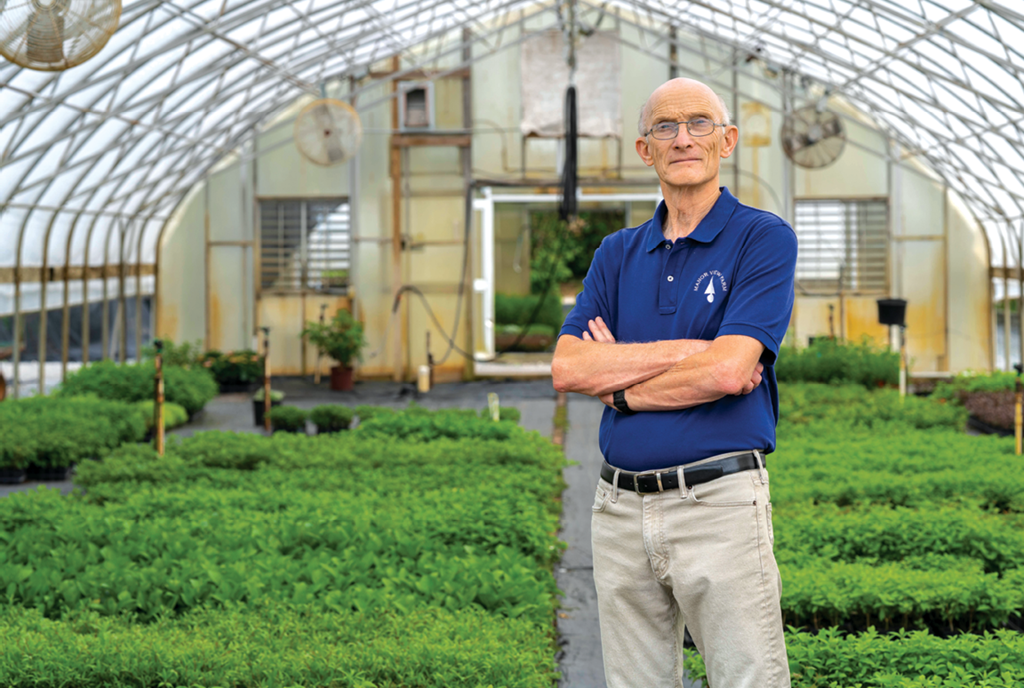 Alan Jones (Manor View Farm photo)
Jones has used H-2A and H-2B workers for more than 25 years. During that time, he says the program has become significantly more expensive and more complicated to navigate.
"The cost is probably the biggest change," Jones said. "You have to hire an agent to do the work for you because if you don't cross every T and dot every I, the application will be returned."
Required wage rates have climbed steadily as well. Department of Labor data shows Maryland's Adverse Effect Wage Rate, the minimum wage employers must pay most H-2A workers, reached $17.96 an hour in 2025. The rate was closer to $11 an hour a decade ago. Wage increases come on top of housing, transportation, visa and administrative costs that employers are required to cover.
Thompson’s bill would codify the Department of Labor’s current methodology for calculating the Adverse Effect Wage Rate. It would also place limits on annual wage increases and decreases while allowing employers to account for housing costs as part of overall worker compensation.
Jones, who relies on both H-2A and H-2B workers, says he's also optimistic about the bill's provision that would give nursery operators greater flexibility by allowing some work currently performed through H-2B visas to be shifted into the H-2A program.
"One of the biggest benefits is that some of the work we currently have to do with H-2B workers could be done with H-2A workers," Jones said. "That would make a huge difference."
Jones said the bill's move from a "seasonal" to a "temporary" labor standard would also better reflect modern growing conditions. Workers typically arrive in March and stay through Thanksgiving, and longer growing seasons have increasingly stretched labor needs beyond traditional seasonal windows.

