
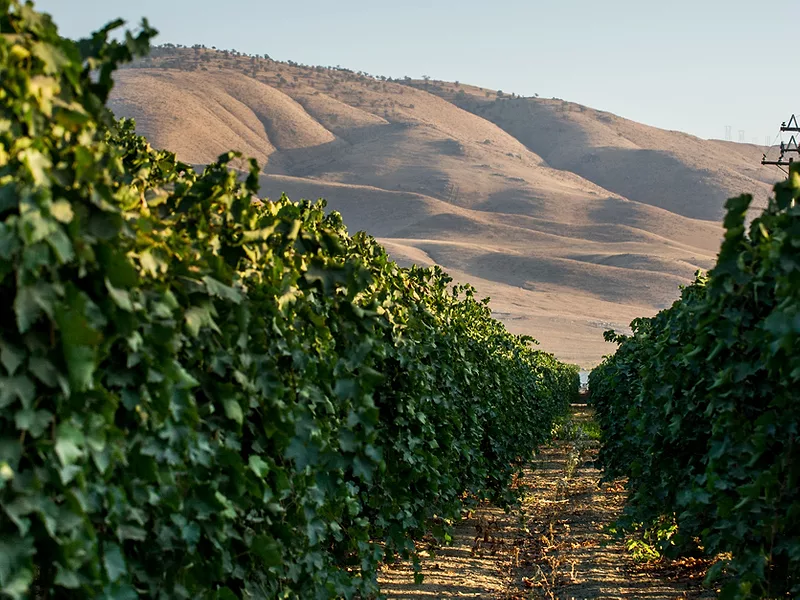
California’s premier wine regions could become less suitable for grape production as the climate warms, while areas opening to vineyards farther north may face a growing wildfire threat, according to a new study.
Researchers at Japan’s Tohoku University projected substantial declines in climatic suitability in Napa and Sonoma counties, as well as in San Luis Obispo and Santa Barbara counties, under both moderate- and high-emissions scenarios. Rising temperatures during the growing season were the primary driver, with warming eventually pushing some established vineyards beyond their historical climatic range.
The study, published in the journal Frontiers in Climate, combined climate projections with an index measuring weather conditions conducive to extreme fire behavior. The researchers modeled conditions for the middle and end of the century using data from five global climate models and 379 California winery locations.
The analysis found increasing grape growing potential along the North Coast, in higher elevations and in some other coastal regions. But nearly half of the areas projected to become more suitable by late century under the high-emissions scenario would also experience more days of extreme fire weather. Much of that overlap was concentrated in the Redwood region of far Northern California.
Parts of Mendocino and Monterey counties emerged as possible exceptions. The researchers identified areas where climatic suitability increased while extreme fire weather days declined, potentially making them more resilient options for future vineyard expansion.
The findings suggest growers and investors should consider wildfire exposure alongside average temperature and precipitation when evaluating new vineyard sites. The researchers also called for agricultural subsidies, insurance models and land-use planning to account for both gradual climate shifts and losses from extreme events.
A separate portion of the study examined Sonoma chardonnay and pinot noir using Wine Spectator vintage ratings from 1996 through 2023. Both varieties were projected to receive lower average rating categories under the higher-emissions scenario. Chardonnay performed somewhat better in years with less-extreme fire weather, while pinot noir showed the opposite pattern, though researchers said the differences were small.
The authors cautioned that their fire index measures weather favoring fires rather than predicting actual ignitions, fire spread or smoke taint. The models also did not incorporate soils, topography or adaptations like irrigation, canopy management, new rootstocks and switching grape varieties. The quality analysis was limited to two Sonoma varieties and relied on subjective vintage ratings, creating a potential risk of overfitting historical patterns.
For more news, explore Agri-Pulse.com.

