
Editor’s
note: Agri-Pulse and The Chicago Council on Global Affairs are teaming up to
host a monthly column to explore how the U.S. agriculture and food sector can maintain
its competitive edge and advance food security in an increasingly integrated
and dynamic world.
The United States is at a critical public policy crossroads over the issue of maintaining a robust national and international program of agricultural research capable of meeting the demands of the global food security conundrum that faces the planet over the next 35 years.
At the core, the problem confronting the broader
community of nations in global food security is a math problem – a math problem
that can only be solved by a renewed global commitment to the fundamental
challenges of agricultural research, expanded technologies, and innovation.
An additional 2.5 billion people are projected to be
taking seats at the world’s dinner table by 2050. Experts estimate that to meet
that exponentially increasing demand, global agricultural production must increase
by from 50 to 100 percent. Historically, food and agricultural research
conducted by the U.S. Department of Agriculture and by the private and
quasi-public sectors have been impressive and resulted in a five-fold increase
in U.S. production alone between 1910 and 2007. That vital research has
produced a global transformation in productivity. The return on
investment from U.S. agricultural research has produced an estimated $10 in
economic benefit for every $1 invested in research.
The math problem I reference also has a human
dimension. If world food production does not grow substantially over coming
decades, the number of people living in poverty and chronic hunger will
significantly increase. This, in turn, could precipitate rising
political instability and possible conflict.
We know that most global population growth will be in
developing countries already facing food insecurity. The world is going to
need much more food, and it must be produced using our finite land and water
resources in the face of uncertainties associated with climate change, among
other challenges.
Against that backdrop, consider that China in 2009
overtook the U.S. as the global leader in public spending on agricultural
research. Investment in agricultural research is increasing in China, India and
Brazil. The U.S. must keep pace unless the gains in productivity over the last
century are eroded.
Yet since 2006, U.S. agricultural research spending
has declined – along with a telling and critical decline in U.S. agriculture
total factor productivity in recent years. Total factor productivity takes into account all of the
land, labor, capital, and material resources employed in farm production and
compares them with the total amount of crop and livestock output. If total
output is growing faster than total inputs, we call this an improvement in
total factor productivity and since U.S. agricultural research spending has
declined, so has U.S. total factor productivity. That linkage is
undeniable.
Mississippi State University has a long and
distinguished history of agricultural research achievement and international
involvement. Throughout the second half of the 20th century, our Seed
Technology Program trained hundreds of individuals from dozens of countries and
greatly enhancing food production efforts.
MSU, working with the USDA Agricultural Research
Service, led the way in commercializing anhydrous ammonia as a soil‑applied
fertilizer back in the 1930s, a development which produced dramatic,
game-changing results in improving crop production around the world.
During my tenure as MSU’s president, we’ve developed
strong partnerships with the United Nations Food and Agriculture Organization
(FAO), the UN World Food Programme (WFP), and the International Fertilizer
Development Center (IFDC). Our university works with FAO on food safety and
nutrition, aquatic animal health, disease prevention, and diagnostics. MSU is part
of a consortium working with the U.S. Agency for International Development
(USAID) to boost soybean production across Africa.
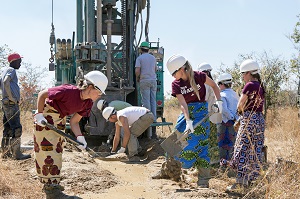
Photo by Beth Newman Wynn, MSU Office of Public
Affairs
We have only scratched the surface of what research,
extension and teaching at academic institutions will be able to contribute to
the fight against world hunger in the years ahead, improving the health, safety
and security of millions. Our universities have the ability to help, and
we actively seek new ways to put our resources to work.
Research universities have knowledge, infrastructure, and
experience pertinent to every aspect of the food chain, from the laboratory to
the farm to the market to the table. Our challenge is to bring our
resources to bear on these and other critical global issues.
-30-