
By Marshall
Matz and Jolyda O. Swaim
We love our pets! There are approximately 80 million
dogs in the United States and a similar number of cats. More than half of
all American households share their home with at least one cat or dog. Evidence is conclusive that pets contribute
to our well-being, both physically and psychologically. Fo
Animals are playing an important role in the military,
assisting police and with rescue missions.
Our animals are also assisting in a wide range of personal services.
As a result, the pet food industry has now grown to $24
billion. According to the American Pet
Products Association, we will spend more than $60 billion this year on our pets,
if you include pet care. In short, pet
food is an important business with many of the same issues faced by other
agriculture stakeholders and companies that produce food for human consumption.
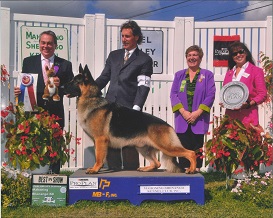 “Fritz,” owned by Ed Farrell at OFW, is a Purina “Best
in Show” winner.
“Fritz,” owned by Ed Farrell at OFW, is a Purina “Best
in Show” winner.
The first commercially prepared pet food was a dog
biscuit introduced in England around 1860 by James Pratt, an American
electrician who initially intended to sell lightning conductors to the
British. When Pratt arrived in England,
however, the first thing he noticed was dogs scavenging for food. In that
moment, Pratt recognized the need for food prepared for animals and turned his
efforts to the production of dog food using wheat, vegetables, beetroot and
meat.
Commercial dry and wet (canned) dog foods began
appearing in the 1920’s and 1930’s, and pet food went mainstream in the 1950’s
when the first extruded pet foods entered the market, with dry cat food
following in the early 1960’s. Since
that time, pet foods have been developed to provide optimal nutritional
benefits for pets in every stage of their lives. There are now commercially-available foods to
address weight management, healthy aging, sensitive skin and stomachs, and –
one of the first targeted life-stage foods developed – puppy and kitten food.
The development that began
in the 1800’s has been followed by more than 150 years of progress and
improvement in pet foods, creating a very large industry with a significant
range of pet food companies.
 Moose and Buster, Maine
Coon Cats, at home relaxing.
Moose and Buster, Maine
Coon Cats, at home relaxing.
Safety
According to Cathy Enright, President of the U.S. Pet
Food Institute (PFI), the national trade association whose members make 98% of
all U.S. pet food products, “Safety is the number one priority for pet food
companies. We are committed to constant
improvement. Advanced science and nutritional knowledge is used to produce complete
and balanced pet foods that result in pets living long, healthy lives.”
Pet foods are regulated by the Food and Drug
Administration, the U.S. Department of Agriculture and state agencies (coordinated
through the Association of American Feed Control Officials.) In short, pet food companies and their
processing methods meet exacting safety standards similar to those required
for foods for human consumption. Pet food labeling and advertising claims are regulated by
the federal government and by the states. The Food and Drug Administration, the states
and Federal Trade Commission evaluate pet food product claims at the federal
level and can take action against products that make claims that are untruthful
o
Pet food companies use many of the same
good manufacturing practices (GMPs) when producing pet food that are used in
the production of human food. Moreover,
the majority have used the food safety programs developed in the 1960’s– Hazard
Analysis and Critical Control Points (HACCP) – to ensure the “food safety” of
their products for years. While GMPs
address the condition of the facility and equipment and how employees must
dress and handle pet food, HACCP is used to ensure that any product leaving a
facility has met all parameters to ensure it is safe for the pet as well as for
entry and handling in the home. These
could include that it is cooked to the proper temperature and a metal detector was
part of the process, as well as other food safety checks.
By the time a finished pet food arrives at
the store for your purchase, it will have gone through many food safety and
quality checks that focused on the ingredients used, the packaging materials,
how these are received at the production facility, the actual finished product
processing and finally, how the finished product is packaged. Tests will be done on ingredients and product
throughout the process to determine whether or not they meet quality and foods
safety specifications.
While the majority of pet food companies have had
rigorous GMP and HACCP programs in place fo
Broadly, the rule requires registered pet food
facilities to maintain a written food safety plan. This includes performing a hazard analysis,
and instituting preventive controls for dealing with any identified hazards. Facilities will have to verify and document
that their controls are working, and if one fails, they will need to document
corrective actions that include reassessing the failed control.
Included in the rule for animal food is the need to
also have a risk-based supply chain program for those raw materials and other
ingredients used in the actual production of pet food for which a production
facility has identified a hazard requiring a supply-chain-applied control. This will mean those ingredients used by a
pet food manufacturer will need to come from an approved supplier unless
another verification process at receiving is temporarily put in place
In addition, the FDA’s FSMA rule for animal food
establishes for the first time the requirements that current good manufacturing
practices (CGMPs) be used in the manufacturing, processing, packing, and
holding of food for animals. These are very
similar to those required in the production of human food and cover areas such
as the condition of the facility and the surrounding grounds, the condition of
equipment and utensils used in production as well as the water supply, plumbing
and sanitation of the facility.
Nutrition
The nutritional requirements of cats and dogs are
different from those of humans of course, but a badly-balanced diet, composed
of table scraps and too many treats is not optimal for a long healthy life. (It may be interesting to note that
veterinary schools place a higher emphasis on nutrition than do medical schools.)
A balanced diet for a cat or dog is achieved through a
thorough understanding of the science of dog and cat nutritional requirements
and the nutrients found in ingredients.
This knowledge is applied when formulating dog and cat foods with the
correct proportions of a variety of quality ingredients including animal and
plant protein sources, grains and even
vegetables in order to meet their needs in terms of protein, carbohydrate, amino
acids, minerals, trace-elements and
vitamins. The nutritional requirements
of an animal will vary according to its size, breed, life-stage, life-style and
body condition. The nutritional needs of
pets also depend on their activity level as well.
In short, our pets are important to us. We are treating them well and our federal
agencies are keeping an eye open just to make sure.
___________________________________________________
Marshall Matz specializes in agriculture and food
security at OFW Law;
