
Every election year, former Senator George McGovern (SD), the 1972
Democratic Nominee for President, seems to find his way back into the news, and
this one, 2016, more than most. Comparisons come up routinely between
McGovern’s 1972 campaign against the Vietnam war and the Democratic Party’s
then-exclusionary nominating rules, a movement that inspired a generation of
young Americans, and Senator Bernie Sanders’ (I-VT) campaign for social justice
today.
On the other side of the political aisle, the conservative Weekly Standard recently carried an
article titled “How George McGovern Made Donald Trump Possible,” explaining how
post-1968 nominating reforms proposed by McGovern for Democrats, and later
adopted by Republicans, made possible the emergence of a Trump-style insurgent
candidate even over objections of party “establishments.”
George
McGovern was a self- proclaimed liberal and received the Presidential Medal of
Freedom by President Clinton for being “one of our greatest humanitarians.” George
McGovern died in 2012; it is time to put the Senator into some perspective.
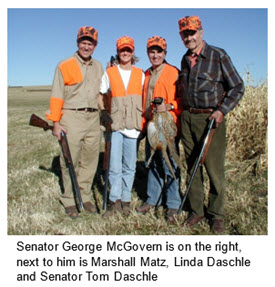
Senator
McGovern was a decorated World War II bomber pilot, a hunter, a capitalist (not
always successful), a supporter of traditional agriculture (including genetic
engineering), and bipartisan in his approach. His well-known special friendship
with Senator Bob Dole (R-KS) produced an extraordinary legacy of legislation
that still feeds millions of children here in the United States and around the
world.
 Many continue to judge Senator McGovern today solely by the margin of
his loss to President Richard Nixon in 1972, carrying only Massachusetts and
even losing his home state of South Dakota.
Many continue to judge Senator McGovern today solely by the margin of
his loss to President Richard Nixon in 1972, carrying only Massachusetts and
even losing his home state of South Dakota.
Why did he lose so badly in 1972? Clearly, it was a combination of
factors:
- First and foremost, he was running against an incumbent president in wartime, backed by a reelection team (fittingly calling itself the Committee to Reelect the President or “CREEP”) that felt little hesitation to ignore the law. Hence, the Nixon impeachment two years later.
- McGovern compounded his disadvantage with a series of early campaign blunders that became impossible to overcome—
o
Having
won the nomination after a long, grueling convention debate, he delivered his
acceptance speech well after midnight rather than insisting on waiting till the
next day. As a result, few voters saw an eloquent statement defining his
campaign. In an age before the Internet or cable TV, once the moment passed,
there was no chance to recapture the audience;
o
In
his acceptance speech and during the campaign, he declined to highlight his
WWII military record, both out of modesty and because he was riding a wave of
public opposition to the Vietnam War. History proved him right about the
Vietnam War. But tactically, his modesty was a terrible mistake;
o
Finally,
having chosen Senator Tom Eagleton (D-MO) as his Vice Presidential running
mate, he stood behind Eagleton “one thousand percent” after it was discovered
that Senator Eagleton had been treated for depression. For McGovern, personal
loyalty trumped politics. But in the end, Eagleton’s problem proved
insurmountable. McGovern reversed course and asked him to leave the ticket.
All this happened before Labor Day 1972. By then, the campaign was
simply too badly wounded to recover. McGovern had allowed the Republicans to
define him.
But McGovern never allowed his painful loss in 1972 to defeat his
spirit or end his political career. He returned to the Senate in 1972, was
reelected to the Senate in 1974, and teamed up with Senator Bob Dole to
assemble a record of legislative achievements in the field of nutrition and
public health second to none.
So where does this place McGovern compared to Senator Bernie Sanders, a
self-declared “democratic socialist”? And did he open the door for Donald
Trump?
On this subject, I find it near impossible to be objective. Senator
McGovern found me in 1972 serving as a young attorney on an Indian Reservation
with South Dakota Legal Services and gave me the life-changing opportunity to
join his Senate staff as committee counsel. We went on to become professional
colleagues and friends. I enjoyed the extraordinary opportunity to serve both
Senator McGovern and Senator Dole, both while they were in the Senate and
afterward. I was with Senators McGovern and Dole when they met with President
Bill Clinton in 2000 to establish the global school feeding program that still
bears their name. (Dole turned to McGovern and said, “George, I always wondered
what the Oval Office looked like.”)
Senator McGovern would clearly be supporting Hillary Clinton this year.
McGovern would applaud Bernie Sanders’ idealism and his ability to engage
younger voters. But ideology was not the whole picture for Senator McGovern. McGovern
knew Secretary Hillary Clinton well over many years and greatly admired her for
her priorities, pragmatism, strength, and faith. He would have been excited for
her and the country to see her as the Democratic nominee in 2016 and President
of the United States in 2017.
As for Trump, yes, Senator McGovern did push to open the nominating
process to the grassroots. And yes this opening has benefited Trump in 2016. But
it also worked to the benefit of Presidents Bill Clinton in 1992 and President
Barack Obama in 2008. In other words, the process worked, and the peoples’
voices are being heard on both sides of the divide.
Senator Bobby Kennedy (D-NY) once referred to George McGovern as “the
most decent man in the Senate.” There was strong support for that sentiment
among his colleagues. George McGovern was a winner in the end, notwithstanding
his loss in 1972.
 Marshall Matz is at OFW Law still working on
global food security and other issues. mmatz@ofwlaw.com
Marshall Matz is at OFW Law still working on
global food security and other issues. mmatz@ofwlaw.com
