
While agriculture, like many other issues, has been
overshadowed in the presidential campaign this year, if you look closely there
is evidence on how Secretary Clinton would approach agriculture policy and
rural America:
-
Senator Clinton had a strong record in
support of agriculture while serving in the Senate and consistently
supported the farm bill;
-
Secretary Clinton addressed
agriculture at the State Department connecting food security to national
security;
-
Rural for Hillary has released
highlights of issues important to agriculture and rural America;
-
Former Deputy Secretary Kathleen
Merrigan was authorized to serve as a surrogate for Secretary Clinton at
the Farm Foundation;
-
A number of agriculture CEOs met with
Clinton staff at the Clinton headquarters in Brooklyn; and
-
Former Iowa Governor Tom Vilsack has
gone on record a number of times in support of Secretary Clinton laying
out positions that impact rural America and agriculture policy.
One of the common themes is that Secretary Hillary Clinton
supports agriculture from the small farms that feed the community to the large
farms that feed the world. “We need it
all” said Dr. Merrigan at the Farm Foundation, “from organic to biotechnology.”
Soon after becoming Secretary of State in 2009, Secretary
Clinton announced the winner of the World Food Prize stressing the importance
of science to food production. The Secretary spoke at some length about Dr.
Norman Borlaug and then honored Dr. Gabisa Ejeta for his contribution “in the
science of plant genetics.” She went on
to say “we will seek to increase agriculture productivity by expanding access
to quality seeds, fertilizers, irrigation tools, and the credit to purchase
them and the training to use them.”
Back home in Iowa, candidate Clinton said “the agenda that I
am putting forth for rural America is very much in line with what Tom (former
Iowa Governor Tom Vilsack) did here in Iowa and what he is doing a the
Department of Agriculture……We have to stand with our farmers, give them the
tools and support they need to boost both production and profits.”
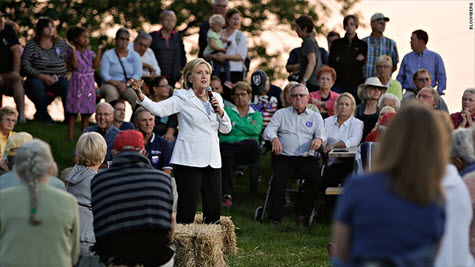
Recognizing that the vast majority of Americans who live in
rural America don’t farm, or rely on second jobs “in town” Secretary Clinton
has made a strong commitment to the broader needs or rural America. “We’re
going to bring diverse economic development to rural communities to support our
farmers and others in small towns who keep America going.” In Clinton’s
position papers, in Dr. Merrigan comments at the Farm Foundation, and in the
discussion we had at the Brooklyn Clinton headquarters, there has been an
emphasis on clean energy jobs, broadband, high speed Internet, health care and
rural education.
“And then there is immigration” she said at an Iowa event. “The
fact is American agriculture is heavily dependent of immigrant labor, form the
orchards of California to the processing plants of Iowa to the groves of
Florida. We’re talking about billions of dollars in income lost because of farm
worker shortages. Comprehensive immigration reform would help address the
problem and give a boost to rural communities.”
Tom Vilsack summed up his support for Hillary this way in an Op Ed on
October 19, 2016 in the Daily Times Herald:
“Over a year ago, I was proud to stand beside her at a
community college in Des Moines, Iowa, where she laid out her vision for rural America.
This plan was grounded in a life’s work fighting for working families and the
most vulnerable among us. Over the past few years, Hillary has listened to the
needs and dreams of thousands of rural Americans, and then she did what she
does best — she built a thoughtful, comprehensive strategy that invests in an
economy that works for everyone — not just those at the top.
“These policies reflect Hillary’s understanding of the hard
work our rural communities do for the good of our country — providing our food,
the fiber for our clothes, the energy for our homes and businesses, and nearly
40 percent of our military members. As president, Hillary will support our
farmers and ranchers, encouraging the next generation by offering training and
credit, strengthening the safety net to help them through unanticipated
challenges, bolstering our regional food systems, and fostering a
renewable-energy future for the United States that utilizes wind, solar and
biofuels.”
This article drew on all of the sources listed above to try and paint a
realistic picture. In short, Secretary Clinton has a proven record in support
of agriculture, rural America and global food security. But let me close on
non-partisan point…..
Both of the major political parties draw from a large base of support and
those who care about agriculture and rural America must be prepared to engage
the new Administration, and future Administrations, across the board. The focus
cannot be just on the Department of Agriculture. Politically speaking, agriculture
is the victim of its own success with only one percent of the country feeding
the rest of us, and much of the world.
Outreach must be to White House from the West Wing to the Office of Science
and Technology Policy, the Trade Representative, the Office of Management and
Budget, and Domestic Policy. It is
important to engage the Environmental Protection Agency, the Food and Drug
Administration and the Office of the First Lady (or First Spouse). While some
organizations have already reached out to both campaigns, the outreach should
ramp during the transition period from November 9th-January 20th;
continue during the confirmation process and then courtesy calls once key
people are in place.
The legislative and regulatory processes
do not ever end. They are about to start all over again with a new
Administration. Let’s make sure agriculture’s voice is heard.
Marshall Matz specializes in agriculture at OFW Law in Washington, D.C. He was formerly Counsel to the Senate Committee on Agriculture and Chairman of the Obama for President, Agriculture Committee in 2008.
#30
For more news, go to: www.Agri-Pulse.com
