
WASHINGTON, Oct. 7, 2015 - From Montana to Maryland, to Brazil,
Bavaria and as far away as Turkey, new “super weeds” are threatening to rob
profits from farmers and could force dramatic changes in production and
harvesting systems – challenging hard-fought gains in conservation practices
that protect soil and water. Will new regulatory actions come next?
“Cold, hard steel may have to become part of my system
again,” noted Montana farmer Gordon Stoner, in reference to tillage tools that
can bury weed seeds deep enough to prevent some emergence. Stoner joined growers
from around the world to share their weed resistance experiences at a global
symposium sponsored by Bayer in Paris last week.
The global crop protection company, based in Monheim,
Germany, says the number of herbicide resistant weeds is growing fast and the economic
threats are very real. Weeds are the single most important reason for crop
losses globally, causing high management costs and threatening food security,
Bayer says in a fact sheet promoting its own integrated weed management
program.
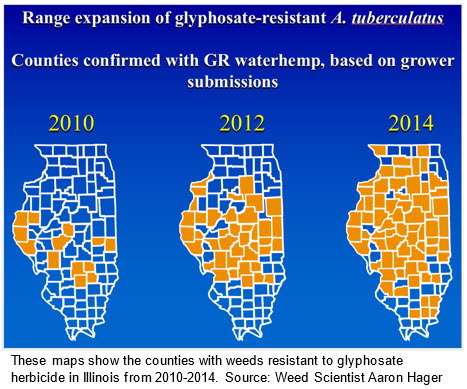 To date, 247 different species have developed resistance
in 86 crops and 66 countries, according to the International Survey of
Herbicide Resistant Weeds, posted on www.weedscience.org.
To date, 247 different species have developed resistance
in 86 crops and 66 countries, according to the International Survey of
Herbicide Resistant Weeds, posted on www.weedscience.org.
The organization also posts an interactive map showing
resistant weeds by state in the U.S.
“It’s not a question of if (weed resistance becomes a
problem), it’s when,” says Stoner, who has not officially documented weed
resistance on his own farm, but sees the problem emerging in nearby fields. For
now, he’s been fighting off weed pressures by using crop rotations and multiple
tank mixes of various herbicides at the maximum recommended rates.
And
he’s thinking about plowing, even though Stoner long ago parked his tillage
tools and has been using 100 percent no-till practices on his 12,000 acre farm,
situated in the northeast part of Montana near the Canadian border.
In fact, weed resistance could become so bad that, Stoner,
who serves as vice president of the National Association of Wheat Growers,
joked that the next national commodity organization may be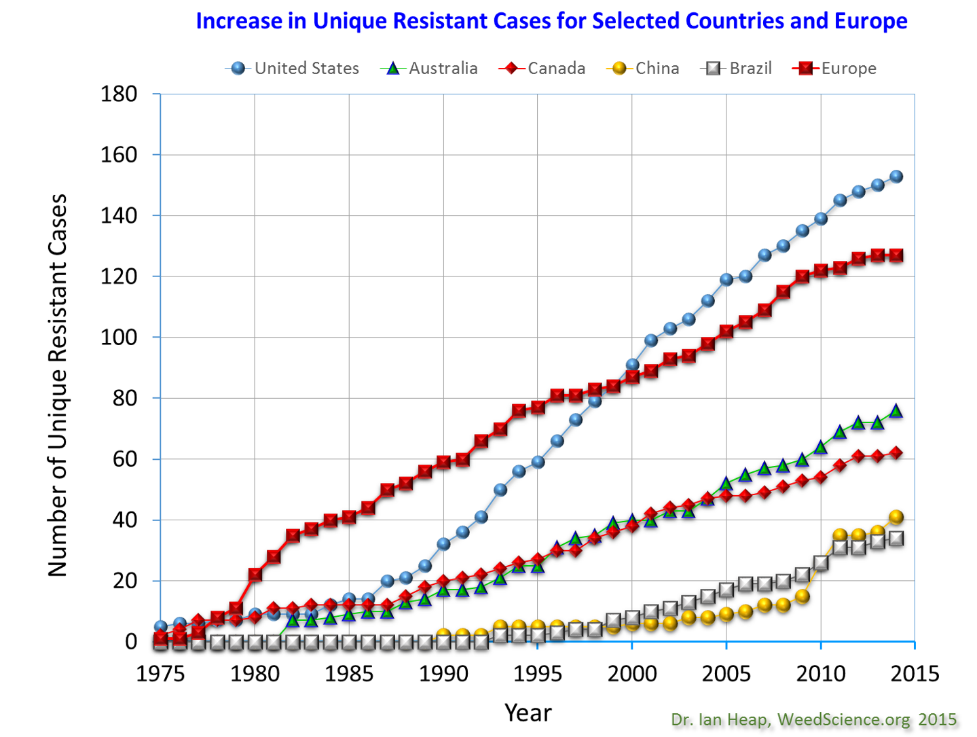 the “National Weed
Growers Association.”
the “National Weed
Growers Association.”
It’s a threat that organizations representing corn, cotton,
soybeans and wheat are taking seriously, according to staff and elected
officials attending the meeting. They know there is not any one “silver bullet”
coming down the pesticide pipeline as a solution. Yet, many of them acknowledge
that, given low commodity prices, many growers would like to “keep on
keeping on” with easier and cost-effective current practices, which often
involve spraying glyphosate (Roundup®)
to kill weeds over their Roundup Ready®
crops. That is, until the weed resistance issue hits them head on.
For Chip Bowling, president of the National Corn Growers
Association, weed resistance challenges hit home about four years ago on his farm,
in Maryland, about an hour south of the District of Columbia. Palmer amaranth, a species of pigweed, arrived
“fast and furious” in his fields and was resistant to glyphosate. He immediately worked to contain the problem,
which emerged on three of the 27 different units he farms, employing tactics like
spraying costly new herbicides, planting cover crops and washing his combine
after harvesting each field. For Bowling, who is careful to protect any
herbicide or nutrient that might run into the nearby Chesapeake Bay, weed
resistance presents multiple challenges.
“My non-farm friends don’t like to see me running the
sprayer, but they also don’t want to see big patches of weeds. From an economic
standpoint, I need to spray and keep weed pressures down and yields up or I
won’t be able to make a profit.”
In order to help growers better understand and address
weed resistance, the United Soybean Board, a handful of commodity
organizations, crop chemical companies and land grant universities launched an
educational website last year called “Take
Action on Weeds.” It’s a start, but farmer leaders say more work is needed.
Many growers know product brand names, but don’t
understand the different modes of action that kill weeds – a crucial piece of
knowledge for fighting weed resistance, observers say. In addition, they need
to be able to access the right pesticides at the right times from local
retailers.
“We’ve made a lot a progress but we are still very
reactive in our approach,” noted Arlene Cotie, product development manager for
Bayer. “We need to have one voice in the U.S. on the sense of urgency to do
everything we can to be cost-effective and competitive in the global market by
managing resistant weeds,” she emphasized.
EPA officials have already been keeping a close eye on the
situation and the scrutiny is expected to be more intense in the future,
according to Yu Ting Guilaran, director of EPA’s Office of Pesticide Programs,
who also spoke at the symposium.
The
agency already signaled a renewed emphasis on weed resistance management with
the 2014 approval of Dow’s Enlist Duo, a combination of 2,4-D and glyphosate,
she said. The terms of the registration impose
requirements on the manufacturer including: robust surveying and reporting to
EPA, grower education, and remediation programs. Going forward, she said weed resistance
management will be a focus for all pesticides coming in for EPA reregistration
and she suggested the need to develop a risk-based framework that includes training,
education, early detection, mitigation, and clearer product labels - among
other things.
#30
For more news, go to: www.Agri-Pulse.com
