
WASHINGTON, Feb. 10, 2016 - Gigantic market opportunities in
the production of organic livestock feed and forage await both American organic
producers ready to expand and conventional ones willing to try organic farming.
Why? The robust growth of the organic meat, eggs and dairy
markets has left U.S. organic feed production far, far short of the needs of
the animals producing those foods. A snapshot: U.S. retail sales of all organic
foods swelled by 66 percent from 2008 through 2014, Organic Trade Association
surveys indicate. Plus, OTA projects growth will average 14 percent annually
for the next three years. However, U.S. farmers aren’t accommodating that
growth: total U.S. organic acreage for grains and oilseeds commonly used to
make feed rose less than 2 percent from 2008 to 2014; for organic hay and
haylage, just 4 percent, USDA
Census of Agriculture data shows.
Instead, farmers abroad are responding to the soaring feed
demands of U.S. organic livestock operations. Penn State University researchers
reported
last year, for example, that imports of organic soybeans (mostly from
China, Canada, Ukraine and Argentina) shot up from $42 million in 2011 to $184
million in 2014, while organic corn (largely from Romania, Turkey, Netherlands
and Canada) jumped from zero to $36 million in the same period.
“American farmers are missing out on an opportunity,
particularly around feed and feed grains,” says Nate Lewis, crop and livestock
specialist for the Organic Trade Association. “We are a corn- and
soybean-exporting country, but we are importing a large percentage of the crops
needed for feed on organic farms.”
Changing that situation won’t be quick and easy, Lewis says.
Organic livestock farms “would like to source their feed closer to home.” But,
he says, “overcoming the barriers is fairly complicated” and will require infrastructure
changes. Local elevators and U.S. farmers, for example, will have to expand
space segregated for organic feed storage, and feed mills wanting organic feed
must first meet stringent USDA rules to avoid blending with even traces of
conventional grains.
For farmers wanting to consider transitioning acreage to
organic field crops, a ton of resources are available, though the path to do so
is complex. (See our
December article.) It’s more than worthwhile to get some mentoring from
other organic producers, including local or regional organic farming groups
such as the Midwest
Organic & Sustainable Education Service. Also, start by checking out
the Organic
Transition Planner, produced through USDA’s Sustainable Agriculture Research and Education (SARE). It
covers the gamut of transitioning: advice on key concepts, detailed worksheets
covering farm operations, marketing, hiring questions, finances, etc. All of
the planner’s electronic spreadsheets and worksheets are available here.
Meanwhile, projecting a good profit is a hurdle for all who
grow such crops. Organic grain and oilseed prices have dimmed with the
strengthened U.S. dollar, which accelerates the flow of imports as it pulls
down domestic market prices, despite the strong domestic demand. Heath Dewey,
who tracks organic
grain and soybean prices for USDA Market News, said he watched cheaper
imports, including Canadian organic grain coming south, erode U.S. prices.
Feed-quality organic corn and soybeans are both averaging about $4 a bushel
less than a year ago.
Nonetheless, prices for organic corn, at $8.50-$10 per
bushel, and organic soybeans, averaging $22 a bushel, are both running about 150
percent more than the conventional market.
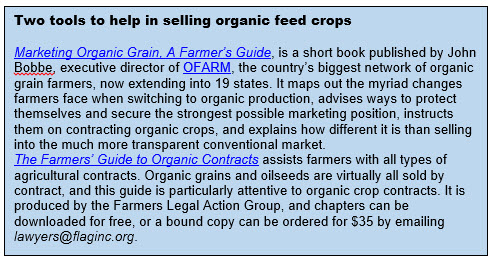 John Bobbe, a long-time cooperative marketing advocate who
heads OFARM (see text box), says getting a marketer’s services usually spells
higher contract prices. Contracting demands a lot of a producer’s time, often
more than he can devote to it. Meanwhile, Bobbe says, hiring an agent, whether
via a co-op, marketing club or another way, “is having someone who is in the
organic markets every day on your side of the bargaining table.” Besides that,
he points out, “volume talks when it comes to contract negotiations,” and
co-ops, which are legally allowed to bargain collectively, “are in a much
better position to negotiate terms of contracts favorable to their members than
are individuals.”
John Bobbe, a long-time cooperative marketing advocate who
heads OFARM (see text box), says getting a marketer’s services usually spells
higher contract prices. Contracting demands a lot of a producer’s time, often
more than he can devote to it. Meanwhile, Bobbe says, hiring an agent, whether
via a co-op, marketing club or another way, “is having someone who is in the
organic markets every day on your side of the bargaining table.” Besides that,
he points out, “volume talks when it comes to contract negotiations,” and
co-ops, which are legally allowed to bargain collectively, “are in a much
better position to negotiate terms of contracts favorable to their members than
are individuals.”
Bobbe advises that
“nothing is ever done in organic graining marketing without some sort of
contract,” and, “in business, you get what you negotiate, not what you
deserve.”
OTA’s Lewis says hiring a marketer “is not the way every
farmer wants to interact with the market.” Still, the trouble with the organic
market for field crops is prices are set between a farmer and a buyer, he says,
and that leaves pricing “fairly opaque,” unlike that for conventional crops,
where market prices are posted daily. “So it’s really challenging for [organic]
farmers to learn where those markets are,” he says.
Lewis says he has observed that “farmers who do have a
marketer seem to access the markets more fluidly.” Those who don’t “seem to be
less aware of the marketing opportunities that are out there.”
They tend to stick with the same buyers year after year
instead of looking for a better deal. Also, “they may not know what the markets
are for their rotation crops. And I think that is where a marketer might really
come in handy.”
#30
For more news, go to: www.Agri-Pulse.com
