
WASHINGTON,
March 9, 2016 - We’ve all seen them in the supermarket. They appear on just
about every food package, making promises to consumers. The words “sustainable”
and “sustainability,” like the terms “natural” or “simple,” are increasingly
being used to market food products in the U.S. And consumers – more intent than
ever on knowing how their food is grown and processed – are responding
favorably.
Recognizing
the power of these words, big food suppliers and retailers like General Mills, ADM, Cargill and Unilever have responded by hiring experts and
developing plans for sourcing “sustainably” grown and processed raw materials
and ingredients. In many instances, these plans directly affect producers who
grow and provide these ingredients.
Take
Hellmann’s mayonnaise from Unilever. The company, along with ADM and several
other partners, started a sustainability pilot program for soybean farmers in
Iowa who supply the oil for the country’s best-selling mayo. In exchange for a
small incentive – 10 cents a bushel of soybeans produced for ADM – farmers are
asked to self-assess the sustainability of their farms against 400 pages of
sustainability objectives and to make “continual improvements” in their
operations, such as integrated pest management plans and conservation practices
like buffer strips, reduced tillage, cover crops and more.
Although the
companies do collect information from the farmers to chart progress, they don’t
actively audit the farmers to make sure they’re using improved practices, nor
do they look at sustainability from a purely environmental angle, says Mark
Jackson, a fifth-generation Iowa farmer and a participant in the program.
Jackson, a
former Iowa Soybean Association president, says true sustainability is a
three-fold proposition – a “trilogy,” he calls it – that includes
environmental, social and economic objectives, a loose definition that the
government first proposed decades ago.
Environmental
sustainability refers to good soil and water management practices that enhance
the long-term viability of a farm, he said. Social sustainability refers to
good management practices for humans – are farm workers fairly compensated? Do
they receive an adequate amount of time off? And finally, economic
sustainability. This principle is crucial, Jackson said, to keeping his farm in
the family, which he hopes some day will be passed on to his grandchildren.
In his
“neighborhood,” Jackson said sustainable management practices, particularly
environmental best-management practices, are the norm because farmers “have to
be sustainable” to survive.
“When (the
pilot program) came here, they thought they were going to tell us (farmers) how
to improve,” Jackson said. Instead, “I think they were amazed at what they
saw.”
USDA defined sustainability in very broad terms that farmers,
industry and even conservation groups seem to be on board with it.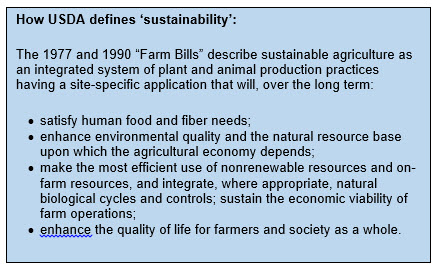
Ferd
Hoefner, policy director with the National Sustainable Agriculture Coalition,
told Agri-Pulse that the definition comes up every farm bill cycle. But
his group has never asked for an enforceable definition or a stricter one, and
doesn’t expect to.
Nancy
Kavazanjian, a Wisconsin farmer who is the sustainability coordinator for the
United Soybean Board and also the chairwoman of the U.S. Farmers and Ranchers
Alliance, says sustainability is “one of those words that can make the hair on
the back of a farmer’s head stand up.” Still, she says it is a quality farmers
and industry need to work together on to define and promote throughout the
supply chain.
“We want it
to mean something,” she said, unlike the term “natural” that “people just throw
around.”
Kavazanjian
says farmers know sustainability is something that consumers want, and that
companies are looking for farmers to help meet those consumer demands. That’s
why she says it’s important for farmers “to get out ahead” and demonstrate to
industry and consumers what they are already doing, instead of waiting for
companies to come to them with what could be a patchwork of sustainability
policies.
One
alternative to industry and producer collaboration is an enforceable definition
of sustainable that restricts how the word can be used, perhaps similarly to
how “organic” is currently enforced by USDA.
Such a
policy would eliminate the threat of a policy patchwork for farmers and may
promote consumer confidence in products labeled as “sustainable,” but it could
also impose more regulatory costs on the food supply chain.
Another
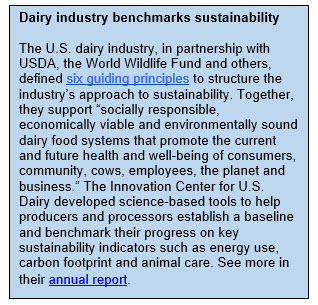
alternative would be a program like Field to Market,
an alliance of more than 95 grower groups, agribusinesses, food
and restaurant companies, universities and conservation groups that offers
producers a method of measuring their farms’ sustainability and improving it
with scientifically verified practices. Field to Market’s Fieldprint calculator – which quantifies soil health, input
levels, and water quality – is also used to measure progress toward total farm
sustainability in the Hellmann’s mayonnaise project.
 Some
companies have also elected to hire third-party auditing firms, like Intertek,
which verifies the origin, quantity, quality and delivery of a sizable portion
of the United Nations’ World Food Programme food aid. For private firms, Intertek
also audits farming operations according to its clients’ definition of
sustainability.
Some
companies have also elected to hire third-party auditing firms, like Intertek,
which verifies the origin, quantity, quality and delivery of a sizable portion
of the United Nations’ World Food Programme food aid. For private firms, Intertek
also audits farming operations according to its clients’ definition of
sustainability.
For
instance, some of Intertek’s clients sell finished cocoa products to a number
of U.S. and international companies that have very strict sustainability
standards that prohibit the purchase of goods produced with child labor or with
insufficient female participation.
Bill
Raffety, Intertek’s director of sales and development for agriculture services,
told Agri-Pulse that producers would probably be interested in enrolling
in a USDA certification program for sustainability if the definition would add
value to their operations, because many farmers in the U.S. already use sustainable
practices. Such a system audited by a third party would make the program more
legitimate in the public’s eyes, he continued, and allow people “to stop
wondering” about what the term really means.
While
consumers are driving companies to source more sustainably, the push for an
enforceable definition would “most likely be driven by demand from industry,
with USDA formulating a definition,” he said.
#30
For more news, go to: www.Agri-Pulse.com