
WASHINGTON, July 26, 2016 - The Democratic National
Convention heads into its second day after Bernie Sanders made a case to his
restive supporters last night for supporting Hillary Clinton. Sanders wrapped
up his speech by taking liberties with the language in the party’s newly approved platform to attack the
Trans-Pacific Partnership.
Sanders called the platform the “most progressive” in the
party’s history and said it calls for “strong opposition to job-killing trade
agreements like the” Trans-Pacific Partnership. In actual fact, Sanders
supporters lost their fight to write opposition to the TPP into the platform.
But Sanders’ reference to the trade deal set off chants of
“No TPP" that prompted Sanders to divert from his prepared text and add,
“We’ve got to make sure the TPP does not get to the floor of the Congress in
the lame duck session.”
What the platform says is that Democrats support trade
agreements that “do not support good American jobs, raise wages, and improve
our national security.”
Tonight’s schedule includes the roll call of the states in
the nominating race and a keynote address by former President Bill Clinton.
Vilsack headlines agribusiness event. Agriculture
Secretary Tom Vilsack and Pennsylvania Agriculture Secretary Russell Redding
will be the featured speakers tonight at an agribusiness reception in downtown
Philadelphia. The sponsors of the event include AgriBank, CoBank, FMC, Growth
Energy, the National Council of Farmer Cooperatives and Pepsico.
Insurance critic not convinced by specialty crop progress. USDA’s
Risk Management Agency provided
an update last week on how federal crop insurance has expanded to
protect more specialty crops and also lowered the program’s error rate. But the
message isn’t winning over long-time critics like Rep. Earl Blumenauer.
The Oregon Democrat stopped by an event hosted in
Philadelphia yesterday by Plate of the Union, a coalition of activist groups
seeking to overhaul farm policy. Blumenauer told Agri-Pulse that many specialty
crops like those grown in his home state don’t have access to “meaningful crop
insurance.” The program is in “dire need of reform,” he emphasized, “We still
pay too much to people who don’t need it.”
Acres covered by crop insurance increased from 264.7 million
for 2009 to 297 million for 2015, while coverage for fruit, vegetables, and
other specialty crops has increased from 7.7 million acres in 2009 to nearly
8.3 million acres in 2015, according to RMA.
The Whole-Farm Revenue Protection policy was also retooled
to help more organic producers and other diversified farming operations. The
number of acres insured by organic producers grew from 576,700 in 2009 to more
than 1 million in 2015.
Pork bellies and food policy. Reps. Rosa DeLauro,
D-Conn., and Jim McGovern, D-Mass., also appeared at the Plate of the Union
event, held under a tent in the sweltering mid-day heat. Local chefs were
serving up such items as vegetable kabobs, edamame hummus on crackers and pork
belly wraps made with radicchio, green papaya and Espelette pepper vinaigrette.
Tom Colicchio, co-founder of Food Policy Action, one of the
groups behind Plate of the Union, told Agri-Pulse in
an interview at the event that he believes the GMO disclosure bill passed by
Congress this month is a fair compromiseand that his fellow activists were
wrong to fight it. “Two or three years ago there’s no way this could have
happened,” he said.
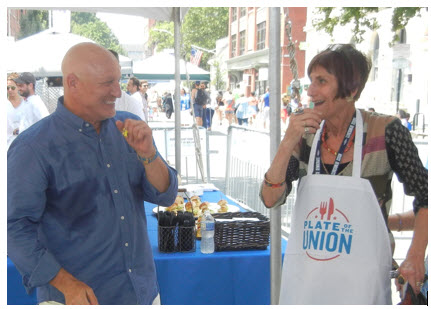
Colicchio and DeLauro enjoy a laugh at the Plate of the
Union event.
Spotted at the DNC: Joe Shultz, minority staff director
for the Senate Agriculture Committee, in the upper deck of the Wells Fargo
Center yesterday as the convention opened … Kirk Johnson, senior vice president
of government relations for the National Rural Electric Cooperative Association
… Delegates wearing buttons that read “No TPP” were all over the arena.
Farm group asks for more transparency in freight rail
investigations.Grain companies say the Surface Transportation Board needs to do
a better job of informing the public when it investigates a potential problem
on America’s railroads.
The board was given new investigative authority under the
STB Reauthorization Act of 2015 and it published a proposed rule in May to
implement the provisions. One thing the board should do with its new authority
is provide public reports on all of the investigations it conducts, even if no
corrective action is called for, the National Grain and Feed Association says
in a letter.
The grain group says the board is going too far to protect the secrecy of the
railroads.
Colombian importers explore U.S. wheat industry. Colombia
is the largest foreign market for U.S. wheat in South America and buyers there
are getting special treatment this week from the U.S. Wheat Associates. Five
officials representing much of Colombia’s flour, cookie and pasta industry are
in the U.S. for a week-long trip that will take them to farms, grain elevators,
research facilities and USDA offices in North Dakota, Montana and Louisiana.
“Colombia is a top destination for U.S. soft red winter and
hard red winter, and this team is very representative of the Colombian
industry,” said Stephanie Bryant-Erdmann, a marketing specialist for USW. The
visiting officials are responsible for buying about 40 percent of the country’s
imports.
Colombia bought about 670,000 tons of U.S. wheat in the
2015-16 marketing year. U.S. farmers typically provide about half of Colombia’s
import needs.
She said it. “Don't let anyone tell you this country
isn't great, that we need to make it great again. This is the greatest country
on earth.” - First Lady Michelle Obama
#30
