
WASHINGTON, Sept. 8, 2016 - The EPA’s Inspector General is
faulting the agency for failing to provide timely reports to Congress on the
impacts of biofuels.
The Office
of Inspector General (IG) conducted an evaluation to determine if EPA has complied
with the Renewable
Fuel Standard (RFS) statutory reporting requirement. It also reviewed
whether EPA had updated the lifecycle analysis supporting the RFS with findings
from the statutorily mandated National Academy of Sciences 2011 study on
biofuels, EPA’s 2011 Report to Congress on the Environmental Impacts of
Biofuels and any subsequent reports or relevant research on biofuels.
The IG says that the RFS reporting requirement provides for
an objective analysis on the environmental impacts and unintended consequences
of the U.S. biofuel policy.
 This analysis is important, the IG said, because of
conflicting scientific opinions about biofuel impacts, potential impacts
outside of EPA’s regulatory control and divergent RFS interests.
This analysis is important, the IG said, because of
conflicting scientific opinions about biofuel impacts, potential impacts
outside of EPA’s regulatory control and divergent RFS interests.
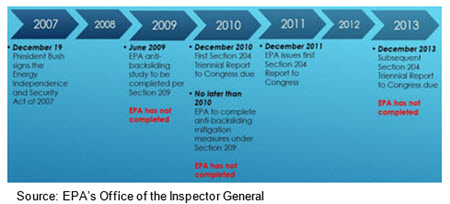
The IG’s evaluation found that EPA’s Office of Research and
Development has not complied
with the requirement to provide a report every three years to Congress on the
impacts of biofuels.
The evaluation also concluded that EPA does not have an
assessment that meets the requirement to identify whether the RFS creates any
impacts on air quality, which would allow EPA to take required measures to
mitigate impacts. This information is needed to fully inform EPA, Congress and
other stakeholders of the environmental impacts of U.S. biofuel policy, the IG
said.
In addition, the report said that EPA’s Office of Air and Radiation has not fulfilled the anti-backsliding requirements for the RFS, which would analyze and address any negative air quality impacts of RFS.
The Inspector General’s office recommended that EPA’s assistant
administrator for research and development provide Congress with triennial
reports on the impacts of biofuels as required and also recommended that the assistant
administrator for air and radiation complete the anti-backsliding study as
required and determine if additional mitigation is needed.
The IG also recommended that, although not required by
statute, EPA develop or identify the process for evaluating the lifecycle
science and determining whether to update the greenhouse gas threshold
determinations.
EPA agreed with all recommendations and provided planned
completion dates, the IG said.
To read IG’s full evaluation and recommendations, click
here.
#30
