
 By
Don Preusser, executive vice president & chief marketing officer,
By
Don Preusser, executive vice president & chief marketing officer,
Farmers Mutual Hail Insurance
When
crop insurance and precision farming technology are combined, improved risk
management solutions will soon follow.
Precision farming technology has been steadily growing for years
and has provided significant gains in producer productivity and efficiency.
Roughly six in ten production farmers are expected to adopt various precision
technology solutions by 2018. From auto steer to variable rate applications,
farmers have an abundance of new capabilities available to improve production
farming.
More recently, precision farming technology has been used by
some farmers to simplify - and make more accurate - their crop planting and
production information for required government reporting as a participant in
the federal crop insurance program. Using the equipment GPS monitor and farm
management software, producers are able to collect and report both planted and
production acres without traditional paper records like planting logs and scale
tickets. In short, by leveraging their precision farming technology
capabilities, farmers are able to “digitize” their planting and production
records, making it more accurate and easier to report and manage critical
planting and production information.
The creation of digitized farm data can also provide much
greater insight into farming practices, including the ability to better
understand crop production risk, particularly when combined with related data
like weather, soil conditions, topography and more. When greater insight and
understanding of crop production risk is developed, insurers are better able to
not only offer more risk management solutions, but more accurately underwrite
and price the risk.
While crop insurance is significantly different than many other
lines of insurance, it does share some fundamental principles similar to home
and auto insurance. For example, auto insurance today is underwritten and
priced significantly different than it was 10 years ago because of the use of
telematics/GPS information obtained from the automobile. Auto insurers are able
to more precisely underwrite and price auto insurance risk because
telematics/GPS data generated from the automobile create better understanding
of driver risk (i.e. speed, braking, etc.). Data generated from the automobile,
combined with other traditional driver risk data, result in improved
predictions of potential risk of an accident. In a similar fashion, precision farming
technology can provide insurers with more precise and greater information about
planting and production activity (i.e. seed spacing, etc.) that can improve the
prediction of potential crop performance beyond what weather alone might cause.
 So how might precision technology and crop insurance solutions
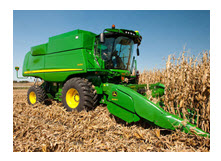
look in the future? Some solutions already exist. For example, Farmers Mutual
Hail Insurance provides a discount on a crop hail insurance policy when a
customer uses a combine head that integrates GPS technology from the combine.
The GPS-enabled combine head is able to more effectively “pick-up” downed corn
from a windstorm as the combine is more precisely guided along the row line
obscured by flat corn stalks. Because less production loss is expected when
using the GPS-guided head, insurance risk is less and a lower insurance premium
can be applied.
So how might precision technology and crop insurance solutions
look in the future? Some solutions already exist. For example, Farmers Mutual
Hail Insurance provides a discount on a crop hail insurance policy when a
customer uses a combine head that integrates GPS technology from the combine.
The GPS-enabled combine head is able to more effectively “pick-up” downed corn
from a windstorm as the combine is more precisely guided along the row line
obscured by flat corn stalks. Because less production loss is expected when
using the GPS-guided head, insurance risk is less and a lower insurance premium
can be applied.
#30