
WASHINGTON, Oct. 6, 2016 - U.S. propane exports increased by
more than 230,000 barrels per day (b/d) in the first half of 2016, over the
same period a year earlier, totaling 730,000 b/d, according to a report from
DOE’s Energy Information Administration (EIA). The total shipments surpassed
motor gasoline to become the second-largest U.S. petroleum product export,
after distillate.
Exports to Asia and Oceania led the growth, accounting for
94 percent of the total.
In the first half of 2016, the U.S. exported 4.7 million b/d
of petroleum
products, up 500,000 b/d and almost 10 times the crude
oil export volume, EIA data show.
Japan imported
the most U.S. propane at 159,000 b/d in the first half of 2016, an increase of
111,000 b/d from 48,000 b/d in the same period of 2015. EIA notes that U.S.
exports of propane to Panama fell
from 41,000 b/d in the first half of 2015 to 7,000 b/d in the first half of
2016.
The large increases in propane exports to Japan and
decreases in propane exports to Panama could be a result of reduced ship-to-ship
transfer activity, EIA says. Some U.S. propane exports that undergo
ship-to-ship transfers cite the location of the transfer, not the final
destination of the propane.
“This often results in larger-than-actual export numbers for
the countries where the ship-to-ship transfers take place and in
less-than-actual numbers for some final destinations,” EIA says.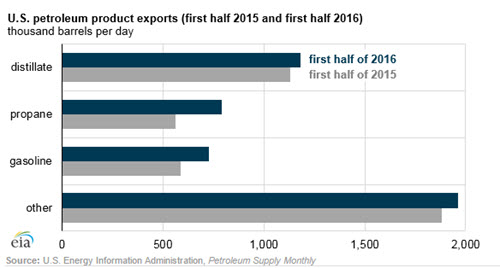
Distillate exports averaged 1.2 million b/d in the first
half of 2016, an increase of 50,000 b/d from the same period of 2015, according
to EIA.
The largest share of U.S. distillate exports went to Central
and South America, EIA says, averaging more than 620,000 b/d in the first half
of 2016, an increase of more than 30,000 b/d. from the same period of 2015
The largest single destination overall for U.S. distillate
exports was Mexico, which averaged 147,000 b/d in the first half of 2016.
Gasoline exports increased 138,000 b/d in the first half of
2016. Canada and Mexico accounted for most of the growth. Similar to U.S.
distillate fuel exports, the data show that Mexico was
the largest single recipient of U.S. gasoline exports, accounting for 363,000
b/d in the first half of 2016, an increase of 283,000 b/d in the first half of
2015.
EIA notes that Mexico began to allow companies
besides state company Petroléos Mexicanos (Pemex) to import fuels in January
2016, which resulted in increased exports from nearby refineries along the U.S.
Gulf Coast.
Canada was the second-largest recipient of U.S. gasoline at
66,000 b/d in the first half of 2016, up from 55,000 b/d in the first half of
2015.
Do you find the
information on Agri-Pulse helpful? See even more ag, rural policy and energy news
when you sign up for a four-week free trial Agri-Pulse subscription.
While total U.S. petroleum product exports grew, EIA data
shows that export destinations remained largely unchanged.
U.S. petroleum products tend to stay in the Western
Hemisphere, EIA says. In 2015, about 60 percent of total petroleum product
exports remained within the Western Hemisphere, down slightly from 65 percent
in 2005.
Mexico, Canada and the
Netherlands received the greatest volumes of U.S. petroleum products
in the first half of 2016, EIA says, importing 775,000 b/d, 579,000 b/d, and
271,000 b/d, respectively.
#30
For more news, go to: www.Agri-Pulse.com
