
WASHINGTON, Oct. 26, 2016 - With mounting concerns about the farm – and the U.S. – economy, a new nationwide poll indicates how farmers and ranchers will vote in the 2016 presidential election.

Some
55 percent of those surveyed in the latest Agri-Pulse
Farm and Ranch Poll say they’ll
support Republican presidential candidate Donald Trump while 18 percent are
throwing their support behind Democratic Hillary Clinton. Only 2 percent plan
to vote for Libertarian candidate Gary Johnson and just 1 percent for the Green
Party’s Jill Stein. However, in another sign of how fluid the race remains in
farm country with less than two weeks until the election, 15 percent of
respondents said they were undecided and 8 percent refused to answer.
Trump
attracted 59 percent of the male and 37 percent of female voters, while Clinton
drew support from 15 percent of the males and 33 percent of the females. Some
18 percent of the female respondents said they were undecided. The GOP nominee
scored particularly well in two battleground states, with support from 68
percent of the farmers and ranchers in Ohio and 58 percent in Florida.
The Agri-Pulse Poll, which was conducted by Aimpoint Research from Oct. 5-18,
reached out to commercial operations of 200 acres or more. The sample was not selected
to favor one party over another, but, reflecting the more conservative nature
of farmers and ranchers in recent elections,  about 67 percent of our sample identified
as Republican or leaning Republican. Democrats
or those leaning Democrat made up 20 percent of the 750 farmers and ranchers
who picked up the phone during what is still a very hectic harvest season for
many. Just 12 percent of respondents identified themselves as Independent.
about 67 percent of our sample identified
as Republican or leaning Republican. Democrats
or those leaning Democrat made up 20 percent of the 750 farmers and ranchers
who picked up the phone during what is still a very hectic harvest season for
many. Just 12 percent of respondents identified themselves as Independent.
Compared
to a similar Agri-Pulse poll
conducted in late January, respondents
indicated an even greater dissatisfaction with the direction of the country,
the farm economy and the regulatory environment. But those numbers were
consistently higher among Republicans.
When
asked if they were satisfied or dissatisfied with the way things are going in
this country, a whopping 86 percent said
they were “somewhat” or “very dissatisfied.” That indicates an uptick from
another Agri-Pulse poll conducted in
late January of this year. At that time, slightly over three-quarters of the
voters surveyed were dissatisfied with the direction of the country. Those
levels of dissatisfaction were at 90 percent or higher in Florida, North
Carolina, Pennsylvania and Ohio.
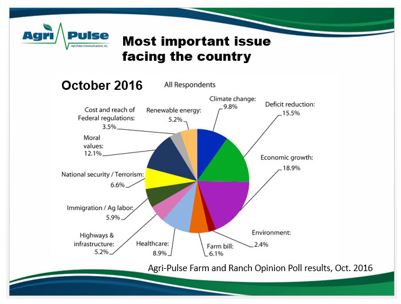
“Economic growth” rose to the top when respondents were asked to identify the one most important issue facing this country heading into the 2016 presidential election, with about 19 percent nationally selecting this option, up from 9 percent in January. That was the choice of about 19 percent of the Republicans, 16 percent of the Democrats and 18 percent of the Independents.
That represents a substantial shift from the January poll, when 19 percent of Republicans and Democrats listed “national security/terrorism” as their top choice, followed by “moral values” at 14 percent, “immigration/ag labor” at almost 14 percent and “deficit reduction” at 13.5 percent
.
In the October poll, the second most
important issue selected was “deficit reduction,” favored by about 16
percent, followed by “moral values” at 12 percent nationally. National security
and terrorism dropped down to 7 percent.
There was a strong uptick in “climate change,” moving from slightly
over 1 percent of farmers and ranchers concerned in the January survey to almost
10 percent in October.
Part of the dissatisfaction could be based on concerns about the overall U.S. economy, and the farm economy, with low prices for many commodities and livestock products. Net farm income is forecast to be $71.5 billion in 2016, down 11.5 percent. If realized, the 2016 figure would be the lowest since 2009. In the most recent poll, 60 percent of the farmers and ranchers expressed dissatisfaction with the ag economy, compared to about 50 percent in January. Among Democrats surveyed in October, the level of satisfaction/dissatisfaction with the ag economy was more equally split, with 49 percent satisfied versus 50 percent dissatisfied.
Still, despite the economic downturns and
tightening farm credit conditions, almost half of those surveyed are planning
to “stay the course” over the next year. About 16 percent said they would
be borrowing more money, 4 percent said they would be selling off assets or
renting out their land and only 3 percent said they had plans to terminate
their operation.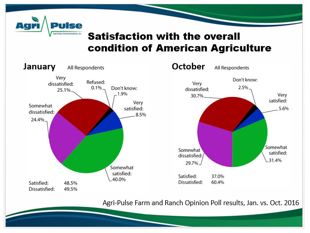
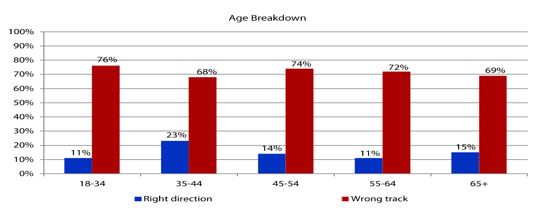
If there is one thing that farmers and
ranchers agree on – across party lines, geography, age and farm size – it’s
that federal regulatory policies related to agriculture are moving in the wrong
direction. Over 70 percent of those surveyed said that regulatory policies
are on the wrong track – up from 66 percent in January. Nationally, over three-quarters
of respondents in the 25-34 age group agreed that things were on the wrong
track. (See breakdown tables, below.)
Asked
to list which types of federal regulations are most burdensome, about one-third
of those responding cited federal pesticide regulations, followed by slightly
over 20 percent who said water quality and farm labor regulations topped their
list.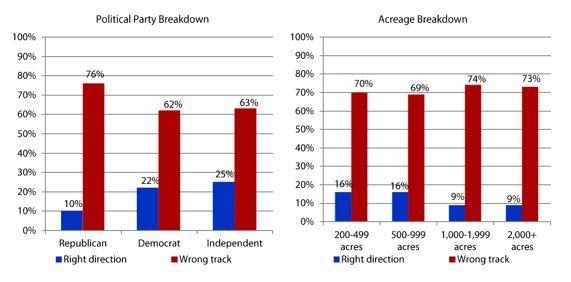
Reflecting
the demographics of commercial agriculture, two-thirds of the farmers polled
were 55 years of age or older, including the 40 percent who were at least 65. Some
83 percent of those surveyed were male. Sixty percent raised cattle, while 25
percent each raised dairy cattle and hogs. Only 3 percent had chicken
operations. There is a margin of error of 3.6 percent with 95 percent
confidence, according to Aimpoint.
#30
