
WASHINGTON, Nov. 23, 2016 - Americans shopping for
Thanksgiving this past week may have noticed that the cost of the traditional holiday
meal is leaving their wallets a little less light this year, according to data
from the American Farm Bureau Federation and the Bureau of Labor Statistics
(BLS).
The average cost of a Thanksgiving dinner for 10 people this year will be
$49.87, down 24 cents from 2015, the Farm Bureau says. And in the 12 months
through October, the food-at-home index fell 2.3 percent, according to the
latest data from the BLS Consumer Price Index (CPI).
At the same time, the amount of corn used for fuel ethanol
is primed to set a record in 2016, up roughly 3 percent from last year, according
to the Renewable Fuels Association (RFA).
“The U.S. ethanol industry is set to produce a record volume
of high octane renewable fuel this year,” says
RFA President and CEO Bob Dinneen, “and at the same time, consumers are
spending considerably less on food today than they did a year ago.”
The association asserts the “current collision” of falling
food prices and record ethanol production should end the “contrived” food
versus fuel debate once and for all.
As evidence, RFA has released an
independent analysis on
the impact of ethanol on food prices.
The new analysis, conducted by Informa Economics IEG, examines
the effect of ethanol expansion on food prices and finds that “retail food
prices were not impacted in any demonstrable way by expansion of U.S. grain
ethanol production under the Renewable Fuel Standard (RFS) over the past
decade.”
In fact, the study finds that food price inflation has
actually slowed during the “ethanol era.”
“Today’s lower food prices continue a trend of deceleration
in food inflation rates that began nearly 10 years ago when the RFS2
was adopted,” Dinneen says. “As the new Informa report clearly demonstrates,
there is no discernible link between ethanol production and retail food prices
— here in the U.S. or globally. It’s time to put an end to the ridiculous ‘food
vs. fuel’ myth that has been propagated for far too long by self-interested
opponents of biofuels and the RFS.”
The analysis shows that growth in food prices slowed considerably
after passage of the RFS2, with prices for groceries advancing at roughly half
the rate seen prior to the program’s adoption.
Prior to the passage of RFS2, food away from home grew at an
average of 3.4 percent, and at 3.2 percent for food at home, the report found. After
RFS2, the study found that food away from home grew at 2.6 percent, food at
home at 1.8 percent.
“The increase in the food [consumer price index] actually
decelerated as the usage of corn in ethanol production increased dramatically,”
RFA emphasizes.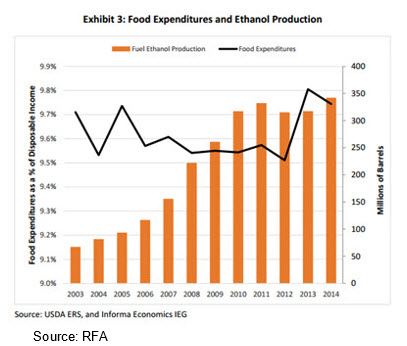
The study also examined the impact of ethanol on corn
prices, and, in turn, the impact of corn prices on retail food items.
While the authors conclude that corn prices were positively impacted by ethanol expansion, higher corn prices did not necessarily translate into higher consumer food prices, RFA notes.
“Statistical analysis shows that the link between corn prices and overall food prices has been weak,” the report states, adding that changes in food prices are primarily driven by “the costs of transforming farm products to retail grocery products, along with transportation and distribution at various levels of the supply chain.”
The study found that only 19 percent of consumer spending on
food pays for the value of the farm commodities, with the remaining 81 percent
paying for post-farm-gate activities such as transportation, processing,
marketing.
Other factors that drive farm commodity and retail food
prices were examined as well.
The report concludes that core inflationary pressures,
weather events such as flooding and droughts, exchange rates and energy prices
all impacted commodity and food prices over the past decade.
RFA notes that comparatively, from 2009 to 2014, the impact
of crude oil prices on consumer food price inflation was nearly nine times
greater than the impact of corn prices.
To read the full report, click
here.
#30
For more news, go to: www.Agri-Pulse.com
