
WASHINGTON, Nov. 30, 2016 - Does Department of Agriculture
research succeed ultimately in helping farmers improve their crops and
livestock, fight all manner of plant, animal and food-borne diseases, produce
improved products and increase profits?
USDA’s Office of
Technology Transfer (OTT) answers that question in a 223-page scoresheet
that summarizes how 10 USDA agencies along with five more entities within the Animal
and Plant Health Inspection Service (APHIS) pitch together to bring research
results to agricultural producers, processors, consumers and others in the farm
and food sector. That extraordinarily broad mission is called “technology
transfer,” which USDA defines as “the adoption of research outcomes (i.e., solutions)
for public benefit.”
Though several USDA agencies conduct research, the report is
compiled by OTT, a part of the Agricultural Research Service, which is the
department’s primary research agency and is also charged, for example, with
handling all of USDA’s patent applications. This month, OTT released its 2015 Report
on Technology Transfer, which includes "... new agriculture-related discoveries,
inventions and processes made by USDA researchers, universities and small
businesses” and their progress toward beneficial uses in the farm and food
arena.
 Why is USDA’s research scoresheet so long? For 2015 alone,
there is a mountain of technology transfers to report: 222 inventions, 94
patents awarded, and 125 patent applications filed. OTT collects updates from
the agencies and files this report annually. The tally since 2009: 883 patent
applications, 405 patents issued and 1,151 invention disclosures. The tab on
the federal budget since 2009: $19 billion in research both intramural and
extramural (outside USDA) grants.
Why is USDA’s research scoresheet so long? For 2015 alone,
there is a mountain of technology transfers to report: 222 inventions, 94
patents awarded, and 125 patent applications filed. OTT collects updates from
the agencies and files this report annually. The tally since 2009: 883 patent
applications, 405 patents issued and 1,151 invention disclosures. The tab on
the federal budget since 2009: $19 billion in research both intramural and
extramural (outside USDA) grants.
If USDA research were a football team, the OTT would be the
offensive coordinator, trying to get the quarterback, running backs, offensive
line and receivers in sync to move the ball down the field. In this case, a
touchdown is researchers bringing a successful, helpful and profitable product
across the goal line and into the farm and food economy.
The department says it uses the offensive coordinator
because getting research results into successful practical use “is complicated,
requiring integration of many assets . . . and . . . achieved through many
mechanisms, including public release of information, tools, and solutions
(e.g., germplasm, plants and other materials), adoption and enhancement of
research outcomes by partners through collaborative research, formal
cooperative research and development agreements . . . direct federal, state, or
local technical assistance, or through the licensing of biological materials or
protected intellectual property . . .”
What’s more, the OTT is expanding its web of coordinated
technology transfer (policy advice, interagency agreements, patenting, etc.),
and in 2015 extended such services to APHIS’s Wildlife Services, Veterinary
Services, and Plant Protection and Quarantine program, as well as to the Forest
Service’s Forest Products Laboratory plus the U.S. Fish and Wildlife Service of
the Department of Interior.
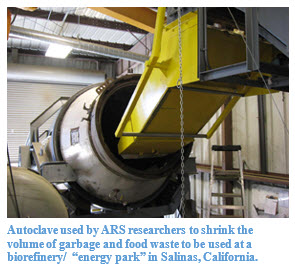
In releasing the report, Agriculture Secretary Tom Vilsack highlighted
a list of USDA research successes, including a biorefinery that is a joint
USDA project with the city of Salinas, California, to turn a landfill into an
“energy park,” a mosquito-resistant uniform for the military, an on-line climate and weather tool to better
manage farm pests and plant diseases, cost-effective solar-powered irrigation
pumps for remote communities and robotic apple pickers.
Vilsack also pointed to progress in efforts to counter the
spread of citrus greening (huanglongbing, or HLB), which has destroyed half of
Florida’s citrus production and has found its way to California citrus areas.
The report highlights how a bevy of USDA agencies and others are contributing
to the fight against HLB:
- ARS researchers in Florida now have large-scale grower trials proceeding at six sites with a high-quality hybrid sweet orange that they developed with high HLB tolerance and released in 2014. This means growers can successfully produce oranges even where the disease and the psyllid (insect) that spreads it is present.
- APHIS’ Center for Plant Health Science and Technology filled several roles in providing a protocol field production system for propagating a wasp that kills the HLB-carrying psyllid, training and technology transfer to California state agents and growers to produce and sustain wasp production, plus monitoring and evaluating the production of the wasp.
- With $13.5 million for USDA’s Huanglongbing Multi-Agency Coordination Group and APHIS, 27 research projects by various state universities, ARS scientists and private companies are searching for near-term remedies to a host of challenges posed by HLB.
- APHIS is also leading joint efforts with the Department of Homeland Security “to establish methods to apply therapies to manage citrus greening disease at large scales applicable to commercial production.”
#30
For more news, go to: www.Agri-Pulse.com
