
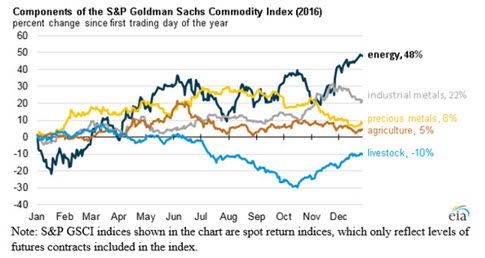
WASHINGTON, Jan. 12, 2017 - In 2016, the spot energy index
in the S&P Goldman Sachs Commodity Index (GSCI) rose more than any other
commodity group, some 48 percent, according to data from the
Energy Information Administration (EIA).
Among individual commodities, zinc, natural gas, crude oil and
diesel saw larger percentage increases than all other commodities in the
S&P GSCI.
EIA notes that commodity price movements for 2016 were
influenced by global economic growth as well as by commodity-specific supply-side
factors.
West Texas Intermediate (WTI) and Brent, two major crude oil
benchmarks, account for 69 percent of the weighting in the S&P GSCI
energy index. As a result, EIA says the energy index tends to follow major
price movements in the crude oil market.
After two years of significant price declines, EIA data show
crude oil prices rose from the 13-year lows set in January and February 2016.
 With declines in crude oil production in the U.S., China,
Canada, and Venezuela, the data show global
liquid fuels inventory growth slowed in 2016 compared with 2015.
With declines in crude oil production in the U.S., China,
Canada, and Venezuela, the data show global
liquid fuels inventory growth slowed in 2016 compared with 2015.
Since May, crude oil prices have generally remained between
$40 per barrel (b) and the low $50/b range. Crude oil prices rose to their
highest points in 2016 during December after the Organization of the Petroleum
Exporting Countries (OPEC) and non-OPEC countries announced agreements to cut crude oil
production beginning in 2017, EIA says.
In addition, EIA notes that improved
economic growth in both developed and emerging markets supported crude
oil prices.
Petroleum-based products such as reformulated gasoline blendstock for oxygenate blending (RBOB), ultra-low sulfur diesel (ULSD), and gasoil comprise 26 percent of the S&P GSCI energy index. RBOB had the smallest price increase among energy commodities, as gasoline stocks rose to a record high earlier in 2016 after refineries increased gasoline production yields.
However, EIA says growth in U.S. gasoline consumption
and record
high U.S. gasoline exports helped to draw down gasoline inventories
and to provide some price support in the last few months of 2016.
Lower distillate production helped stabilize
distillate inventory levels in 2016 after distillate stocks rose
significantly in 2015, EIA says. In addition, expanding
manufacturing sectors in several regions in the world contributed to
higher distillate consumption and supported ULSD and gasoil prices in 2016.
Natural gas accounts for the remaining 5 percent of the
S&P GSCI energy index, and it experienced the largest percentage increase
in price among energy commodities in 2016.
EIA notes that high levels of natural gas storage at the
start of the 2015–16 winter, together with warm winter weather that kept
withdrawals below seasonal norms, translated into very low natural gas prices
at the start of 2016.
The agency says natural gas prices increased rapidly in the
second half of 2016 because of record
natural gas-fired electricity generation in the summer of 2016 and
expectations that the 2016–17 winter would be significantly colder than the
previous winter.
#30
For more news, go to: www.Agri-Pulse.com