
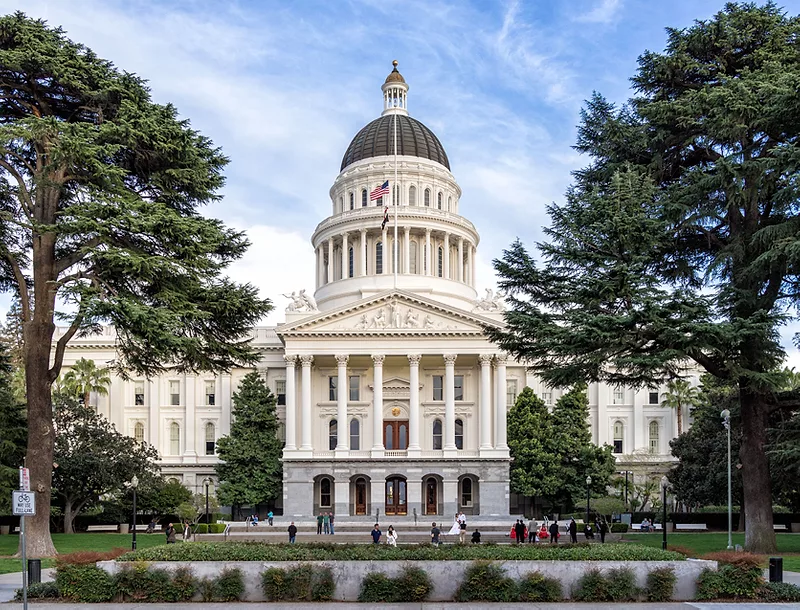
The California Cattlemen’s Association is setting out to work with CalEPA and the Natural Resources Agency on collaborative wildfire fuel reduction strategies, seeing it as an opportunity to amplify prescribed grazing.
Gov. Gavin Newsom proclaimed a state of emergency this week to fast-track wildfire prevention projects. It creates exemptions from environmental permits for risk reduction projects throughout the state and expedites environmental reviews for projects to remove vegetation.
The agencies will draft recommendations on scaling up prescribed burn projects in coordination with local air pollution control districts.
CalCAN asks lawmakers for climate funding assurance
The California Climate & Agriculture Network is pushing lawmakers to commit 15% of the state’s cap-and-trade revenues to fund CDFA programs on water efficiency and healthy soils. Farmers, ranchers and CalCAN advocates plan to lobby at the Capitol on March 11.
The organization argues that inconsistent funding streams have stifled technical assistance support for farmers and put state agencies in a bind by limiting investments to one-time allocations. CalCAN claims that agriculture is disproportionately underfunded compared to other sectors, given its 8% share of total emissions.
Canada, Mexico tariffs to raise food prices 0.7%, study finds
New 25% duties on Canada and Mexico could have a muted impact on food prices, new analysis from Rabobank finds. But the effects won’t be evenly distributed.
The authors calculate that across the economy food prices are set for a 0.7% increase. The U.S. relies on imports for a significant share of domestic supply for fruits and vegetables, however. Accordingly, these prices could rise by more than 3%.
Some specific products are set for even greater price increases. Avocado and tomato prices could jump by around 4%. Sourced mainly from Canada, snow crabs could see price increases of more than 6%. Meanwhile, French fries are set for a 2% retail price increase.
The U.S. also imports around 10% of its sugar from Mexico.
Sugar tariffs “will inevitably lead to higher prices for sugar and sweets for Americans,” the report says. “And could destabilize the [U.S.-Mexico-Canada Agreement’s] fragile accord on sweeteners.”
It’s easy to be “in the know” about what’s happening in Washington, D.C. Sign up for a FREE month of Agri-Pulse news! Simply click here.
Probationary employees at USDA get reprieve from judge
USDA probationary employees who were abruptly fired from their jobs last month have gotten a temporary reprieve. The chair of the Merit Systems Protection Board ordered that they be reinstated in their jobs for 45 days while the case against the department is stayed.
Late Wednesday, USDA sent a statement to Agri-Pulse that said, “The Department will work to abide by the ruling and has no further comment at this time.”
Judge Cathy Harris agreed with the Office of Special Counsel, an independent agency, representing a plaintiff who is a forestry technician in the U.S. Forest Service. Under the order, about 5,900 USDA employees will get their jobs back temporarily.
Read our full report at Agri-Pulse.com.
Senate panel to question FDA commissioner nominee today
President Donald Trump’s pick to lead the Food and Drug Administration, Johns Hopkins surgeon Martin Makary, has his confirmation hearing today before the Senate Health, Education, Labor and Pensions Committee.
Observers believe Makary will take a more moderated approach to food and nutrition issues than his would-be boss, Robert F. Kennedy Jr. Still, Sen. John Hoeven, R-N.D., said he has concerns about Makary’s past statements on food and pesticides.
Hoeven, who chairs the Senate Agriculture Appropriations subcommittee, said in his meeting with Makary, the nominee assured him he is focused on providing consumers with the right information about nutrition, rather than taking a prescriptive approach. Hoeven, however, still seemed skeptical about this and Makary’s comments linking pesticide use to cancer.
Senator pushes for rescissions to codify DOGE cuts
A select number of Senate Republicans now have the personal cell number of Elon Musk. They include Senate Ag Appropriations Chair John Hoeven of North Dakota, who has urged more communication between Musk’s DOGE, the White House and Congress.
The senators got the number from Musk at a meeting Wednesday about the Department of Government Efficiency’s cost-cutting efforts.
During the meeting, Sen. Rand Paul, R-Ky., raised the idea of using the rescission process to lock in some federal funding cuts made by DOGE. Rescissions can be requested by the president and effectively cancel unobligated dollars appropriated to federal agencies before funding expires.
“I love the cutting of the waste. I love finding all the crazy crap that we're spending overseas,” Paul told reporters later. “But to make it real, to make it go beyond the moment of the day, it needs to come back in the form of a rescission package.”
The last time Republicans tried to pass rescissions, under the first Trump administration, the measure narrowly failed in the Senate with two Republicans opposing it.
Ways and Means chair wants to see more Senate action on reconciliation
House Ways and Means Committee Chair Jason Smith, R-Mo., says the House wants to have its “one big, beautiful” reconciliation bill, including tax and spending cuts, on Trump’s desk by Memorial Day.
But the House and Senate GOP still must agree on a budget blueprint, and they are far apart on details and strategy. Some senators have been adamant that they want a two-step reconciliation process to deliver border funds to Trump as soon as possible, leaving tax cuts until later.
“I would bet my farm 10 times that you will never pass two reconciliation bills in the same year in Congress,” Smith said at an event hosted by the American Enterprise Institute.
He said some House Republicans could “care less” about extending Trump’s 2017 tax cuts, but they want to see action on border and energy funding.
Final word:
“If you can eat your dessert first, you're not going to eat the broccoli later.” – House Ways and Means Chair Jason Smith, R-Mo., on why he thinks Congress needs to pass a single, massive budget reconciliation bill that would include spending cuts as well as spending increases and tax cuts.
Senate Republicans prefer a two-step approach that would leave big spending cuts and tax cuts to later.


