
There is continued handwringing on Capitol Hill over the president’s vast new duties on U.S. trade partners. Senators have launched a bipartisan bid to claw back some congressional oversight of U.S. trade policy less than 24 hours after the “Liberation Day” announcement.
Finance Committee Sens. Chuck Grassley, R-Iowa, and Maria Cantwell, D-Wash., have introduced a bill that would require Congress to approve any new tariff increase by the president.
“These are big economic impacts,” Cantwell told Agri-Pulse. “People who have been part of trade discussions, like the Finance Committee members, know how important this is.”
Take note: Four GOP senators on Wednesday backed a Democratic-led resolution challenging the emergency declaration underpinning the U.S. tariffs on Canada. Sen. Tim Kaine, D-Va., led that effort and said he is now teeing up a new challenge on the 10% baseline tariff unveiled this week.
Kaine thinks the momentum will grow. “People are going to go home and they're going get an earful about this,” Kaine told Agri-Pulse. He added this pressure could lead to “a more robust vote” next time.
Administration sends mixed messages on tariff dealmaking
The Trump administration is sending mixed signals about whether it is open to cutting deals with countries to lower new duties announced this week.
Multiple agriculture groups — including the American Soybean Association — are pressing the president to swiftly cut deals with countries to secure greater market access for U.S. agricultural products.
But the White House is reluctant to frame the duties as a negotiating tool. The Washington Post has reported that administration officials are being instructed not to characterize the new tariffs as a starting point for discussions.
But, but, but: President Donald Trump told reporters on Air Force One on Thursday that he was open to cutting deals for the right concessions. “It depends,” Trump said. “As long as they're giving us something that's good. … The tariffs give us great power to negotiate.”
It’s easy to be “in the know” about agriculture news from coast to coast! Sign up for a FREE month of Agri-Pulse news. Simply click here.
Burgum pressured to add potash, phosphate to critical minerals list
Lawmakers are urging Interior Secretary Doug Burgum in a letter to restore potash and add phosphate to the department’s critical minerals list.
Their letter comes weeks after the White House issued an executive order to boost potash and domestic mineral production. Items included on the list receive increased research funding and streamlined permitting procedures, which could support U.S. production of fertilizer.
Potash was removed from the list in 2022. The mineral’s “significance for U.S. national security, food security and American farmers is especially critical, particularly given recent global events that have affected fertilizer markets and highlighted the risks of disruptions,” the letter reads.
Why it matters: The U.S. imports more than 90% of the potash used annually. A majority of that is supplied by Canada and is now subject to a 10% tariff, unless covered under USMCA.
Sen. Joni Ernst, R-Iowa, told Agri-Pulse she was confident that “ensuring both potash and phosphate — two essential fertilizer components — receive this designation will strengthen domestic fertilizer production.”
Rollins doubts tariff compensation necessary
Ag Secretary Brooke Rollins says it will be “literally months” before the administration knows whether it will be necessary to compensate farmers for the results of Trump’s trade policy.
“I don't believe that it will, but if it is, then this president has always said … he is resolute in his commitment to our farmers and our ranchers and our great rural communities in America. So, we will … we'll make sure we're ready if, in fact, that is necessary,” Rollins said from the White House, where she had just met with farmers from Florida.
By the way: Sen. John Hoeven, R-N.D., is our guest this week on Agri-Pulse Newsmakers. He talks about Trump’s tariff plan and addresses the question of how long the government could politically sustain trade compensation payments. “Obviously, I hope it doesn't go on for several years,” he says.
On the tariff plan, Hoeven says, "If you think about it, for as long as I can remember, our farmers have always said they want a free but fair trade, a level playing field. How many times have you heard that? And really that's what he's after. He's talking about reciprocity."
Newsmakers will be available today at Agri-Pulse.com.
Kennedy, Rollins address nutrition in joint appearance
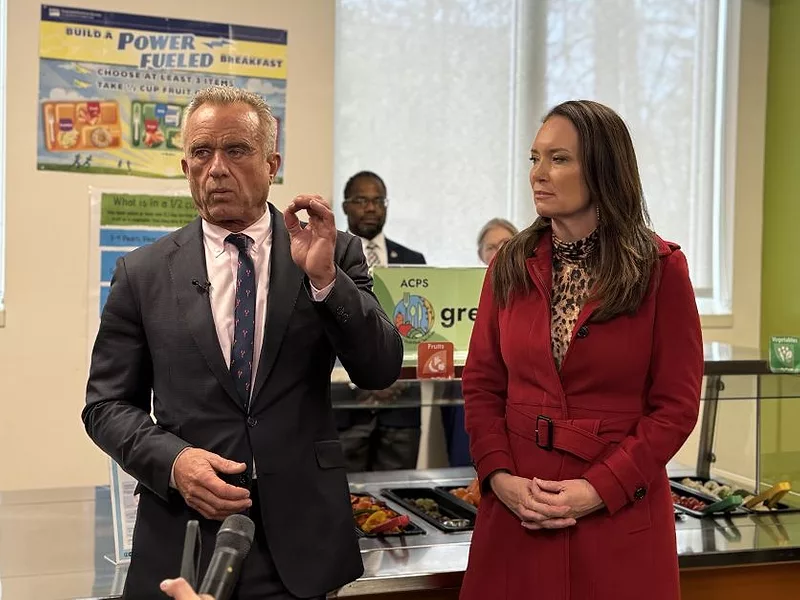
In their first joint appearance, Rollins and Health and Human Services Secretary Robert F. Kennedy Jr. said they’re working together to improve child nutrition but offered few details on what policies they may pursue.
Kennedy said they are encouraging governors to apply for SNAP waivers to exclude purchases of soft drinks and “other substances that we know are dangerous to our children.”
“We believe in choice,” Kennedy said. “But the federal taxpayers should not be paying to poison our children, and we’re going to end that. And we’re going to end it very quickly.”
When asked directly about potential federal action to address additives, dyes and processed food in school meals, Kennedy said the two secretaries are actively collaborating on the upcoming Dietary Guidelines for Americans. He said the recommendations released by the Dietary Guidelines Advisory Committee “looked like” they were “written by the food processing industry.”
He said the goal is to get the final guidelines out as quickly as possible.
Rollins said she views states as the “laboratories of democracy” where the innovation on how to improve these nutrition programs can take shape.
“The states begin to compete with one another, and I think the result of that will be alongside us with the dietary guidelines and what we're doing at the federal level, through both of our agencies. I think you'll see a new day in terms of how we think about nutrition and programs,” Rollins said.
Bipartisan Senate leadership calls for extended E15 sales
Republican and Democratic senators are urging Trump to allow the use of E15 year-round.
Senate Majority Leader John Thune, R-S.D., joined Minority Whip Dick Durbin, D-Ill., in a letter encouraging Trump to let E15 be used during the summer.
Specifically, the senators urged the president to extend the Reid vapor pressure waiver nationwide from June 1 through Sept. 15. They argue this would lower prices for consumers and benefit the domestic energy market and agricultural producers.
The letter was signed by 15 other Democrats and Republicans, including Senate Ag Committee ranking member Amy Klobuchar, D-Minn.
Final word
“If the result is our trading partners jack up their tariffs and we have high tariffs everywhere, I think that is a bad outcome. … Tariffs are a tax on consumers, and I’m not a fan of jacking up taxes on consumers.” – Sen. Ted Cruz, R-Texas, on Fox Business.
For more news, go to www.Agri-Pulse.com.


