
In the wake of a U.S. Supreme Court decision rolling back federal water quality protections, California stepped in to assume those duties. But lawmakers want to go further and are proposing to restructure the foundational law that established the state’s regulatory framework for water.
Businesses and water interests warn the measure would mire industries in excess permitting paperwork and delays — at a time when Sacramento’s attention has shifted to streamlining regulatory programs to lower costs on the public.
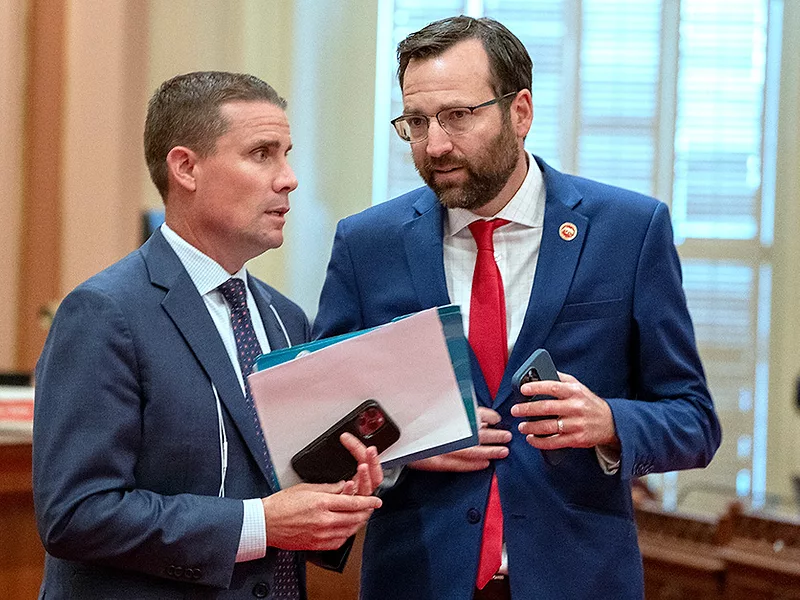
“It's a very East Coast decision,” said Senator Ben Allen, D-Santa Monica, explaining the court ruling in a hearing last week on his Senate Bill 601. “It doesn't incorporate the very different hydrology in the West.”
Allen said the Sackett v. EPA determination stripped wetlands and streams of protections and created uncertainty for ephemeral water systems. He argued the 1969 Porter-Cologne Act, which established the current version of the State Water Resources Control Board and its nine regional boards, “lacks some of the strict standards” under the Obama-era version of the “waters of the U.S.” rule in the Clean Water Act.
To Allen, the Sackett decision upended the state’s “whole system” for protecting water, and the shift in regulatory oversight to the state level has led to a significant increase in staff workload, particularly since the Porter-Cologne process “can be more cumbersome” to implement. He reasons that the act’s penalties are too low and the state needs “citizen enforcement tools” to hold polluters accountable.
Allen is also seizing on President Donald Trump’s executive order on overriding state authorities to argue the state faces even more uncertainty over the extent of its regulatory scope going forward.
SB 601 is proposing to expand the water board’s jurisdiction by redefining waters of the state to incorporate nexus waters, covering all wetlands previously overseen by the U.S. Army Corps of Engineers. The bill would enable Californians to sue water managers and landowners over perceived violations in protecting those waters.
The water board had already expanded the state’s definition of protected wetlands ahead of the Sackett ruling. Unsure where the federal government would land with the WOTUS rule, staff crafted the board’s implementation procedures to ensure a standard of protections regardless of state and federal jurisdictions. Yet the additional workload for absorbing the federal duties led to a 40% increase in regulatory fees to finance the rapid expansion.
It’s easy to be “in the know” about agriculture news from coast to coast! Sign up for a FREE month of Agri-Pulse news. Simply click here.
The California Coastkeeper Alliance views SB 601 as “just trying to maintain the status quo,” according to Executive Director Sean Bothwell. He assured the agriculture industry the bill would not expand Clean Water Act protections to state permit holders and would exclude groundwater from the rules. He believed it would improve government efficiency by seamlessly transitioning as many as 18,000 industrial storm water permits to the new state version and updating the bureaucratic approval process.
In 2019 Bothwell helped to write SB 1, California’s first attempt at dramatically expanding the water board’s authority to counter Trump’s deregulation threats. The bill garnered intense backlash from agriculture, business and water interests, compelling Governor Gavin Newsom to veto it. Bothwell acknowledged he repurposed some of the SB 1 language into SB 601 when drafting the legislation for Allen.
The same opponents are seeking to establish a bulwark against SB 601 as well.
“California already has the most expansive water quality regime of any state in the nation and far broader than that of the federal Clean Water Act,” said Kristopher Anderson, a policy advocate at the California Chamber of Commerce. “There are no water bodies that lost protections after the Sackett decision that are not regulated under state law. SB 601 is simply seeking to fix a problem that does not exist.”
Anderson charged that by creating an entirely new permitting regime, the state would regulate far more water bodies than the former WOTUS definition. He worried the requirements would be more onerous and would not account for economic feasibility or the potential impacts on housing development and water supply infrastructure, while ushering in a wave of frivolous and predatory lawsuits.
Anderson referred to Newsom’s strategy for expanding the water supply to counter a 10% climate-induced deficit expected to take hold by 2040 and said the state is already falling behind just three years into the process.
“Everything we know tells us we need to build more, faster,” he said. “[SB 601] will raise costs and delay these critical projects, and the cost of this bill will ultimately be borne by Californians.”
Dozens of agricultural associations have lined up in opposition, alongside business trade groups and housing developers.
Lately Democratic leaders in the Legislature have grown circumspect with provisions proposing a new private right of action to authorize citizen lawsuits, often striking those clauses from bills. As chair of the Senate Environmental Quality Committee, Sen. Catherine Blakespear, D-Encinitas, was the first to express skepticism over that language in SB 601.
Allen signaled he is open to such amendments, and he has the track record to back up the claim. In 2023 he authored one of three bills seeking to expand the water board’s authority over senior water rights and to ratchet up penalties, after reports circulated of ranchers ignoring drought curtailments to water their livestock. Yet the following year Allen took significant amendments to SB 389, watering it down to simply clarify the board’s role with pre-1914 rights. Agriculture dropped its opposition, and the governor signed the bill.
For more news, go to Agri-Pulse.com.

