
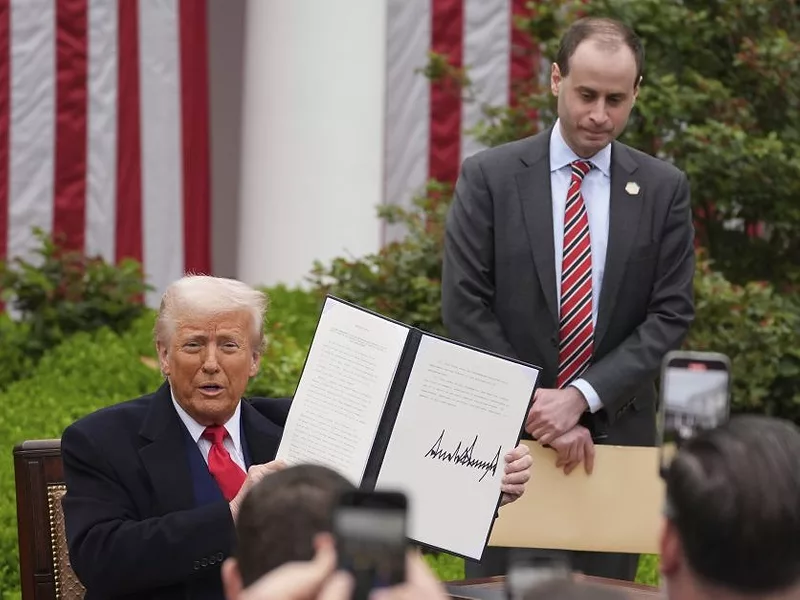
President Donald Trump tacked on an additional 50% to reciprocal duties applied to Chinese exports just hours before the tariffs were set to take effect. Beijing responded on Wednesday by hiking its own retaliatory duties to match the new 84% reciprocal tariff figure.
China was due to face a reciprocal duty of 34% beginning at 12:01 am on Wednesday. But after Beijing announced that it would respond to new U.S. tariffs in kind with a matching 34% levy on U.S. products, the president signed an executive order Tuesday raising the U.S. duty to 84% ahead of the tariff taking effect.
On Wednesday, after the new U.S. duty rate took effect, a spokesperson for China's Finance Ministry said Beijing will raise its own retaliatory duties to 84% starting Thursday. It will also limit exports to 12 more American companies and add six new businesses to its "unreliable entities" list that face restrictions doing business in China.
Combined with the two previous tariff hikes, Trump has now imposed additional tariffs worth 104% on U.S. imports from China since taking office. That is to say nothing of the U.S. tariffs already in place before Trump’s second term, which amounted to an average tariff rate of around 20%, according to the Peterson Institute for International Economics.
In addition to the new reciprocal duties, the president also increased the duties that will be applied to low-value shipments from China worth less than $800 from May 2. Trump said last week he was ending duty-free treatment for low-value shipments and that packages that previously entered tariff-free under the $800 threshold would be subject to either a 30% tariff or $25 fee. Tuesday’s executive order raised those new rates to 90% or $75. The fee will increase to $150 after June 1, according to the executive order.
Ahead of the further tariff hike, China’s Commerce and Foreign ministries pledged to “fight to the end” if the U.S. hiked duties.
“We will continue to take resolute and strong measures to safeguard our legitimate rights and interests," Chinese Foreign Ministry spokesperson Lin Jian said during a press conference on Tuesday, according to a translation from China’s state-run media.
It’s easy to be “in the know” about agriculture news from coast to coast! Sign up for a FREE month of Agri-Pulse news. Simply click here.
“If the U.S. truly wants to talk, it should let people see that they're ready to treat others with equality, respect and mutual benefit,” he added. “If the U.S. decides not to care about the interests of the US itself, China and the rest of the world, and is determined to fight a tariff and trade war, China's response will continue to the end.”
In her own press briefing on Tuesday, White House Press Secretary Karoline Leavitt warned that China was “making a mistake” by retaliating against U.S. reciprocal tariffs.
"President Trump has a spine of steel and will not break,” she told reporters.
The first tranche of Trump’s reciprocal tariffs, which featured a 10% across-the-board tariff on almost all U.S. imports, went into effect on Saturday. At an event in the White House on Tuesday, Trump said the duties were bringing in $2 billion a day to the U.S. Treasury.
“We're doing very well,” Trump said. “The money is pouring in.”
For more news, go to Agri-Pulse.com.

