
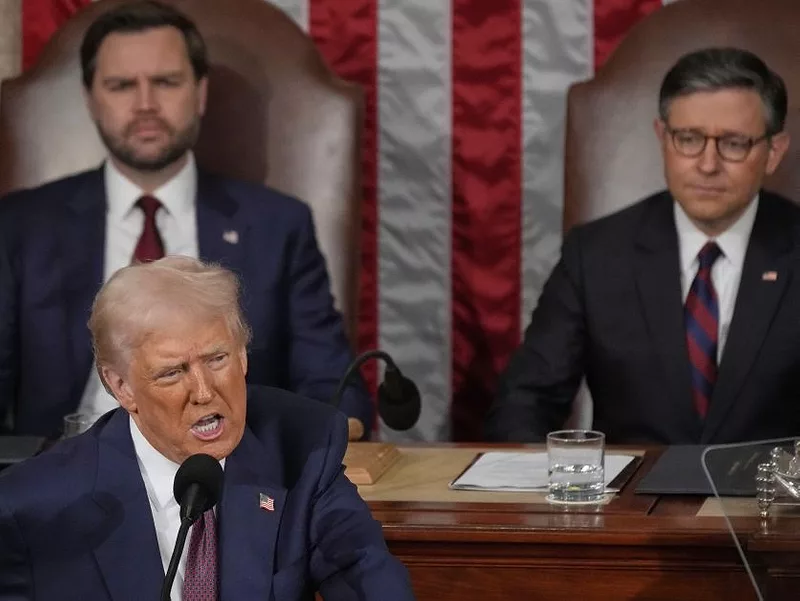
President Donald Trump announced Wednesday he will temporarily pause the country-specific reciprocal tariffs announced last week, except those applied to China.
“I have authorized a 90 day PAUSE, and a substantially lowered Reciprocal Tariff during this period, of 10%, also effective immediately,” he wrote in a post to Truth Social.
White House Press Secretary Karoline Leavitt clarified that all countries' reciprocal tariffs except China's will be brought down to the 10% baseline rate.
"We will continue with the tailor-made negotiations," Leavitt said at a White House press conference. "In the meantime, there will be a 90-day pause on the reciprocal tariffs as these negotiations are ongoing and the tariff level will be brought down to a universal 10% tariff."
The move comes just days after a 10% baseline tariff went into effect on almost all U.S. imports, and hours after higher, country-specific reciprocal tariffs kicked in. Treasury Secretary Scott Bessent said that the moves have spurred more than 75 countries to pursue negotiations with the U.S. to secure lower duties.
In the same post, Trump also said he would be raising the reciprocal duty rate applied to Chinese products entering the United States.
“I am hereby raising the Tariff charged to China by the United States of America to 125%, effective immediately,” Trump wrote. “At some point, hopefully in the near future, China will realize that the days of ripping off the U.S.A., and other Countries, is no longer sustainable or acceptable.”
Earlier on Wednesday, Beijing announced it would increase the retaliatory duty imposed on imports from the U.S. to 84%, matching the president’s rate he unveiled on Tuesday evening.
"When you punch at the United States of America, President Trump is going to punch back harder," Leavitt said.
In the same press conference, Bessent rejected the idea that the pause was a result of stock and bond market turmoil and cast the pause as part of the president's overall tariff strategy.
It’s easy to be “in the know” about agriculture news from coast to coast! Sign up for a FREE month of Agri-Pulse news. Simply click here.
"This was his strategy all along. You might even say that he goaded China into a bad position," Bessent said.
"Many of you in the media clearly missed 'the art of the deal,'" Leavitt echoed. "You clearly failed to see what President Trump is doing here."
The president himself seemed to undermine this message just hours later when he told reporters at the White House that he had been eying the impacts on the markets.
"I was watching the bond market," Trump said. "I saw last night where people are getting a little queasy.
The president also suggested that there could be future exemptions to the tariffs, but asked how he would decide to award carveouts he said "instinctively, more than anything else."
"You almost can't take a pencil to paper. It's really more of an instinct, I think, than anything else," he said.
Asked by reporters at the White House whether Mexico and Canada are part of the duty reductions, Bessent seemed to indicate that they are.
But a White House official told Agri-Pulse that the duties on Mexico and Canada remain unchanged.
"Fentanyl tariffs on Canada and Mexico remain unchanged," the official said. "The baseline of 10% did not go into effect on Canada and Mexico on April 5, and neither country is getting the 10% baseline now."
Both were exempt from the reciprocal tariffs, including the 10% baseline rate, because they had already been hit with 25% duties over concerns they are not doing enough to curb the flow of fentanyl and illegal migrants to the U.S.
The news of the pause landed as the U.S. Trade Representative Jamieson Greer was defending the tariffs in a hearing before the House Ways and Means Committee. Pressed for details about the announcement, Greer responded that as he understands it the pause will last for 90-days, but said that he hadn’t spoken to the president about the specifics of the announcement.
“The trade representative hasn’t spoken to the President of the United States about a global reordering of trade,” Rep. Steven Horsford, D-Nev., responded. “You announced it on a tweet. WTF?”
“It looks like your boss just pulled the rug out from under you,” Horsford said.
Rep. Tom Suozzi, D-N.Y., argued that recent tariff whiplash demonstrates that the administration doesn't have a plan.
"There's no plan," Suozzi said. He charged that Trump "pulled the rug out from under" Canada and Mexico when he slapped new duties on their products. "Do you do you think that there's a plan? Can you share a plan with us?" Suozzi asked.
Greer said that the plan is to use tariffs to balance U.S. trade and ensure fair treatment for U.S. exports in other markets.
Multiple Republican lawmakers told Agri-Pulse that they welcome the pause.
“I was pleased to see that there was a path forward that the president has found,” Sen. Mike Rounds, R-S.D., told Agri-Pulse.
Sen. Kevin Cramer, R-N.D., argued that the pause had generated a sense of optimism.
“There’s all kinds of opportunity now that … that we weren’t sure was going to exist 12 hours ago.”
Meanwhile, Sen. John Kennedy, R-La., argued that the pause is "a win for America" and the president. He added that he was confident the U.S. and China would eventually secure a deal to end the tit-for-tat tariff escalation.
"Eventually, China will come to the table," Kennedy said. " I feel confident that we'll negotiate with China separately from the rest of the world."
Lawmakers had been hearing concerns from ag industry groups and farmers over the scale of the new duties and the potential for retaliation against U.S. agriculture. Rep. Greg Murphy, R-N.C., told Agri-Pulse Wednesday that he had been stressing to rural constituents that the tariff would be a "short-term pain for long-term gain."
While Senate Ag Committee Chair John Boozman, R-Ark., doubted the announcement would quell tariff concerns from farm country, he called the move a “really good sign.”
"I think it's positive that the administration is getting themselves in a situation where they can negotiate, that's really what it's all about," he added.
"What the President is doing today is good news for not just farmers, for the whole economy," Iowa GOP Sen. Chuck Grassley said, "because this moderation brings credibility to what he started two weeks ago -- and credibility is very important in a free market economy.”
Rebekah Alvey and Philip Brasher contributed to this report.
For more news, go to www.Agri-Pulse.com.

