
Leaders of projects funded under USDA's canceled-and-rebranded Partnerships for Climate-Smart Commodities program are waiting for more guidance on how to reapply after the Trump administration labeled the program a “slush fund” and apparently terminated most of its grants.
A requirement in the newly named Advancing Markets for Producers initiative that 65% of federal dollars go directly to farmers could mean less money for technical assistance and carbon measurement and verification, according to conversations with participants and observers.
In order to qualify for AMP, termination letters said projects must meet “Farmer First policy priorities,” which include having enrolled and paid at least one producer by Dec, 31, 2024.
The deadline to reapply is June 20.
Project leaders said they received an email April 17 from Colton Buckley, chief of staff at USDA's Natural Resources Conservation Service, promising a "frequently asked questions" statement and sessions for stakeholders on how to reapply.
The program funded with $3.03 billion from the Commodity Credit Corp. involved 135 projects and covered an array of agricultural production practices in an effort to create a market for “climate-smart” commodities. Private funding accounted for another $1 billion.
In a statement, USDA Communications Director Seth Christensen said more than 100 of the projects "didn’t meet the criteria of sending a minimum of 65% of the initiative’s federal funds directly to producers."
Christensen said USDA officials have had "dozens of meetings" with program participants, "as well as those who wanted to participate but couldn’t, and heard deep frustration time and time again about the shifting goals and guideposts of the program under the previous administration. Specifically, we heard the required climate reporting was nearly impossible to carry out and consistently took dollars away from farmers only to be redistributed to climate-focused non-governmental organizations."
All projects terminated "were paid what they were owed based on the work completed" and have been given the opportunity to resubmit a proposal.
"Gone are the days that hardworking taxpayer dollars are siphoned off to special interest groups at the detriment of U.S. farmers," Christensen said.
Project leaders contacted by Agri-Pulse largely say they want to reapply but need more details. They worry that significant delays in getting reapproved could hamper program effectiveness.
“We're certainly interested and we want it to work out, but we just don't know enough to say whether or not it's going to be a good fit for the type of work that we want to do,” said Jon White, climate smart project director for Working Landscapes, a North Carolina nonprofit organization that works to incentivize small-scale farmers growing for local food hubs.
He said he needs more clarity on what would qualify as a payment to farmers, citing the purchase of shared equipment. “I think that it's a hard line to draw, but the administration is drawing a line, and so I think we will do our best to adapt our project to meet that line,” he said.
White said he’s encouraged by the administration’s emphasis on market development but is concerned about how long it would take to get reapproved.
The June 20 reapplication deadline “is over two months from now, and who knows how long it would [take] to actually award these grants and get us started?” he said. In addition, he worries that thousands of people working on projects nationwide “will likely have moved on by then.”
Complicating matters is that the funding freeze means White and his staff aren’t being paid. In its announcement April 14, USDA said it would cover all disbursements from before April 13.
White organized a letter to Agriculture Secretary Brooke Rollins last month from more than 100 project participants, most of them smaller scale, seeking to discuss how to keep the program going. He said an informal survey of 34 smaller projects showed that only one met USDA’s criteria to continue. The rest had grants terminated with an opportunity to reapply.
It’s easy to be “in the know” about agriculture news from coast to coast! Sign up for a FREE month of Agri-Pulse news. Simply click here.
Based on a Agri-Pulse analysis of 82 PCSC projects with $5 million or more in overall funding, only 19 would have met the requirement to provide at least 65% of federal funds to producers. Two of the 82 did not include information on total producer incentives and the remaining 61 did not appear to meet the threshold, based on the contract agreements.
Information about the program was taken down from the USDA website as part of a Trump administration scrub of climate-related information.
 Rivka Hodgkinson (LinkedIn)
Former NRCS Director Bruce Knight told Agri-Pulse he thinks it’s possible that fewer than a dozen projects meet the USDA’s minimum for direct AMP payments. He said some projects were using private funds to pay farmers.
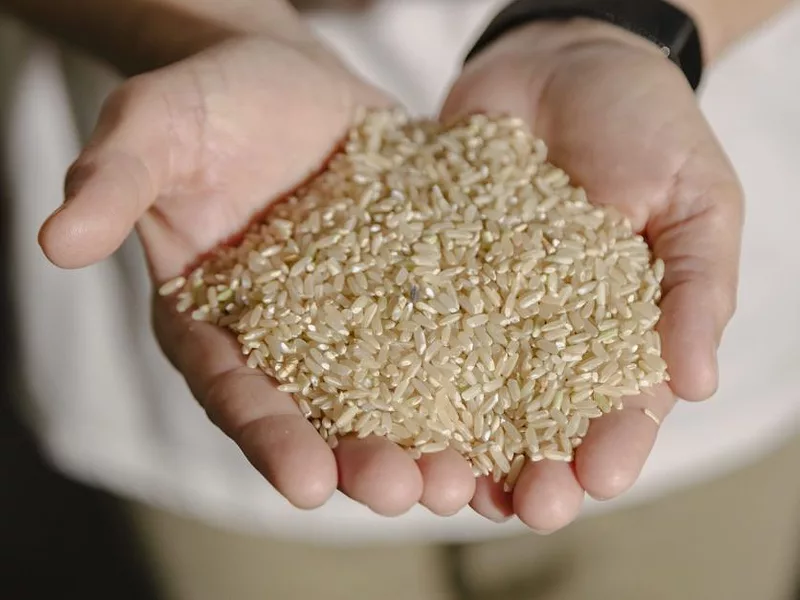
One project that made the cut was AgriCapture's climate-friendly rice program.
The Tennessee-based company said it had not only met but exceeded all three criteria. "Since its launch in 2023, the program has developed two distinct markets for U.S. rice farmers and distributed over $4 million in incentives to 33 rice farmers across 42,000 acres, channeling 74% of USDA funds directly to producers," the company said in a news release April 16.
When will new program be up and running?
With farmers beginning field work, some question whether the timeline for the updated program will extend into next year.
“It’s always challenging to make repairs on the car while it’s driving down the road,” said Rivka Hodgkinson, executive director of the Michigan Association of Conservation Districts, which has a project that does not qualify for AMP.
“It’s not an ideal timeline,” Lisa Woodke, sustainability director for Star of the West Milling Co. in Michigan, said. “When the announcement came in January, had they just terminated all of us, we would have had several months to get ready for this spring season and we probably could have figured it out and we could be enrolling growers right now.”
Hodgkinson said she was “very thankful” that the program is proceeding. But she said the 65% number could require organizations to take project money from technical assistance or soil sampling, potentially forcing producers to take on some of those costs.
“I think it’s very easy to look at the surface level, and for people to be like, ‘Oh, this means more money is going to producers. That’s good, right?’" Hodgkinson said. “But there is a whole lot of support being removed from them at the same time.”
Hodgkinson said her association is looking at reapplying but is waiting for more guidance.
Woodke said her group's project is “very close” to meeting the 65% minimum, though she will need to shift some funding around. Star of the West, the ninth-largest miller in the country, will reapply for AMP once USDA provides more information.
While “change is never comfortable,” Woodke said she thinks 65% is an acceptable number for the amount of federal funding that should go to growers.
 Lisa Woodke (LinkedIn photo)
“I don’t have any problems with that,” she said. “Had we been given that direction with the Partnerships for Climate-Smart Commodities grant, we would have followed that.”
Woodke added, however, that she does have concerns about AMP timing. Farmers are in the early stages of planting, which means they have made important conservation decisions for the year. While farmers who have already decided to plant cover crops or use a no-till system this year may be able to get funding if the program were to be reapproved later this year, others may have to wait until next year.
Silvia Secchi, a professor at the University of Iowa, said several projects were using payments in kind or giving farmers the tools to implement practices, but not necessarily delivering payments.
She said projects with greater emphasis on science or measuring, monitoring, reporting and verification are likely to struggle adjusting to meet the new requirement. That would hit universities that were doing extension work with farmers particularly hard.
“It would really require them to restart from scratch in the middle of it,” Secchi said. “You can’t just midstream kind of pick up and completely alter direction. It creates a lot of chaos.”
Initiatives like PCSC must be in place for a long time for a market to develop, Secchi said. And efforts to create marketplaces have to go beyond farmer incentives but help the supply chain.
More broadly, Secchi said she’s concerned how the changes to PCSC and other action by the administration will affect U.S. agriculture’s global competitiveness. Outside the U.S., she said, there’s more buy-in from consumers regarding climate and the food system. Scaling back support for building climate certification schemes for multiple commodities will hurt efforts to export those goods in the future, she said.
Less red tape a good thing, grain miller says
Rollins’ emphasis on reducing paperwork resonated with at least one grant coordinator, Jessica Whitaker Allen of Whitaker Grain in Arkansas. She said she quickly reapplied for a project she’s involved in, testing a water-saving technique in rice called alternate wetting and drying, or AWD.
She said she has doubled the number of producers in the program from 12 to 24 and shifted funding for specialized equipment to verify methane reductions from AWD into producer incentives in order to meet the 65% threshold.
“It does look like they're trying to cut out a lot of this red tape, and a lot of this paperwork that we were really getting bogged down with originally, to get this money out the door as quickly as possible,” she said.
She acknowledged that her project is unique in that it was just approved in December and has had no expenses. “We haven't spent $1 yet, so we’re actually in a really good spot,” she said.
Nevertheless, “there's a lot of things that haven't been addressed,” she said, such as a Biden administration requirement that 40% of project benefits go to historically underserved producers.
“I asked directly [about the 40% requirement], didn't get an answer, so we submitted with the information that we had been given thus far, and we're going to wait to see,” she said.
For more news, go to www.Agri-Pulse.com
This story was updated April 23 with a statement from USDA.


