
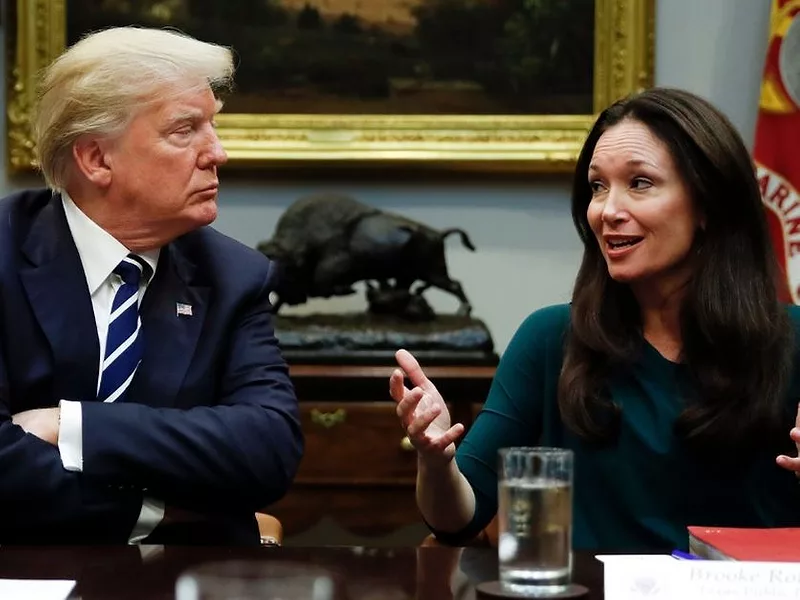
President Donald Trump is celebrating 100 days in office this week as Ag Secretary Brooke Rollins says we should start seeing some progress on trade deals.
"I'm not in the room. I'm not negotiating the trade deals. But my understanding is, we should have several this week that are coming forward that are very, very close,” Rollins said Sunday on CNN’s State of the Union.
She added, “China is a very important one. Every day, we are in conversation with China, along with those other 99, 100 countries that have come to the table.”
On farmers: She said “no one supports President Trump more than our farmers and ranchers in our rural communities.” Despite the fact that “soybean farmers, some of our row croppers, some of our pork, et cetera, they certainly are … more in the crosshairs than a lot of our other agriculture industry. But for the most part, from every – every farmer I have talked to says, we understand this, and we are with you.”
By the way: Rollins is in Ohio today to visit an egg farm and highlight precision agriculture. She’ll be joined by Gov. Mike DeWine.
For more on this week’s D.C. agenda, check out our Washington Week Ahead.
USDA boosts food inflation forecast
Rollins will almost certainly highlight the drop in wholesale egg prices while she’s in Ohio. But USDA economists have sharply raised their forecast for the increased cost of eating at home this year to 3.2%. The estimate had been 2.7%.
Keep in mind: The average annual inflation rate for grocery prices over the past 20 years has been 2.6%.
The new estimate reflects in part higher price estimates for beef and pork. Beef prices are expected to rise 6.3% this year “due to tight supplies and continued consumer demand.” The March estimate was 5.2%. USDA had expected pork prices to decline 1.5% in 2025 but now predicts they will rise 1.8%.
USDA expects egg prices to average nearly 55% higher this year over 2024, although the department has slightly lowered its forecast since March.
EU commissioner: EU-U.S. trade talks in early stage, not drawing ‘red lines’
The European Union commissioner for economy and productivity, Valdis Dombrovskis, says U.S.-EU trade discussions are still in a nascent stage. “We are not in very mature stage,” Dombrovskis told reporters Friday. “There is a degree of interest” from the U.S. side in EU proposals to slash tariffs on industrial goods and buy more U.S. energy products, he said. But he added that other issues would also likely feature in discussions.
Why it matters: Dombrovskis didn’t rule out agriculture’s inclusion in a potential deal. “We’re not drawing … red lines,” he told Agri-Pulse. But he stressed that agriculture is somewhere the bloc would be “exercising caution.”
Dombrovskis previously told the Wall Street Journal that EU ag subsidies won’t be up for negotiation. He told Agri-Pulse that food standards are also an important area for the bloc – “which obviously we are upholding.”
Take note: Treasury Secretary Scott Bessent told ABC on Sunday that while hashing out trade deals can take months, countries will be able to avoid reciprocal tariffs by securing deals “in principle.” “Staying within the parameter of the deal by our trading partners can keep the tariffs … from ratcheting back to the maximum level,” he said.
Warren presses Bessent on tariff comments
Massachusetts Democratic Sen. Elizabeth Warren is concerned about Bessent’s comments on tariffs at a private meeting with business leaders last week. Bessent told participants in a private speech hosted by JPMorgan Chase that the current tariffs on China are unsustainable and that he expects de-escalation.
Cut through the clutter! We deliver the news you need to stay informed about farm, food and rural issues. Sign up for a FREE month of Agri-Pulse here.
Warren wrote to Bessent on Friday to complain that his comments to “a room full of wealthy investors and Wall Street executives” had created the “opportunity for insider trading or other financial profiteering.”
She is asking the treasury secretary for more details on the meeting and the information provided by May 8.
Report pushes Congress to avoid upping SNAP work requirements
Congress should invest in job training, higher wages and affordable childcare rather than expanding work requirements for programs like SNAP, according to a report by the Robert Wood Johnson Foundation.
Lawmakers will return from recess this week to start work on a sweeping budget reconciliation bill in the House. The House Ag Committee is expected to consider tightening work requirements for SNAP. Provisions aimed at reducing SNAP error rates also are in play.
The report by RWJF cites research arguing that work requirements do not reach the goals of moving participants out of these programs and into self-sufficiency. Instead, the group says evidence shows these requirements increase costs for states, block eligible participants from getting assistance from these programs and can drive people further into poverty.
Challenge to Florida’s lab-grown meat law can continue, judge rules
A U.S. district court judge has ruled that a lawsuit challenging Florida’s ban on cultivated meat can move forward.
The lawsuit, filed by cultivated meat company Upside Foods, says Florida’s lab-grown meat law violates the constitution’s Commerce Clause “because it was enacted with a discriminatory purpose, and has the discriminatory effect, of benefiting in-state agricultural interests at the expense of out-of-state competitors.
Lawyers for Florida’s Agriculture Department had previously asked the judge to dismiss the case, calling Upside Foods’ argument tying cultivated meat producers to conventional meat producers “sleight of hand.” They had argued the plaintiff failed to state a dormant Commerce Clause claim.
What to watch: Lawyers for Upside Foods allege the ban discriminates against out-of-state products because cultivated meat is entirely produced outside of Florida, while also benefiting conventional meat businesses “by shielding them from the potential decline in market share they would face from competing with out-of-state cultivated meat.”
Final word
“I think the first and most important thing that is really relevant to today is, this president has never, ever governed by poll. And I just saw those same numbers too, so I haven't had a chance to dig in. But the second thing is that every -- there are hundred different polls that say a hundred different things.” – Agriculture Secretary Brooke Rollins on CNN Sunday, responding to a question about a poll showing that 64% of Americans disapprove of President Donald Trump’s use of tariffs.
For more news, go to Agri-Pulse.com.


