
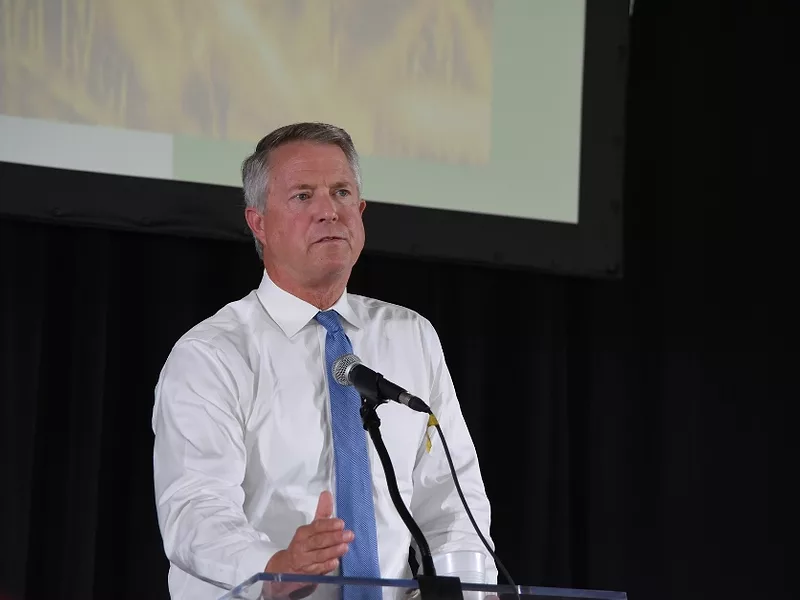
Sen. Roger Marshall, R‑Kan., is introducing legislation to block tariffs on phosphate fertilizer, saying the move would help lower costs for U.S. growers.
The Lowering Input Costs for American Farmers Act, shared exclusively with Agri‑Pulse, would bar the U.S. from imposing Section 122 or Section 301 duties on phosphate fertilizers imported from Morocco and revoke existing countervailing duty orders. It also would direct refunds of cash deposits already paid.
“Kansas farmers are getting hit by a fertilizer market that’s working against them,” Marshall said, adding that current prices “threaten their bottom line.”
A summary says the bill would end all tariffs and countervailing duties on phosphate fertilizer and related products, repeal the April 7, 2021, CVD order and “restore access to competitively priced fertilizer for U.S. farmers.”
USDA says Vaden does not need recusal from CVD decision
A USDA spokesperson says Deputy Agriculture Secretary Stephen Vaden does not need to recuse himself from administration decisionmaking around the future of tariffs on phosphate fertilizer.
Both Vaden and U.S. Trade Representative Jamieson Greer were involved in a case challenging countervailing duties on Moroccan and Russian phosphate fertilizer. The former presided as a judge at the Court of International Trade, while the latter represented Simplot, one of the North American fertilizer producers involved in the case.
A spokesperson for USTR told Agri-Pulse Friday that Greer has recused himself from any administration decisionmaking on the future of the tariffs. A USDA spokesperson said Monday that Vaden has not done so.
“In both [his] prior position as a federal judge and in his current position as USDA’s Deputy Secretary – he was, and still is, a federal employee,” the spokesperson said.
“Accordingly, as a federal employee at all relevant times regarding this matter, there is no conflict of interest, and the federal ethics rules allow full participation in the current policy discussions concerning countervailing duties in this matter,” they added.
Rules panel stalls as pesticide fight intensifies
The House Rules Committee, which is teeing up the farm bill for floor consideration later this week, adjourned Monday night without completing its work — a delay that could complicate plans to bring the package to a vote. The House is scheduled to convene Tuesday for a Joint Session of Congress at 3 p.m. to receive King Charles III of the U.K.
The panel went into recess late Monday as lawmakers weighed how to handle a bipartisan amendment that would strip the bill’s pesticide‑labeling provision, a flashpoint drawing resistance from both Democrats and Republicans. The language would assert federal supremacy over state pesticide labeling laws, a move critics say would override local warning requirements and “shield” chemical manufacturers from lawsuits. House Agriculture Chairman Glenn “GT” Thompson disputes that, arguing states could still refuse to register a product and that the provision is intended to prevent a patchwork of label mandates.
The pesticide fight is among the most contentious issues threatening support for the bill, which Thompson is advancing with backing from seven Democrats on the committee. The clash came the same day the Supreme Court heard arguments in a high‑profile case involving Bayer’s Roundup and the scope of federal authority over pesticide labels.
Prop 12 lobbying fight heats up
Nearly 400 state and federal agricultural groups on Monday wrote House leadership in support of farm bill language that would preempt California’s Proposition 12 and similar state-enacted welfare regulations, calling the prospect of a patchwork of state regulations “unsustainable.”
"If Congress fails to act, the chaos from a segmented market will drive consolidation and force American family farmers out of business, as the rest of agriculture remains exposed,” the letter said.
The National Pork Producers Council, American Farm Bureau Federation and other groups point to a North Dakota State University report that shows prices for certain pork products have jumped as much as 30%, while consumption of pork has fallen 16% in California due to Prop 12.
Meanwhile, a group that says it advocates for higher standards in food safety and animal care kicked off a $1 million ad campaign this week that calls for removal of the farm bill’s “Save Our Bacon” provision that would block state laws like California’s Prop 12.
The politically targeted digital and TV ads feature China-owned firms and their alleged interest in expanding “cruel production methods nationwide and eliminating states’ ability to protect their citizens’ food choices,” according to the American Meat Producers Association, which represents ranchers and meat producers.
As of Monday evening, it wasn’t known if the bipartisan amendment from Reps. Anna Paulina Luna, R-Fla., and Jim Costa, D-Calif., would be considered on the House floor later this week when the farm bill gets a full vote in the chamber.
Interested in more news on farm programs, trade and rural issues? Sign up for a four-week free trial to Agri-Pulse. You’ll receive our content - absolutely free - during the trial period.
“This is about states’ rights, voter rights, and the future of America’s family farmers,” Holly Bice, AMPA CEO, said in a statement. “We’re putting members of Congress on notice: a vote against the Luna amendment is a vote against your constituents — and the voters watching this vote will not forget it.”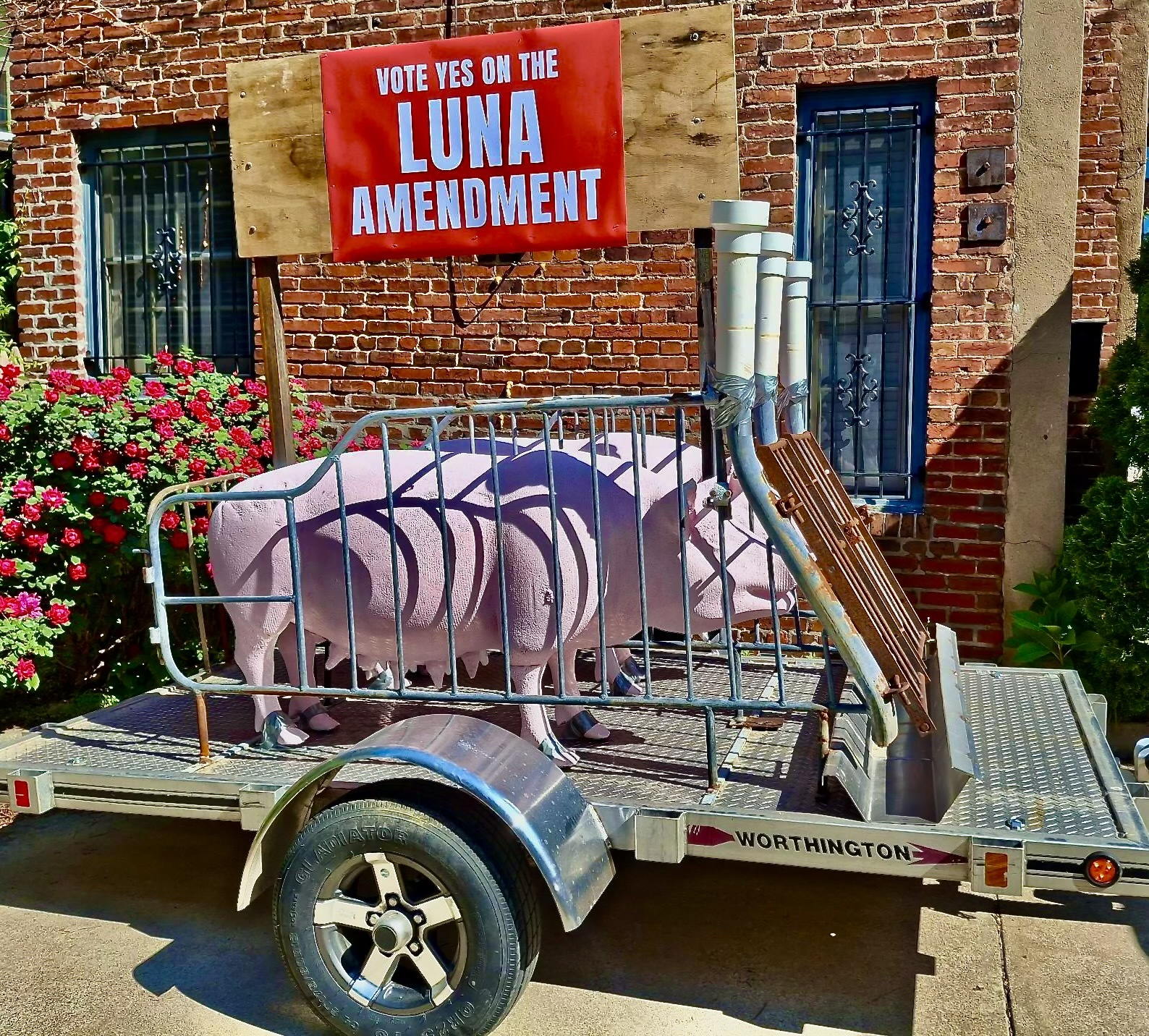
The American Meat Producers Association rallied on Monday against attempts in Washington to repeal animal welfare laws like California’s Prop 12. (AMPA photo)
SCOTUS takes up H-2A caseThe Supreme Court will review an appeals court decision that found the Labor Department cannot impose fines on employers who violate the H-2A farm labor program.
A department administrative law judge ordered New Jersey grower Sun Valley Orchards to pay about $580,000 in back wages and fines in 2019. The ALJ found that the company had terminated more than 20 workers without cause and had not provided workers sanitary housing – among other violations.
The 3rd Circuit’s decision “incorrectly invalidates an Act of Congress. Indeed, the court’s reasoning casts doubt on all administrative adjudications of employers’ violations of conditions of H–2A and related programs,” the Labor Department’s petition to the Supreme Court says.
The court granted the petition to review two questions: first, whether Article III of the Constitution precludes the Labor Department from adjudicating proceedings to collect “monetary remedies” from employers who have violated employment terms for H-2A workers. Second, whether the 1986 Immigration and Nationality Act authorizes the department to collect the monetary remedies.


Senate leaders gather for tributes and the portrait unveiling of former Senate Agriculture Committee Chairman Pat Roberts, an event originally delayed by COVID‑19. More than 70 former staffers, House members, family and friends join a reception in the Mansfield Room and sing “Happy Birthday” in honor of his 90th birthday. Pictured above: Roberts and Agri-Pulse Founder and Publisher Sara Wyant.
APHIS loosens HPAI transport requirements for dairy cattle
The Animal and Plant Health Inspection Service will no longer require testing of Highly Pathogenic Avian Influenza in lactating dairy cattle being transported from states where dairy herds have been confirmed free of the virus.
New agency guidance specifies that transport of lactating dairy cattle in states with “unaffected” status under its National Milk Testing Strategy no longer will require testing, though testing is still required for states with “affected” status. Unaffected states are states where dairy herds have been confirmed free of the virus.
According to USDA data, only five dairy cases of HPAI have been confirmed in the United States so far this year. All were detected in Idaho.
Mexico: Screwworm fly facility mostly complete
The Mexican government says a sterile fly production facility in Metapa is around 75% complete and is still on track to begin operations at the end of June.
The project, which is renovating an existing fruit fly facility, will double the production capacity of sterile flies to bolster the cross-border effort to curb New World screwworm.
“In the coming days, the reception and installation of the main industrial equipment will be completed to generate controlled artificial conditions for breeding,” a release from Mexico’s Ministry of Agriculture reads.
Take note: In addition to the sterile fly production facility in Mexico, USDA has broken ground on a Texas facility, which it hopes to open late next year.
Agriculture Secretary Brooke Rollins has come under pressure from industry figures in Arizona to reopen the southern border to live cattle trade. She has signaled that she could soon visit the Douglas border crossing to assess the situation, but a visit initially floated for last week did not materialize.
Final words
“The justices were asking, I think, the right questions, and it's really going to come down to – is there uniformity of labels and federal preemption of EPA decisionmaking related to the science and the data for registrations on the labels, particularly the warning labels. Or you can allow 50 states or 50 trial courts decide through tort law what should be on the warning labels.” – Richard Gupton, senior vice president for public policy and counsel at the Agricultural Retailers Association, speaking to Agri-Pulse. Read more on yesterday’s arguments here.
"Let me be a little more bold. I think we should be independent of foreign fertilizer within five years." – Rep. Glenn “GT” Thompson, chair of the House Agriculture Committee, on the Trump administration’s effort to boost domestic fertilizer production.
For more news, go to www.Agri-Pulse.com.
.webp?t=1762183428)


