
Next week is shaping up to be a big one for ag policy. Ag Secretary Brooke Rollins says she’ll release her plan next week for reorganizing and downsizing her department. But she told members of the National Association of Farm Broadcasting on Tuesday the downsizing won’t be as “drastic” as some observers fear.
She later told the Senate Ag Appropriations Subcommittee she’s rehiring some staff, primarily in the Farm Service Agency, Animal and Plant Health Inspection Service, and wildfire response offices.
Meanwhile, House Ag Committee Chairman Glenn “GT” Thompson, R-Pa., says he plans to bring the committee’s portion of the budget reconciliation bill to a vote of the panel next week. The text could be out this weekend. But committee members continue to wrangle over whether – and how – to force states to start sharing the cost of the SNAP program.
Take note: For more on reconciliation, read our weekly newsletter today. We also have Aubrey Bettencourt talking about her plans as chief of the Natural Resources Conservation Service amid its staffing cuts. Plus, we have report on U.S.-UK trade, Proposition 12, pesticide regulation, and food dyes.
Rollins grilled on disaster aid timing
William Dellacamera, a vegetable farmer from Connecticut, came to Capitol Hill Tuesday to quiz Rollins about the status of $220 million in disaster aid for farmers.
Dellacamera said he is awaiting funds through the Farm Recovery and Support Block Grant that offers funds to states in New England, Alaska and Hawaii for 2023 and 2024 losses from weather events.
The block grant program was included in the end-of-year continuing resolution, but Dellacamera said USDA has dragged its feet in releasing the funds, preventing farmers from accessing it until the fall.
“Why would I or any other farmer want to have to even keep farming, right, if that’s what it’s going to be year after year, disaster after disaster,” Dellacamera told reporters at the Senate subcommittee hearing where Rollins was testifying.
Take note: Senators also pressed her on the status of $20 billion in farmer disaster aid, which she said would open up for applications in the coming days. In front of reporters after the hearing, Rollins told Dellacamera that USDA would open up the funds in the coming weeks, and her team assured him that they are trying their best.
“But how do we stop creditors from calling every day?” Dellacamera responded. “That’s the problem.”
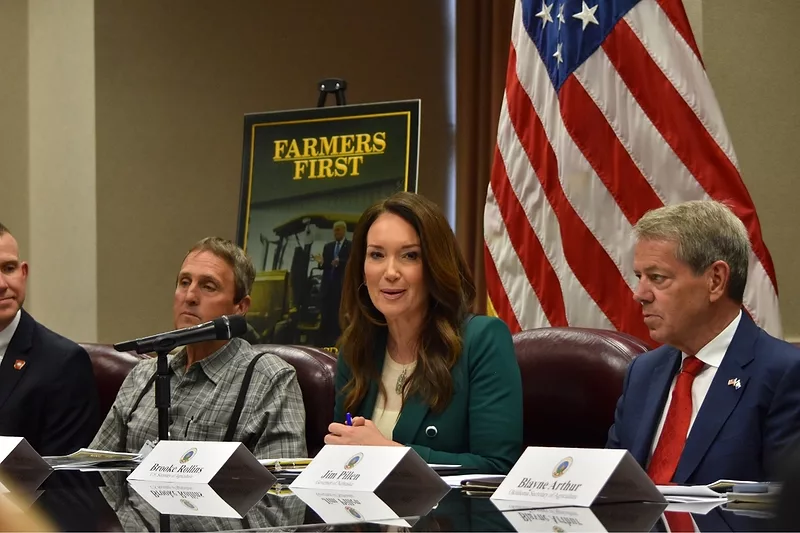
Take note: Today, Rollins is expected on Capitol Hill again. This time, she will appear before the House Ag Appropriations Subcommittee. William Dellacamera and Agriculture Secretary Brooke Rollins (Agri-Pulse photo).
Trump, Carney hold ‘constructive’ meeting, as Trump digs in on tariffs
Canadian Prime Minister Mark Carney said his meeting with President Donald Trump on Tuesday was “wide-ranging” and “constructive,” insisting that he made the case for lifting tariffs.
Meanwhile, Trump told reporters there was nothing Carney could say to get him to undo Canada’s 25% duties.That’s “just the way it is,” Trump said in the Oval Office.
In a sign of how far U.S. trade policy has come since Trump’s first term, the president questioned whether the U.S.-Mexico-Canada Agreement is “even necessary.” Trump negotiated the North American trade deal in 2018, and it runs until 2036, with a review slated for next year.
But on Tuesday, Trump referred to the pact as “transitional.” But he stressed it was not “dead” and has been, and remains, “very effective.”“Really, today marked the end of the beginning of a process of the United States and Canada redefining that relationship,” Carney told reporters after leaving the White House. “The question is how we will co-operate in the future.”
Zeldin: Pesticide programs to benefit from EPA research cuts
EPA Administrator Lee Zeldin says the Office of Pesticide Programs will benefit from the dissolution of the Office of Research and Development, the agency’s scientific research arm.
The agency said last week the Office of Chemical Safety and Pollution Prevention, which includes OPP, will get more than 130 employees, some of whom will work on pesticide reviews.
On Tuesday, Zeldin told the farm broadcasters EPA chemicals staff had urged him to bolster chemical reviews and pesticide registrations.“They said that if they were able to get scientists sent to them from the Office of Research and Development, that can help them in getting through this backlog that we inherited,” Zeldin said.
Zeldin also urged growers to reach out with suggestions for the recently released insecticide strategy.“My message would be for any individual growers that are out there and they read the insecticide strategy, and they have an idea for us on how to do anything better, let us know, and we'll update. This isn't a final document.”
 Environmental Protection Agency Administrator Lee Zeldin speaks to National Association of Farm Broadcasting members at the USDA building. He touched on how the agency will balance the Make America Healthy Again movement’s views on crop protection tools.“Follow the science. It’s as simple as that for us.” (Agri-Pulse photo)
Canada rules U.S. biodiesel no threat to domestic industry
Canada’s International Trade Tribunal has ruled that U.S. renewable diesel exports aren’t hurting its domestic industry, ending an antidumping and countervailing duty probe.
“The evidence does not disclose a reasonable indication that the dumping and subsidizing of renewable diesel from the United States of America have caused injury or are threatening to cause injury to the domestic industry,” a statement from the tribunal reads.
Tidewater Renewables, a Canadian renewable diesel company had brought the complaint to the Canadian government.
By the way: The U.S. industry sector still faces an ongoing antidumping investigation in the United Kingdom. If the UK’s Trade Remedies Authority rules against the U.S., tariffs could be applied in the fall.
Lawmaker reintroduces precision ag bills
Sen. Deb Fischer, R-Neb., has reintroduced a package of bills intended to expand the adoption of precision agriculture technologies.
The “PRECISE Act” and “Precision Agricultural Loan Act” would allow producers to use USDA loans to purchase precision ag equipment. Meanwhile, the “Last Acre Act” would create a new USDA grant and loan program to improve connectivity across tracts of farmland, while also requiring the Agricultural Census to collect information on farm internet accessibility
Final Word
 Rep. Tracey Mann, R-Kan., co-chair of the House Hunger Caucus, also spoke at the NAFB event.“I don't get the sense that we're pitting in any way food nutrition against production agriculture,” Mann said, responding to a question about proposals to cut SNAP benefits to pay for a boost to commodity and crop insurance programs. "We need both."
Rebekah Alvey, Oliver Ward, Steve Davies and Lydia Johnson contributed to this report.
For more news, go to www.Agri-Pulse.com.


