
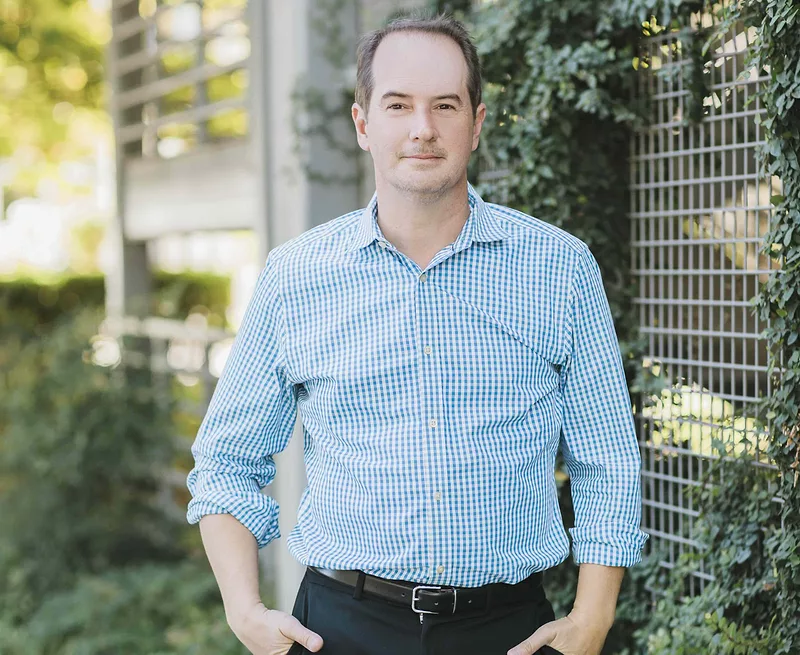
Former Chico Mayor and City Councilor Andrew Coolidge launched his bid for state Assembly District 3 back in December. He was the first of three Republican candidates to begin the campaign for outgoing Republican Minority Leader James Gallagher’s seat.
Coolidge produces home and garden shows across Northern California. He has also run marketing and public relations for events, including the California Peach Festival, California Prune Festival and Butte County Fair, eventually serving on the Butte County Fair’s board of directors. He was born and raised in the Yuba County foothills and started his first business doing local campaign consulting after graduating from Chico State University.
He told Agri-Pulse that he first fell in love with the political process at age 21 after interning at the California Capitol.
This conversation has been edited for brevity and clarity.
Q: What led you to run for Assembly?
If you would have asked me a year ago, I was not running. I was gonna finish out my mayorship. But I realized someone needed to step into the job who had the interest and care and concern that I thought was necessary. And that's not to diminish my opponents; I think they have good backgrounds. At least one of them could also do the job very well. But I don't know necessarily that they have the same depth of concern that I do for some of the issues we're facing up here.
I wanted to announce while I was sitting mayor. But I didn't realize that would spur my competitors to start this crazy campaign so early. It's just May, and we're already contending with one another all over the place. It'll be a long campaign.
Q: What were standout moments from your time on Chico’s city council and as its mayor?
We allocated a lot of money for our roads. Part of that was through a one-cent sales tax, but it was necessary, particularly after the Camp fire. Chico is now doing close to $150 million a year of road improvements, whereas before there were $20 million — which was barely keeping up with the potholes.
In the last two years of my mayorship, we added 45 staff members — officers and assistant staff — to our police department. When I came into office in 2020 that department was pretty well decimated. We had something like 69 police officers; when I left we had [about] 105.
Cut through the clutter! We deliver the news you need to stay informed about farm, food and rural issues. Sign up for a FREE month of Agri-Pulse here.
Q: Describe your relationship with agriculture.
I was a 4-H kid. I didn't raise an animal, but I did a lot of classes. One of the organizations [that] my home and garden show donate money to [has 4-H] kids running our entrance. I donate to Nord Cana 4-H up here in Butte County pretty substantially, so the kids can get the skills of making change at the gate.
Being involved in the Yuba-Sutter and the Butte County fairs for a lot of years, [I saw] agriculture raising [a lot of the] funds for the fairs. I have good relationships with folks in agriculture.
Q: You’re running as a Republican in a Democratic-majority Legislature. How will you get bills to the governor’s desk while navigating this supermajority?
We love being here. We love our towns, and there's a lot of pride in this area. But realistically, there's also a lot of poverty, a lot of unemployment; there's very little job opportunity. So whether it comes to agricultural issues or to social issues like education or health care, we need to look at other areas of the state that are failing. We need to go to the inner city of Oakland … certain areas of LA, of San Diego, other rural counties –– and create coalitions between Republicans and Democrats to move legislation forward that will actually make changes for the rural or downtrodden areas in California. That is not being done, and that has not been done for 20 years [in the] Legislature. And that's what we need to get back to –– that's the only way forward for our area.
I believe the same for agriculture. While you may not be able to contend with LA and San Diego and San Francisco majorities in terms of moving agriculture forward, certainly they have to realize that there's value to agriculture — we all know that California puts half the fresh vegetables of the nation on the table. It's important that we have conversations with Democrats and get legislation moving forward that makes sense. There's a laundry list of regulations that the state has, a way that we approach certain legislation coming out of Sacramento that simply rolls over rural agriculture communities without paying attention to them.
Q: Your policy priorities include creating water storage and maintaining water rights “where they belong.” What is your action plan?
Sites Reservoir [is] obvious. … I want to make sure [Sites] moves forward, and on time, because it's incredibly important in terms of water distribution, and storage is always the issue. We learned that in Oroville with the dam crisis. Some of these things are neglected, whether that be through the Department of Water Resources or through the state of California. Certain regulations [the state wants] for the first couple of feet for salmon runs. All that's understandable. At the same time, it's not understandable when they push legislation that goes against families eating and having enough water to make do for crops both in the Central Valley as well as up here.
Q: Other key issues facing agriculture include the labor shortage, emissions reductions requirements and pest management. How would you address these?
The biggest push back that [farmers are] facing right now is the rising cost of everything: labor, insurance, fuel. Their percentage of profit is usually based on very small margins. … I believe in subsidies for farms [because] there's no ease of entry into the business. You don't one day go, “Hey, I'm going to be a farmer.” We have to protect and fight for these farms to continue to move forward and balance out bad years with their good years so they can still be profitable. We're at times doing the exact opposite in California.
Then, obviously, having to deal with water practices … the regulations, pest issues, there's a whole host of things. Shannon Douglas, president of the Farm Bureau, had a conference — [she] talked about how we need regulations, but those regulations need to come with the farmers sitting at the table. They can't simply just come from the Legislature.
Q: How can the California Legislature work with the Trump administration to address issues pertinent to growers?
It's almost laughable to talk about the Legislature working with Trump, right? And that's the problem.
A lot of people talk about tariffs and their impact. Obviously I'm not for tariffs on agricultural goods. But I think by the time I hit the Legislature at the end of 2026, that will have been wrapped up. It will either be a massive crisis that requires immediate attention, or it's something that will be parsed out by then.
Going back to your question — the Trump administration and California working together — I think there has to be an intermediary. I would like to be the person who could do that and push forward that conversation. There's going to have to be a lot of people at the table, and the state's going to have to come to the table. I think it will if we continue on this path of losing so many farms in California.
Q: What makes you a qualified Assembly candidate?
I've always stuck to my slogan: someone who is calm, experienced and intelligent. Now I know how to do the job. I know exactly what it entails on a daily basis. [I am] very in touch with the folks here, and I plan on having open communication with other leaders in the area.
Q: How are you pacing your campaign?
I was always a very open mayor who responded to every single person. If [people] have a question or they want to share their story with me, I'll sit with them and discuss their concerns.
That's what most people really want out of their politicians. And unfortunately, [that] is missing in today's political arena. It's a majority of the people who hire me and I need to represent their views, [but] at the same time, people who are not in that majority still deserve to get their voice heard.
At this point in time, [the campaign is about] talking to other elected officials. It's talking to people who donate. I really want to focus on locals and small towns and talk to the individual leaders in these various areas and get their support. I find that much better than having a retired senator’s support.
Q: Anything else you’d like people to know?
I could probably go on for 10 hours about all the terrible things facing agriculture. That is not my background; it's something that I have not made my living in. But that doesn't mean I don't recognize and understand its importance in this area, and I would do everything in my power to represent it better than it has been in the past.
For more news, go to Agri-Pulse.com.

