
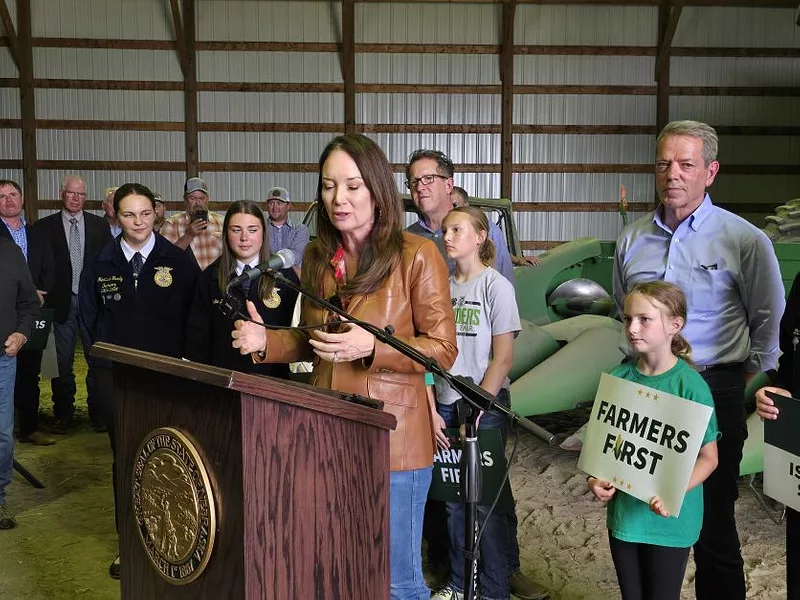
Agriculture Secretary Brooke Rollins says the Trump administration is having internal discussions about what to do regarding farmworkers who are in the country illegally.
Back in April, President Donald Trump said farmers would get some kind of flexibility under his administration’s mass deportation program to keep employing undocumented immigrants. But the administration has yet to follow up publicly on the president’s remarks.
During a stop in Nebraska on Monday, Rollins said she was working on the issue with her counterparts in the Labor and Homeland Security departments. “Our teams are meeting and figuring out how to make that a reality, and what that looks like and what the time frame looks like,” she said.
By the way: Rollins also said Monday that USDA was unlikely to seek another round of staff buyouts. About 15,000 USDA employees have accepted buyouts through two rounds since Trump took office.
Read our report here.
USDA grants first SNAP waiver to Nebraska
In a major victory for the “Make America Healthy Again” movement, Rollins signed off on a Nebraska pilot to prevent purchases of soft drinks and energy drinks through the Supplemental Nutrition Assistance Program.
The pilot is expected to start in January and last for two years.
Following encouragement by Health and Human Services Secretary Robert F. Kennedy Jr., states have introduced and passed bills that seek similar waivers from USDA. Some go further in the number of items that could not be bought using SNAP.
So far, seven states — including Indiana, Arkansas, Texas, Colorado, Iowa and Kansas — have submitted similar SNAP waiver requests.
USTR’s Greer: Potatoes a ‘priority’ in any Japan negotiations
U.S. Trade Representative Jamieson Greer says increasing market access for potatoes is a priority in trade discussions with Japan.
Senate Finance Committee Chair Mike Crapo, R-Idaho, asked Greer in written questions following his appearance before the committee last month whether he planned to include potatoes in ongoing discussions.
“Gaining market access for U.S. fresh potato exports to Japan is a top priority for this administration in any negotiations with Japan,” Greer responded in answers obtained by Agri-Pulse.
Take note: The U.S. potato sector has long accused Japan of dragging its feet on pest risk assessments to limit market access for U.S. potatoes.
Japan was the first major economy to begin trade talks with the Trump administration following the reciprocal tariff announcement. It is currently considering a package of trade demands that could include increased purchases of U.S. corn and soybeans, Reuters reports.
Cut through the clutter! We deliver the news you need to stay informed about farm, food and rural issues. Sign up for a FREE month of Agri-Pulse here.
UK and EU will work to align food standards
The United Kingdom and the European Union will work to create a common sanitary and phytosanitary zone as part of a deal to reset the relationship more than five years after Brexit.
A forthcoming SPS agreement should eliminate certificates or border checks on “the vast majority” of animal and plant trade, according to a “common understanding” document published Monday. The document adds that the scope of the future arrangement will cover pesticide and live animal regulations, as well as food production and distribution.
Further, the U.K. also agreed to “dynamic alignment,” meaning future EU standards will also apply in the U.K., except for a “short list of limited exceptions.”
Why it matters: The U.S. recently unveiled an outline for its own trade pact with the U.K., in which the U.K. agreed to allow some U.S. beef into its market and to work together on further market access for ag.
But U.S. beef exports still have to meet U.K. standards. So, a common U.K.-EU SPS area will likely shape the future regulatory landscape U.S. beef exporters face.
Lawmakers push administration for higher RVOs
Members of Congress are urging the Trump administration to set biofuel volume obligations in line with what a coalition of farm, biofuel and oil groups are seeking.
Under the Renewable Fuel Standard, the agency sets renewable volume obligations for different fuel types like biomass-based diesel, advanced and cellulosic biofuels. The “Set 2” rule setting RVOs for 2026 and beyond is already delayed, and the Environmental Protection Agency recently sent its proposed RVOs to the White House for review.
In a letter to the president, the lawmakers asked the administration to set a conventional biofuels RVO of at least 15 billion gallons, with the biomass-based biodiesel RVO at 5.25 billion gallons in 2026 and increasing in future years.
This is similar to the request a coalition of oil, biofuel and farm groups shared with the EPA in recent meetings.
Take note: Members also asked the administration not to “abuse” its small refinery exemption authority and ensure any granted exemptions have their volumes accounted for in the RVOs to prevent any lost demand for farmers.
Reps. Ashley Hinson, R-Iowa, and Angie Craig, D-Minn., led the letter, which is signed by 26 other members from both parties.
Corteva scientist to discuss AI at House hearing
Corteva Agriscience is employing AI to identify molecules that can be used in crop protection, a company scientist will tell a House subcommittee today.
Brian Lutz, vice president of agricultural solutions, will present testimony to the environment subcommittee of the House Science, Space & Technology Committee. In it, he says the company recently used AI “to model how 10,000 different molecules might be used in crop protection, all within a matter of weeks.”
The model was able to identify “dozens of new potential crop protection molecules that our chemists could not have found otherwise. We are currently testing these now. This is the new face of ag innovation.”
Lutz also will say that with AI, “We can begin to predict the incredible diversity of biomolecules and metabolites that are produced by microbes and other organisms, with the goal of unlocking the secrets within plant biology to develop the next generation of safe, highly targeted, nature-inspired products.”
Final word
“No. 3, ensuring working farmland is used to farm, not to put solar panels from China on top of.” – Ag Secretary Brooke Rollins, outlining a 10-point Small Farms Policy Agenda in Nebraska on Monday. The agenda also calls for streamlining application processes for farmers and ensuring reliable access to credit.
Rebekah Alvey, Oliver Ward and Noah Wicks contributed to today’s Daybreak.


