
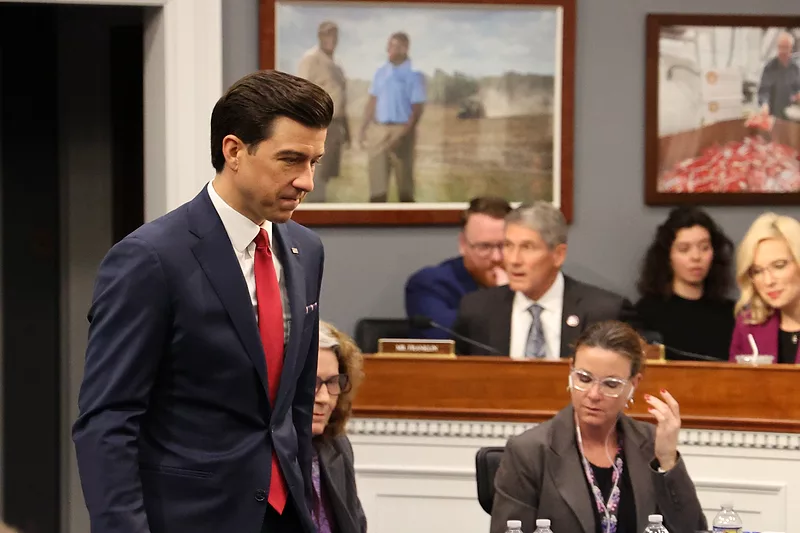
Rubio goes to bat for Lindberg at the UN
Secretary of State Marco Rubio is making the case at the United Nations to push Luke Lindberg’s candidacy to lead the World Food Program.
In a post to X on Tuesday, Rubio said he had spoken with UN Secretary-General Antonio Guterres about the USDA undersecretary for trade and foreign agricultural affairs.
“His appointment is essential to ensuring [the UN] operates with the transparency and accountability required to feed the world,” Rubio wrote.
“I’m ready to get started!” Lindberg responded.
Is a tomato just a tomato?
The International Trade Commission is grappling with this question as it weighs whether antidumping duties on Mexican tomatoes are still necessary to protect U.S. industry.
At a hearing Monday, representatives from trade groups, importers and Mexican growers tried to persuade commissioners that discerning consumers don’t see tomatoes equally. They argued that consumers choose specific tomatoes to meet specific needs, and do not substitute Florida-grown round tomatoes for imported specialty varieties, for example.
Accordingly, they claimed that the antidumping duties on Mexican tomatoes are no longer needed to protect the Florida industry, which has been the most vocal on the issue, because they don’t compete with them directly.
The duties came into effect last year when the U.S. pulled out of a decades-long suspension agreement.
Supporters of the tariffs, however, framed the duties as the only line of defense against rising imports and even lower prices. They also challenged the notion that Mexican tomatoes aren’t directly competing with U.S. producers, arguing that the same varieties from both countries appear side-by-side in grocery store displays.
At least one large producer of premium snack varieties has closed U.S. production because it couldn’t compete with Mexican imports, the supporters noted.
“Without the anti-dumping order, there will be nothing to stop the flood of unfairly low-priced Mexican tomatoes coming into our market,” said Bob Spencer, president of West Coast Tomato.
But the commissioners pressed critics of the duties to lay out what circumstances had changed since 2019, when the commission last found that imports presented a threat.
“What has meaningfully changed?” asked Commissioner Jason Kearns. He said that consumer spending habits were “exactly what we were talking about in 2019, and I spent a lot of time thinking about it. So, I don't see that that has meaningfully changed.”
Trump goes against GOP grain on China and U.S. farmland
President Donald Trump’s recent comment on Chinese ownership of U.S. farmland is putting him at odds with some fellow Republicans.
Trump, in a recent Fox News interview, suggested it would be bad for farmers if the U.S. were to stop China from buying American cropland.
“You want to see farm prices drop? You want to see farmers lose a lot of money? Just take that out of the market,” Trump said.
Chinese ownership of U.S. agricultural real estate has been a hot-button issue for years on Capitol Hill and in states like California and Texas.
“China poses a real threat to Iowa agriculture and our national security,” Republican Rep. Randy Feenstra, who is running for governor in Iowa, posted on social media Tuesday. “It’s why I’ve led the fight to ban China and our foreign adversaries from buying our farmland.”
It’s easy to be “in the know” about what’s happening in Washington, D.C. Sign up for a FREE month of Agri-Pulse news! Simply click here
Sen. Chuck Grassley, when asked about Trump’s remark, referred to his record on the matter. The Iowa Republican has sponsored a bill with Sen. Tammy Baldwin, D-Wis., to address foreign ownership of U.S. farmland. Grassley, in introducing the measure last year, noted potential national security risks of Chinese interests buying agricultural real estate near military installations.
Trump’s position, especially at a time of growing concern over farm bankruptcies, is already being used by Democrats ahead of the high-stakes midterm elections in November.
“Based on our recent poll, farmers are worried about rising input costs, volatile commodity prices, tariffs and the impact that federal policy is having on their farms,” Mike Amato, founder of Amato Advisors who previously worked in the Obama and Biden administrations, told Agri-Pulse. “Farmers want to stay in business and sell their products to China, not their land.”
Energy shortfalls are set to intensify next month, analyst says
Ongoing trade blockages in the Middle East translate into worsening energy shortages in June and July, particularly in Asia, says Arlan Suderman, chief commodities economist for StoneX Group.
“The bottom line is that there is little evidence that the Strait of Hormuz will open any time soon,” Suderman said in a note on Tuesday. “The fertilizer story is more of one for the 2027 global crop cycle, with some localized exceptions,” he said.
Separately, Sen. Chuck Grassley, R-Iowa, said he’ll be pressing the Trump administration to lift tariffs on ammonia and sulfur as American farmers continue to contend with soaring fertilizer prices.
Grassley also reiterated that countervailing duties on phosphate imports from Morocco need to be removed. “Mosaic doesn’t need the protection,” he said.
Senate votes to end war in Iran
The Senate voted 50-47 to advance a resolution that would compel President Trump to end the war in Iran or obtain congressional approval to continue the conflict.
Republicans voting to move ahead with the measure were Sens. Bill Cassidy of Louisiana, Susan Collins of Maine, Lisa Murkowski of Alaska and Rand Paul of Kentucky. All Democrats voted in favor except Sen. John Fetterman.
Three Republicans — Sens. John Cornyn of Texas, Tommy Tuberville of Alabama and Thom Tillis of North Carolina — did not vote.
Keep in mind: Even if the House also agreed to the resolution, Trump would be expected to veto it. But Democrats said it was a sign that support for the war is weakening.
Trump-backed farmer defeats Massie in primary
Kentucky congressman and frequent critic of Trump, Rep. Thomas Massie, has lost the Republican primary for his House seat to Ed Gallrein, a farmer and former Navy SEAL who had been endorsed by the president.
With 96% of votes counted as of Tuesday evening, Gallrein had secured 54.8%, according to the Associated Press. Meanwhile, Massie, a former engineer who has held the seat since 2012, had gotten 45.2%.
Final word
“Nothing is going to help more than getting the Iran war over.” — Sen. Chuck Grassley, R-Iowa, on how to help farmers struggling with high fertilizer prices.
.webp?t=1762183428)


