
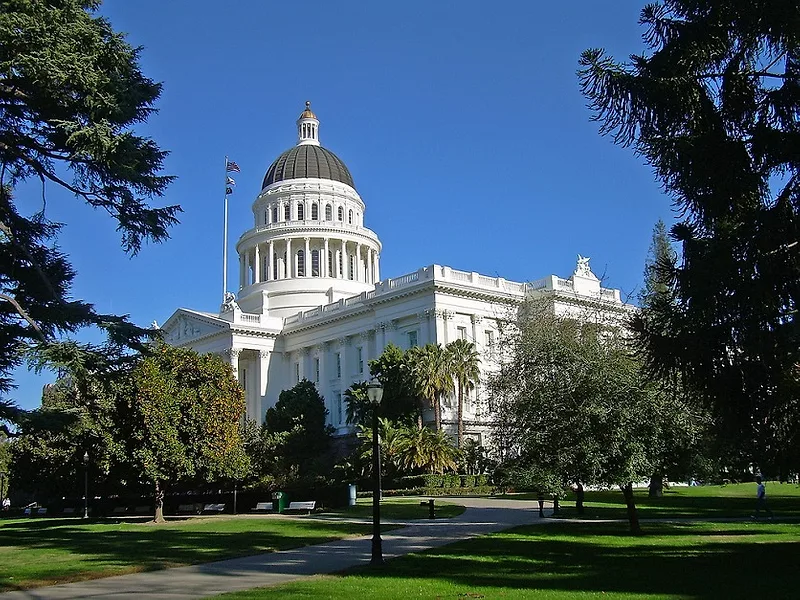
Several proposals to curb regulatory authorities and rein in costs fell by the wayside last week. Appropriations committees quietly blocked the bills from advancing to floor debates this year. Agriculture-backed bills were not spared.
Notably, the California Farm Bureau and the Western Growers Association had joined a push for more accountability in drought orders through Assembly Bill 430. It would have required the State Water Resources Control Board to perform a comprehensive economic and environmental impact study on each emergency regulation before renewing it.
“Economic and environmental data is important to the operations and decisions of the state,” said Assemblymember Juan Alanis, R-Modesto, in a committee hearing last month on AB 430. “We need concrete data of the impacts emergency regulations have on agricultural products, on cattle products, on fisheries and wildlife conservation efforts.”
In her testimony, CAFB policy advocate Alexandra Biering described the bill as “a commonsense step towards greater openness and accountability, without tying the hands of the water board in a true emergency.” Noting that in January the agency readopted a set of instream flow requirements for the Scott and Shasta rivers for the fourth year in a row, Beiring argued the board has been using the regulations as a water management tool long after the drought is over.
The bill had gained broad support in its first and only policy hearing.
Assessing cost-of-living impacts was also at the heart of a bill backed by WGA and the California Cattlemen’s Association. AB 1232 would have required all state agencies to undertake an economic impact assessment on their regulations and verify the accuracy of their reporting through the Office of Administrative Law. Asm. Anamarie Avila Farias, a first-term Democrat from Concord, called the existing processes for such evaluations insufficient and unsuccessful at preventing rising regulatory costs. Her bill had unanimous bipartisan support from two committees.
Likewise, Senator Roger Niello, R-Fair Oaks, hoped to help agencies write better regulations. Yet his second attempt at establishing a counsel to assist in drafting and amending the rules fell victim to the same committee as the first attempt, despite support both times from the California Association of Winegrape Growers.
Republicans also unsuccessfully sought to curtail costs on businesses and consumers by capping electric rate increases at the rate of inflation, which drew support from CAFB and the Agricultural Energy Consumers Association.
It’s easy to be “in the know” about agriculture news from coast to coast! Sign up for a FREE month of Agri-Pulse news. Simply click here.
Another bill on the cutting room floor at the Legislature is Senate Bill 223, a second attempt at tracking the impacts of wildfire smoke on public health and local economies. While such data was unlikely to change the state’s direction on climate policies, proponents hoped it would better inform investments in mitigating wildfire fuels, such as funding for prescribed grazing projects. CAFB supported the measure, along with CCA and the Association of California Water Agencies. Two committees unanimously approved it.
More directly related to climate mandates was SB 496, a bill by Senate Agriculture Chair Melissa Hurtado, D-Bakersfield, to make water providers and other local agencies eligible for exemptions from the Advanced Clean Fleets Rule. Considered quasi state agencies, the districts are still required to convert medium- and heavy-duty trucks to zero-emission models, despite the state rescinding its request for a federal waiver and trimming back the scope of the contentious regulation. Rural County Representatives of California backed the measure, alongside dozens of water districts.
The California Air Resources Board fell into Hurtado’s crosshairs for another bill as well. SB 348 would have tasked the air quality agency with revising its recent update to the Low Carbon Fuel Standard to consider the financial burdens on drivers. According to Hurtado, the “troubling dynamics” behind the update mean that “billions of dollars are flowing into the hands of out-of-state corporations, wealthy investors and industrial agriculture operations — while everyday Californians shoulder the cost.” CARB has refuted claims that the program has led to a dramatic increase in gas prices, and biofuels groups also opposed the assertions, as well as the bill.
Some of the same groups locked arms with several agricultural associations in protest to AB 1305, another attempt by Asm. Joaquin Arambula, D-Fresno, to put more scrutiny on emission reduction credits approved by the San Joaquin Valley Air Pollution Control District.
“The government's No. 1 job is to protect the people we serve, but we are failing to do this for the people in many of our communities,” argued Arambula, while defending his bill in committee debate last month.
Officers for the districts contended the measure would “take precious resources away from programs that actually get emissions reductions,” namely FARMER, a program the valley district often celebrated for its success in converting older tractors and other diesel equipment to newer, less polluting models.
While hundreds of other bills stalled last week, the Appropriations committees gave the green light to more than 700 measures in all. Those that made it through the fiscal gauntlet are now moving through the next lap of the legislative marathon, when lawmakers race through bills in a flurry of floor sessions to lob measures to the other chamber ahead of next week’s deadline.
For more news, go to Agri-Pulse.com.

