
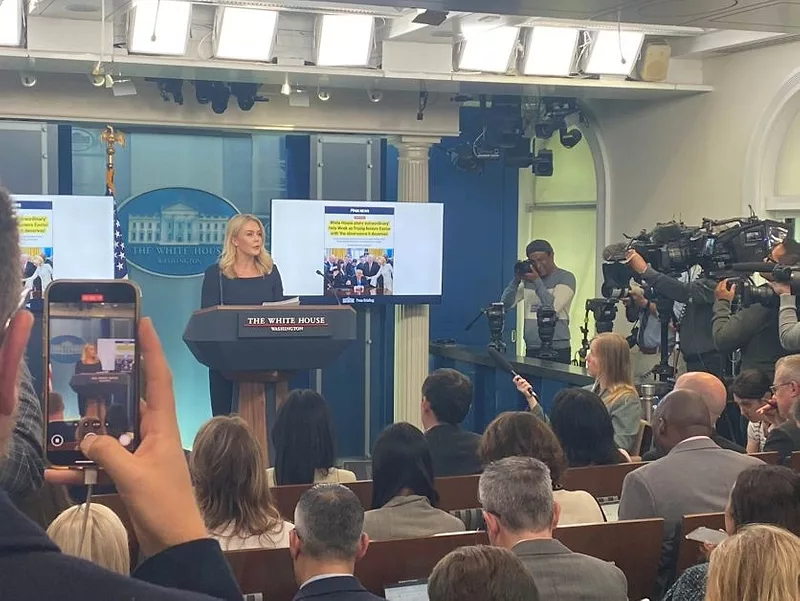
The White House is downplaying a report that found problems with dozens of citations in the Make America Healthy Again Commission report.
On Thursday NOTUS reported that at least seven cited sources did not exist. Dozens of other citations had other issues like incorrect authors and broken links, while other cited studies were mischaracterized.
When asked about the story during a press briefing, press secretary Karoline Leavitt said there were “formatting” issues that are being addressed, but they should not detract from the report’s substance.
Calley Means, a special adviser to the White House and a key figure in the MAHA movement, echoed Leavitt’s defense but said on social media that the “formatting errors” had been corrected. “The MAHA report's underlying data and conclusions are correct,” Means wrote on X. “It's telling that the critics of this groundbreaking report don't want to engage with the substance.”
Take note: While not an erroneous citation, the report does refer to a Foundation for Government Accountability estimate on expected spending by SNAP participants on sugar-sweetened beverages in FY2025. FGA’s affiliated lobbying arm has long backed efforts to cut back on SNAP and Medicaid at the state level. Recently, the group has reportedly backed state bills that would restrict purchases of soft drinks through SNAP.
Citing FGA, the commission report states that “by one estimate, nearly twice as much will be spent by SNAP on [ultraprocessed foods] and sugar-sweetened beverages ($21 billion) compared to fruits and vegetables ($11 billion) in FY2025.” The FGA analysis cited by the MAHA report came up with that estimate using USDA data and the "author's calculations."
The MAHA report also cites a USDA analysis on SNAP spending that was published in 2016 and uses purchasing data from 2011. USDA data show that soft drinks were the top commodity purchased by SNAP households, making up about 5.44% of expenditures. However, USDA also noted it could not separate out purchases made with the SNAP EBT card from purchases using other payment methods.
Former ag secretaries: Farm bill coalition was dismantled before reconciliation
Lawmakers sounded the alarm months ago that the House’s reconciliation bill slashing SNAP spending would break apart the historic rural-urban farm bill coalition.
Ag secretaries from the administrations of former presidents Bill Clinton and George W. Bush, Dan Glickman and Mike Johanns, agree that the coalition was split far before Congress reached the reconciliation vote. Now, they’re pessimistic a complete farm bill will ever be passed again.
It’s easy to be “in the know” about what’s happening in Washington, D.C. Sign up for a FREE month of Agri-Pulse news! Simply click here
“If you look into the reconciliation bill and start peeling back the onion, it's pretty amazing to me how much farm bill was put into the reconciliation bill,” Johanns said.
“So it looks to me like the coalition broke up… I think Chairman Thompson said, ‘Look, this is the only train leaving this station. So I've got to get on top of this and try to get some things done through reconciliation.’”
Glickman said if farmers are worried about if will there be another farm bill this year or next year, “They should be worried.”
As the Senate begins its turn in the reconciliation process, Glickman predicts the chamber will offer a less generous boost to commodity spending and minimize cuts to the nutrition program, which he says is “fraying right before our eyes.”
New day, new tariff regime
The Trump administration snatched victory from the jaws of defeat Thursday when it secured a court decision allowing its “Liberation Day” tariffs to remain in place.
The legal fight over tariffs is by no means over, but the Federal Circuit Court of Appeals on Thursday stayed a decision the day before from the U.S. Court of International Trade. The trade court had enjoined implementation of 10% global tariffs and higher tariffs on China, Canada and Mexico.
At issue is Trump’s use of the International Emergency Economic Powers Act to impose the tariffs. The trade court said IEEPA doesn’t give Trump “unbounded authority” to impose duties on other countries.
The issue is likely to wind up being decided by the Supreme Court, which would be the final stop after the Federal Circuit Court of Appeals, which has jurisdiction over international trade cases.
Where’s USDA ag trade forecast?
USDA failed to release its quarterly agricultural trade outlook as scheduled on Thursday afternoon. A statement from the department’s press office said the forecast was still “under final review.
In February, USDA estimated the ag trade deficit would reach $49 billion in FY2025.
USDA releases ELRP payments
USDA is releasing $1 billion in Emergency Livestock Relief Program payments for 2023 and 2024.
The funding comes from the American Relief Act passed in December and will be used to compensate producers for grazing losses due to drought and wildfire events.
According to a press release, payments will be factored at 35% due to expected high demand. The agency may issue a second payment if additional funds remain.
Take note: Producers who had already had Livestock Forage Disaster Program applications approved for 2023 and 2024 will have their payments automatically issued.
There’s more: USDA will announce ELRP assistance for flooding and other losses later this summer, according to the release.
HHS cancels $766 million for human avian flu vaccine
The Department of Health and Human Services has canceled about $766 million in contracts to Moderna for development of a human avian flu vaccine.
The company announced the cancellation Wednesday in a news release touting results of trials for its vaccine.
The termination of the HHS funding “adds uncertainty” to the vaccine’s development, said Moderna CEO Stéphane Bancel. However, he added, “We are pleased by the robust immune response and safety profile observed in this interim analysis of the Phase 1/2 study of our H5 avian flu vaccine and we will explore alternative paths forward for the program."
The likely reason for the cancellation is Moderna’s use of mRNA technology, which has been in the crosshairs of the Trump administration — HHS Secretary Robert F. Kennedy Jr. in particular.
KFF Health News reported in March that officials at the National Institutes of Health had advised grant applicants to scrub any mentions of mRNA technology from applications.
In its release, Moderna said, “These clinical data in pandemic influenza underscore the critical role mRNA technology has played as a countermeasure to emerging health threats."
Final word
“We're at a strange junction point when it comes to passing farm policy.” – Dan Glickman
Rebekah Alvey, Philip Brasher and Noah Wicks contributed to today’s Daybreak.


