
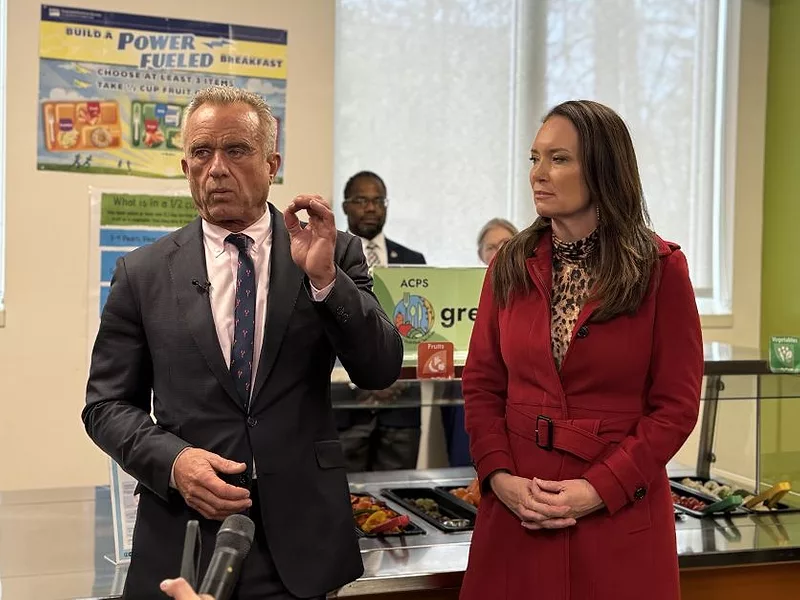
Statehouses across the country are going “MAHA” -- considering dozens of bills that could potentially limit food dyes, seed oils, ultra-processed foods and soft drinks in federally supported nutrition programs.
Over the last several months, state lawmakers in red and blue states have introduced measures that align with policies touted by Secretary of Health and Human Services Robert F. Kennedy Jr. under the "Make America Healthy Again" banner.
Some ideas are not new and history has shown it is difficult to pass them on a federal level. But Kennedy has thrown his support behind state efforts in a public way by hosting public events in states pushing the legislation.
One bill being considered in at least 17 states would add restrictions on purchases in the Supplemental Nutrition Assistance Program. The bills direct state agencies to seek waivers from USDA to restrict purchases on certain foods. Many are limited to candy or soft drinks but some, like a bill in Indiana, would expand restrictions to chips, prepared desserts and more.
Governors in Nebraska and West Virginia have signed letters of intent to request such waivers. In Utah and Idaho, bills pushing for waivers have passed their legislatures.
The list could grow, following recent appearances by Kennedy where he encouraged states to file for waivers, promising the administration would grant them.
USDA, not HHS, has authority to grant waivers. However, Agriculture Secretary Brooke Rollins has so far been in lockstep with Kennedy when it comes to MAHA.
Gina Plata-Nino, SNAP deputy director at the Food Research and Action Center, said this has been the most traction on SNAP restrictions the group has observed.
However, she said restrictions are not effective on multiple levels. For one, it takes more manpower and communication for retailers. Some details on what foods would not qualify for SNAP are vague, and retailers would need detailed guidance that is regularly updated on new products.
Such restrictions could be an additional burden on small grocers that can be the only food source in rural communities, she said.
It’s easy to be “in the know” about agriculture news from coast to coast! Sign up for a FREE month of Agri-Pulse news. Simply click here.
“If any ... extra burden gets added to them, we're concerned that they will not want to participate in the program, and that means less access for people within that geographic location, which will create a lot more issues in terms of food insecurity,” Plata-Nino said.
It also puts additional burdens on state SNAP agencies that are already struggling to meet current guidelines, she added.
Ultimately, the biggest challenges to a nutritious diet are food access and price, Plata-Nino said. She said participants want fresh fruits and vegetables, but they are often more expensive – and will likely be more costly after new tariffs are implemented.
The issue of SNAP restrictions is not new for many Republicans but has become more mainstream since Kennedy became part in the Trump administration.
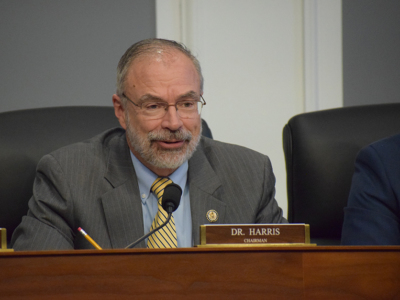 Rep. Andy Harris, R-Md. (Agri-Pulse photo)
Rep. Andy Harris, R-Md., who chairs the House Agriculture Appropriations Subcommittee, has repeatedly but unsuccessfully pushed to include SNAP restriction pilots in spending bills.
The House Freedom Caucus, which Harris chairs, released a letter to Speaker Mike Johnson on its expectations for his tenure. Among those was a reversal of the “massive subsidization of unhealthy foods” in SNAP to save taxpayer dollars and address chronic diseases.
Still, Congress generally recognizes logistical challenges to implementing SNAP restrictions.
Asked about state bills advocating waivers, House Agriculture Committee Chair Glenn "GT" Thompson, R-Pa., said it’s not a “functional proposal.” He doesn’t anticipate federal action on restrictions, citing a lack of a concrete definition of “nutritional” and efforts by the snack food industry to make items healthier.
Bans on ultra-processed foods and more
Additional proposals in state legislatures touch on other MAHA issues.
Several states have introduced bills that would ban food dyes and ultra-processed foods in school meals or more broadly. They appear in California, Arizona and West Virginia.
It’s not surprising that governors or state legislators want to capitalize on the MAHA movement. But industry groups say attacks on ultra-processed foods and some ingredients are not grounded in science.
“We're seeing just this proliferation of state bills that are, I think, trying to be in service of something that is a big political platform, but is missing a lot of the really important detail around the safety of the products, why we process food, how food is available to consumers across the country, and allowing our members and our industry to innovate so that as consumer preferences change, we can do that,” said Sarah Gallo, who oversees policy and federal affairs at Consumer Brands Association. “But we can't do that absent a science and risk-based system.”
 Sarah Gallo (CBA photo)
She said CBA is pushing for science-based federal standards for consumers and businesses when it comes to things like ultra-processed foods. Absent those, there’s concern it could create challenges for businesses and consumer confusion.
Additionally, there is a lack of consistency on the definition of ultra-processed foods in different state bills. In Arizona’s bill, for example, it classifies an ultra-processed food as FD&C colors in school meals. California’s bill includes eight different criteria points about if the chemicals show up in the food substances database. A similar bill in Texas defines ultra-processed foods as those with FD&C colors, plus four additional ingredients.
“There is no uniformity,” said John Hewitt, senior vice president of state affairs at CBA.
Challenges defining these foods in state law mirror issues faced by the Dietary Guidelines for Americans. The advisory committee that drafts a scientific report for the guidelines declined to make a recommendation on ultra-processed foods because of a lack of definitive research.
Efforts to restrict SNAP or address food chemicals are not new but are taking a new focus with the MAHA movement, Gallo said. Under a new, more political umbrella, she said conversations have turned from science to ideology.
“If we want to have a conversation about making America healthy again, like we've already showed up to that table, we want to stay at that table,” Gallo said. “But what we can't do is have this patchwork that's going to erode our ability to make positive changes on behalf of consumers.”
The School Nutrition Association is concerned about unintended consequences of the state legislation, said Diane Pratt-Heavner, SNA director of media relations. Not only would some bills create different standards for school meals from one state to another, they also would set different expectations for foods at schools versus food sold at restaurants and food stores.
Schools are already preparing to comply with Biden administration-era rules that limit added sugar and sodium. Pratt-Heavner said there’s concern that companies will pull out of supplying the school meal market, which would limit menu options for schools.
“That could have a big impact on schools' ability to meet these regulations,” Pratt-Heavner said. “Fewer menu options, higher prices, fewer kids eating these meals that are proven to be the healthiest meals that Americans are eating today.”
If these bills are enacted, Congress would need to provide more money for schools to expand scratch cooking and fresh-prep efforts, she said, as schools struggle to cover costs.
Bills aim to cut down on seed oils
There also have been efforts to address seed oils. For example, lawmakers in Iowa re-introduced a bill that would ban margarine and seed oils in school meals.
A bill in Louisiana includes a ban on ultra-processed foods in school meals, instructs physicians to complete continuing education on nutrition, and directs a state agency to request a waiver to ban soft drink purchases in SNAP. The bill also would require food service establishments to disclose the use of some seed oils on menus.
Kennedy and MAHA allies have targeted seed oils as a source of chronic illness among Americans, particularly children. During his confirmation hearing, FDA Commissioner Martin Makary suggested the need for more research on seed oils and health outcomes.
Seed oils include soybean, corn, canola and sunflower products. Kennedy has supported using alternatives like beef tallow in place of vegetable oils.
Bills like Iowa’s are opposed by groups such as the Iowa Soybean Association.
“Despite recent claims suggesting potential risks, scientific evidence consistently supports the role of vegetable oils like soybean oil in promoting cardiovascular health and reducing the risk of chronic conditions,” said Katie Hall, ISA’s senior director of advocacy, in a press release. “As a soybean producer, your product plays a key role in feeding our future generations and should be protected for use in school meals.”
So far, there has been little change when it comes to seed oil use. Firms that have shifted from seed oils, like Steak n Shake, have received public support from Kennedy.
Shortly after the chain announced it would switch to tallow, Kennedy visited one of the restaurants with Fox News.
The main concern among industry groups is the impact the anti-seed-oil rhetoric could have on public perception. While seed oil bills face an uphill battle, there’s concern about reputational harm, according to an industry source, and concern it could create a patchwork that would be challenging for food companies to operate in some states.
Many of these bills could be an attempt to capitalize on the MAHA movement to appeal to the administration. Based on Kennedy’s visits to states pushing these bills, it appears to be working.
For more news, go to: www.Agri-Pulse.com

