
The Legislature is threatening to unravel last year’s grand compromise to reform California’s notorious PAGA law, warns a coalition of farm and business groups. Labor advocates hoping to boost wage protections, however, see their bill as unrelated to the Private Attorneys General Act and the effort to rid the state of litigation abuse.
The 2004 law allows aggrieved employees to sue over alleged labor violations on behalf of the state. A decade after passing PAGA, the state was averaging about 4,000 violation claims per year, according to the Labor and Workforce Development Agency. Over the next decade, nearly $10 billion was awarded through PAGA court cases, with workers receiving just a third of the money. The flurry of lawsuits drove the Western Growers Association and several other trade groups to describe PAGA as broken, since employers saddled with the lawsuits often agree to substantial settlements to sidestep the legal costs and avoid hefty penalties.
The growing burden on farmers drove WGA to join a coalition last year that successfully placed a proposal on the November ballot to replace PAGA with alternative enforcement mechanisms. The California Chamber of Commerce spearheaded the effort in partnership with associations for grocers, manufacturers, restaurant owners and retailers.
The threat to rescind PAGA propelled Gov. Gavin Newsom and state lawmakers to strike a legislative compromise last summer that would limit the lawsuits while streamlining the PAGA process for workers. The coalition, in turn, pulled the ballot proposal.
Farm groups celebrated the deal as a landmark achievement, ushering in the most significant reforms to hit PAGA in its 20-year history.
 Ashley Hoffman (photo: CalChamber)
“Far too many ag employers have been on the receiving end of these shakedown lawsuits and have spent millions of their hard-earned dollars in attorney fees to make them go away,” said Daniel Hartwig, president of the California Fresh Fruit Association, in a statement following the announcement.
Newsom called it “a big win for both workers and businesses.”
The agriculture industry has been racing to catch up on the new policies. Yet those companies have now returned their attention to the Legislature, where lawmakers propose several measures every year to enhance worker protections and rights.
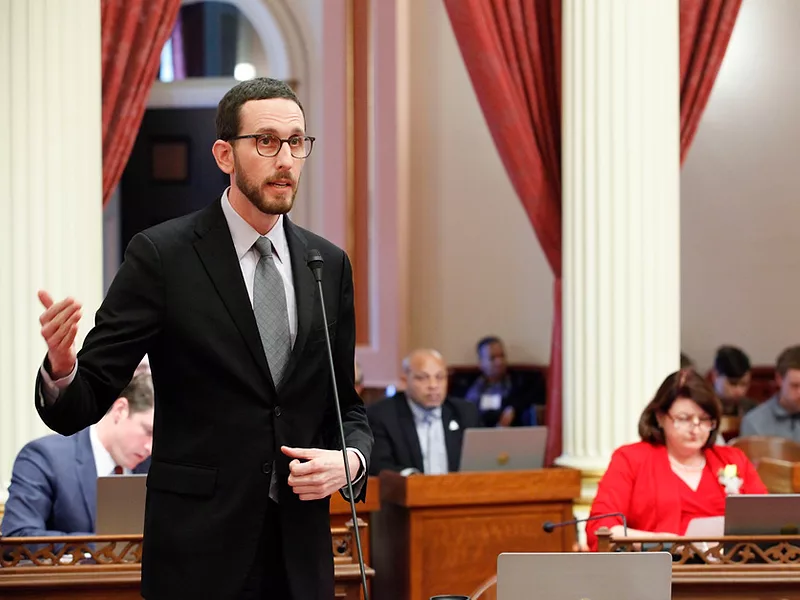
The most prominent of the labor bills this year is by Senator Scott Wiener, D-San Francisco, who wants to help workers recover penalties from employers who fail to pay wages on time. Through Senate Bill 310, he is seeking to grant a right to independent civil actions — the same litigation tool pioneered through PAGA and later downsized under the reforms.
Currently workers must file a claim through the labor commissioner’s office. But the extensive backlog has delayed the process, with workers typically waiting two to five years to secure a hearing date. Wiener also pointed out that workers can speed up the process by filing a PAGA action in court. Yet that would deliver just 35% of the penalties, which would “not make it even worth it.” The rest of the money goes to the state.
It’s easy to be “in the know” about what’s happening in Washington, D.C. Sign up for a FREE month of Agri-Pulse news! Simply click here
“Late payment of wages — whether the check bounces or they just don't pay them, whether it's a matter of days or weeks — has profound ramifications for low-wage workers,” Wiener said, during an April policy committee hearing introducing SB 310. “That's the difference between being able to pay rent and potentially getting evicted or being able to put food on the table.”
Without the penalties, he argued, the employers have no incentive to pay workers in a timely fashion.
Alexx Campbell, a senior staff attorney at Legal Aid at Work, a nonprofit providing free legal services and advocacy for low-income workers and a cosponsor on the bill, described the “very real knock-on effects.” One older client of his had to borrow money from family and friends to make ends meet, destroying those relationships when he was unable to repay the loans. A young woman paying for college by working at a Subway restaurant was forced to drop out of school. In Los Angeles, explained Campbell, as many as 42% of workers surveyed said they had experienced some form of wage theft and 27% had been paid late.
It can be more challenging for farmworkers, claimed Verónica Meléndez, who directs the labor and civil rights unit at the California Rural Legal Assistance Foundation, the other cosponsor. She said the labor commissioner’s Fresno and Salinas offices suffer from insufficient staffing, adding further delays.
“SB 310 does not touch PAGA,” Meléndez tried to assure lawmakers. “It doesn't change it and doesn't amend it at all, neither does it increase the amount of the penalty that has to be paid.”
Yet the specific code targeted in the bill featured prominently in the conversations over reforms, according to CalChamber senior policy advocate Ashley Hoffman. She argued that updating those provisions was vital to the legislative compromise, which included penalty caps for good actors and for violations involving only brief wage delays, and that the bill would bypass those caps.
“To now take a bill — less than one year later — and pull out those provisions, from our perspective, is a complete undermining of the reform that we worked so hard, for many years, to accomplish in this Legislature,” said Hoffman. “What it tells the employer side is that even if you make a deal again months later, it could start to be unwound by a new bill.”
Dozens of business associations backed CalChamber’s opposition to SB 310, including WGA, the Agricultural Council of California and the California Farm Bureau, along with food processors and winemakers. They warn the bill would encourage more frivolous lawsuits and litigation abuse and enrich trial lawyers at the expense of workers and small businesses.
“Californians should be able to trust that thoughtful negotiations, producing sound public policy, are more important than back-room political dealmaking,” said WGA President and CEO Dave Puglia, in a joint statement last week with CalChamber President and CEO Jennifer Barrera and leaders representing grocers, new car dealers, restaurant owners and retailers.
The bill survived a critical vote last month out of the Appropriations Committee and is on the Senate floor this week for a full chamber vote before advancing to the Assembly.
For more news, go to Agri-Pulse.com.

