
A delegation of Democrats in Congress and the Legislature are pressuring state lawmakers to reject the governor’s proposal to fast-track environmental permitting and judicial reviews for the tunnel project through the Sacramento-San Joaquin Delta.
Farmers and their water suppliers stand on all sides of the issue — as entrenched opponents, as the less vocal lynchpin in a broad coalition of backers, and as the targets of water shaming.
The long-simmering sentiments once again boiled to the surface in April, when Gov. Gavin Newsom unveiled trailer bill language on the Delta Conveyance Project, as he rebranded the tunnel plan after taking office in 2019. Despite the downsizing, Newsom has been the project’s most outspoken advocate.
As a central component in the State Water Project, the tunnel would ensure a more reliable supply of irrigation water to 750,000 acres of south-of-Delta farmland and drinking water to 27 million people, primarily in the Los Angeles and San Diego regions.
In 2023 he persuaded the Legislature to approve a package of bills to streamline environmental permitting and the process for reviewing lawsuits for a range of infrastructure projects. It sped up approvals and court reviews for the Sites Reservoir project. But an outspoken cohort of lawmakers representing portions of the Delta inserted language to bar the tunnel project from benefitting. While some of those legislators have termed out of office, their replacements have only been more ardent in their criticism.
The California Department of Water Resources, meanwhile, took the traditional route to advance the project. It finalized the environmental plan last year and has gained permits under the California Environmental Quality Act and the California Endangered Species Act. Yet the administration continues to share frustration over the slow pace and claims the “path forward is burdened by complicated regulatory frameworks and bureaucratic delays.” The project has also been navigating legal challenges from environmental groups and Delta farmers, who worry about the impacts on groundwater quality due to the construction and from taking land out of production to accommodate the new pumping infrastructure.
At a press conference in April, Newsom called the tunnel “one of the most important projects in the United States of America and one of the most important climate adaptation projects in this country.”
The water backers and the environmental and tribal detractors
The announcement ushered a wave of applause from water contractors. Jennifer Pierre, general manager of the State Water Contractors, described the review process for major infrastructure projects as “hampered by red tape and frivolous delay tactics for decades.” SWC claims Newsom’s proposal would save $354 million for every year of delays the state would avoid. The California Chamber of Commerce also shared praise for speeding up critical infrastructure projects to strengthen the economy.
 Sen. Rhodesia Ransom, D-Tracy (photo: Ransom's office)
Martin Milobar, who directs the Kern County Water Agency and chairs the Delta Conveyance Design and Construction Authority, said implementing processes to reduce costs is "critical to maintaining a thriving agricultural industry in California. We cannot afford any more costly and unnecessary delays.”
It’s easy to be “in the know” about what’s happening in Washington, D.C. Sign up for a FREE month of Agri-Pulse news! Simply click here
Yet the Legislature’s Delta Caucus, which has risen to prominence in the wake of the announcement, echoed longstanding concerns from environmental critics like Restore the Delta. The group has called the project a costly boondoggle and disputed the promotion of it as a climate-resilient solution. It has claimed that Newsom struck a backroom deal with President Donald Trump “to pump the Delta dry.”
In March DWR Director Karla Nemeth pointed out that both leaders are interested in investing in projects to expand and improve water infrastructure. Yet the commonalities end there. Trump has routinely criticized Newsom for not putting more support behind water storage efforts and has not taken a position on the Delta tunnel project.
Restore the Delta also called the plan “a reckless attack on democracy” to support industrial agriculture and wealthy water agencies. Sportfishing groups and Northern California tribes were just as incensed about Newsom’s trailer bill.
The Delta Caucus has endorsed many of the claims from the groups. Senator Jerry McNerney, D-Pleasanton, blasted the proposal as “poorly conceived” and warned the project would destroy 4,000 acres of farmland and lead to skyrocketing utility bills.
Assemblymember Rhodesia Ransom, D-Tracy, claimed the proposal would override legal protections, violate property and water rights, and bypass public oversight. She vowed to launch an audit into DWR in partnership with Restore the Delta.
Last month the two lawmakers hosted a lengthy press conference ahead of a budget subcommittee hearing on the trailer bill.
“The tunnel is being advanced to benefit agricultural interests in other regions, interests helping fund the very effort to divert water away from the Delta,” said Ransom. “Let's be clear: shifting water from one farming region to benefit another farming region doesn't solve our water crisis. It only makes it worse.”
Sen. Christopher Cabaldon, D-Yolo, charged that expanding DWR’s bonding authority “under the dead of night,” as proposed in a trailer bill rather than a standard policy bill, would be like writing a blank check to the governor. He asserted the $20 billion cost is certain to go up, since the state has a track record of going over budget on large projects. He said agricultural users in the San Joaquin Valley would get just 38 cents back on the dollar for their investment.
Elisia De Bord, who is the governmental relations and legislative officer for Sacramento County and coordinates the Delta Counties Coalition, speculated that the project could balloon to $60 billion or more.
Democratic Congress members have stepped in as well. Representatives Mike Thompson, Doris Matsui, John Garamendi, Mark DeSaulnier, and Josh Harder voiced strong opposition last month and advocated for alternatives they viewed as less costly and more forward-looking, such as increasing water storage capacity, modernizing existing conveyance infrastructure to limit evaporation, and increasing water use efficiency.
Delivering more water, more quickly
Nemeth, who also serves as the governor’s senior advisor on water, took the spotlight in the Legislature at the subcommittee hearing to defend the project.
A seasoned advocate for the tunnel, Nemeth has touted it for more than a decade as DWR director. She had explained to lawmakers in April the cascading nightmare scenarios she envisions if the state does not step up to build a tunnel.
Nemeth said California averted a disaster in 2023, when it suddenly shifted from extreme drought to one of its wettest winters on record. DWR expected the shadow of the incoming atmospheric rivers would roll over the Golden Gate Bridge, with rain saturating Northern California and draining south through the state’s water projects.
Instead it “slammed the central Sierra.” At 200,000 cubic feet per second, the stormwater threatened to topple Delta levels, she explained. That would have led to saltwater intrusion into the Delta and into the conveyance canals of the water projects, compromising the water supply for potentially months while failing to capture the much-needed runoff to replenish reservoirs. Such a scenario would have been “a real failure of government, in my mind,” said Nemeth.
“Fundamentally, the need to address the vulnerability of the Delta in delivering water is an issue that has been around for a while,” explained Nemeth at the subcommittee hearing. “Three governors have moved a version of this project forward.”
Yet many were reluctant to take a position on the tunnel, since it is “one of the most controversial things in California.”
With the changing climate, the project has grown in importance. Nemeth warned that droughts will come back and “will in all likelihood be deeper and longer,” making it more important than ever for the state to move more water in wet years to bank underground and in reservoirs.
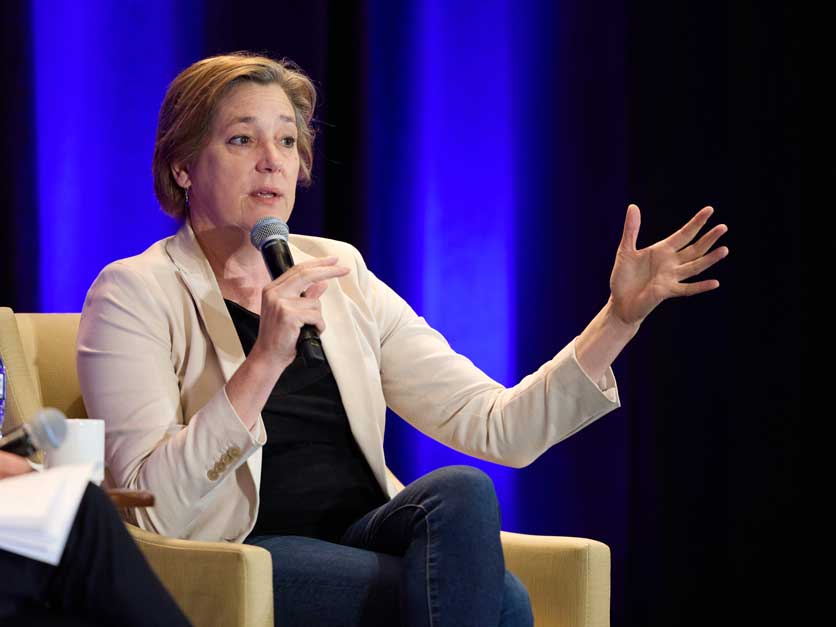 DWR Dir. Karla Nemeth (photo: Agri-Pulse)
Nemeth corrected many of the Delta Caucus assertions, pointing out that the proposal is not suddenly new and was before the body just two years earlier. She stressed that it is not a CEQA waiver that would exempt the project from the comprehensive environmental analysis.
Taxpayers would not pay for the project, but a subset of water contractors would finance it through revenue bonds with “lots of contractual agreements” that they would separately vote on. DWR officials also stated the state would not take any farmland to build without fair compensation and, under the proposal, would be able to purchase properties above the fair market value.
Nemeth also shot down claims the project would not have to comply with the Delta Reform Act and said it is subject to public review through the independent Delta Stewardship Council.
She said the department has delivered "an extremely solid cost estimate" of $20 billion, with a 37% contingency built in, but acknowledged inflation could boost it further over the coming decade. DWR has also adopted a novel design approach that promises to trim a billion dollars in costs.
“The reality is, for this project, the benefit-cost ratio is two-to-one,” said Nemeth. “The State Water Project continues to be some of the most affordable water in the state.”
She noted the benefits of being able to take bigger gulps when excess water is flowing from the rivers. Earlier this year about 200,000 cubic-feet-per-second of water was rushing through the Delta but regulations protecting endangered fish species from the intakes required the state to “turn down” the pumps to around 3,000 cubic-feet. The tunnel would cut in half the amount of water lost through such a scenario, she estimated.
The debates over the tunnel project will likely extend well into the summer. The Legislative Analyst’s Office is recommending lawmakers take more time to consider the proposal in depth, rather than approving it with the budget framework the Legislature must approve by June 15.
For more news, go to Agri-Pulse.com.

