
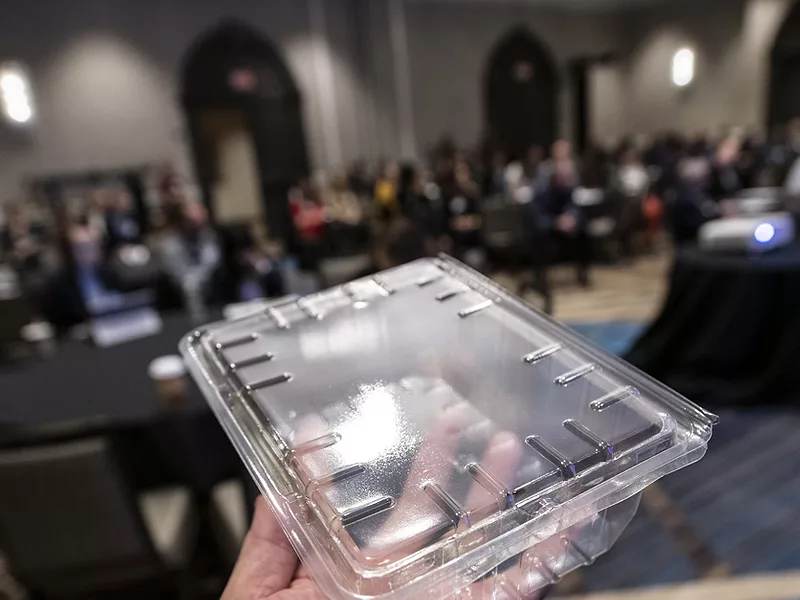
As California pushes forward with a landmark law to reduce plastic waste and transform the packaging industry, a new front has emerged in food and agriculture. Stakeholders from across the composting, farming, grocery and packaging sectors are voicing concerns that the latest version of the rules could raise costs, confuse consumers and lead to more plastic in the soil on farms.
The debate centers on the state’s evolving regulations to implement Senate Bill 54. The 2022 law mandates that all packaging sold in California be recyclable or compostable by 2032, shifting the financial burden from ratepayers to producers. As the rulemaking advances, the intricacies of how food-related packaging fits into the system are drawing fierce scrutiny.
Composters sound the alarm on contamination
“We need to keep plastics out of compost,” warned Neil Edgar, executive director of the California Compost Coalition, during a meeting last week of the California State Board of Food and Agriculture.
Edgar noted that agriculture is already the largest market for compost in the state, and residual plastics — especially from mislabeled or misdesigned compostable food packaging — pose a major barrier to growth.
The stakes are rising as SB 1383, the state’s 2016 methane law, and Assembly Bill 1201, signed in 2021 to clarify composting standards, accelerate organic waste diversion from landfills to composting facilities. Edgar pointed to a 66-page National Organic Standards Board report that flagged concerns about paper and fiber-based food service ware, which often includes undisclosed chemical additives under federal food contact rules.
“There appears to be, based on this report, a significant threat to compost quality from paper and fiber food service wear as well, not just plastics,” said Edgar, who called for tighter labeling, clear standards and transparency in what is allowed in compost systems.
 Adam Regele, CalChamber (photo: CalChamber)
Retailers fear rising food prices, compliance confusion
Grocery store operators and distributors echoed Edgar’s concerns from a different angle: the fear of ballooning compliance costs. Daniel Conway, vice president of government relations at the California Grocers Association, said grocers are already seeing disruptions from mandates to shift to compostable bags, which have been costly and difficult to source.
“We're having conversations across the street with legislative leadership about what can we do to make groceries more affordable — and at the same time, we see SB 54 coming down the line and we’re profoundly concerned about the impact that it’s going to have on, frankly, not just our members but our consumers,” said Conway.
Without flexibility or exemptions, retailers could be forced to remove products from their shelves or absorb new compliance burdens, the industry warns.
The evolution of clamshells and salad bags
A major flashpoint in the rulemaking discussion is the fate of common food packaging like plastic clamshell containers and flexible salad bags — ubiquitous in California's produce aisles but problematic under SB 54’s draft recyclability criteria.
Industry advocates, including the California Chamber of Commerce and food brands, argue these formats are essential for maintaining food safety, extending shelf life and transporting perishable goods.
It’s easy to be “in the know” about what’s happening in Washington, D.C. Sign up for a FREE month of Agri-Pulse news! Simply click here
Growers have been hard pressed to find alternatives that are just as protective and lightweight as plastic, according to Rick Tomlinson, president of the California Strawberry Commission.
“There is a cardboard clamshell made,” he explained. “You have to coat it with plastic. If you don't, it absorbs the moisture out of the berries and then you'll get structural collapse.”
Yet environmental and circular economy advocates warn these materials lack viable end markets and recycling infrastructure, and, if granted a categorical exclusion, could undermine the law.
Debate over exemptions for food packaging
Throughout the board hearing, as well as two days of CalRecycle workshops the prior week, one of the most hotly contested elements in the discussions was whether certain types of food packaging — especially those required for food safety under FDA or USDA standards — should be categorically excluded from SB 54’s requirements.
The California Chamber of Commerce, grocers and food producers strongly support the exclusion, arguing they’re essential for shelf-stable items, raw meat, dairy and medical products.
“We shouldn’t demonize the very folks feeding everybody, but push them to get more sustainable,” said Adam Regele, vice president of advocacy and strategic partnerships at the California Chamber of Commerce.
Yet Jennifer Fearing, a lobbyist for the Monterey Bay Aquarium, the Ocean Conservancy and the advocacy organization Oceana, instead called for an exemption process, in which producers must qualify ahead of time. A broad exclusion, she argued, would mean the environmental watchdogs could challenge the compliancy of a package only after it shows up on store shelves.
 Katie Davey, Dairy Institute of California (institute photo)
Milk cartons: The recycling question
Another packaging format drawing scrutiny is the milk carton — often made from layered paper, plastic and sometimes aluminum.
Some environmental advocates raised concerns that, despite their fiber-based appearance, milk cartons often contain plastic or polymer linings that make them difficult to recycle in practice. CalRecycle staff acknowledged the issue, noting that some jurisdictions accept them while others don’t, creating confusion and inconsistent end markets.
Packaging industry representatives argued that many carton types are technically recyclable and that the infrastructure is evolving. They warned against blanket disqualifications that could penalize producers using otherwise efficient and shelf-stable formats.
“They’re prized for their stackability and their portability,” Katie Davey, executive director of the Dairy Institute of California, told the board. “This is a huge problem for our members, who will have to look to transition their lines from cartons to plastic, if we are not able to restore the recycling symbol.”
Those retrofits cost up to $140 million, at a 40% cost increase for the packaging, she added.
Stakeholders in the workshop urged CalRecycle to provide clarity on whether milk cartons fall under the state’s covered material list and what standards must be met for them to qualify as recyclable. The issue underscores the broader tension in the rulemaking between theoretical recyclability and actual, market-based recyclability for complex, multilayer food packaging.
Pushing back on the cost concerns, Fearing said that cities and counties — and ultimately Californians — are already paying those costs through waste cleanup projects.
The road ahead
CalRecycle emphasized that the revised draft regulations reflect Governor Gavin Newsom’s directive to reduce costs for Californians and expedite rulemaking. Still, regulators acknowledged ongoing challenges in balancing flexibility, clarity and enforceability.
Karen Ross, secretary of the California Department of Food and Agriculture, hopes ongoing dialogue will bring resolution to the outstanding issues.
“I totally have an appreciation for how huge this is and also appreciate that we want to accomplish our environmental goals without wrecking our economy,” said Ross.
Formal rulemaking is expected later this year, with compliance deadlines kicking in shortly after the final adoption.
For more news, go to Agri-Pulse.com.

