
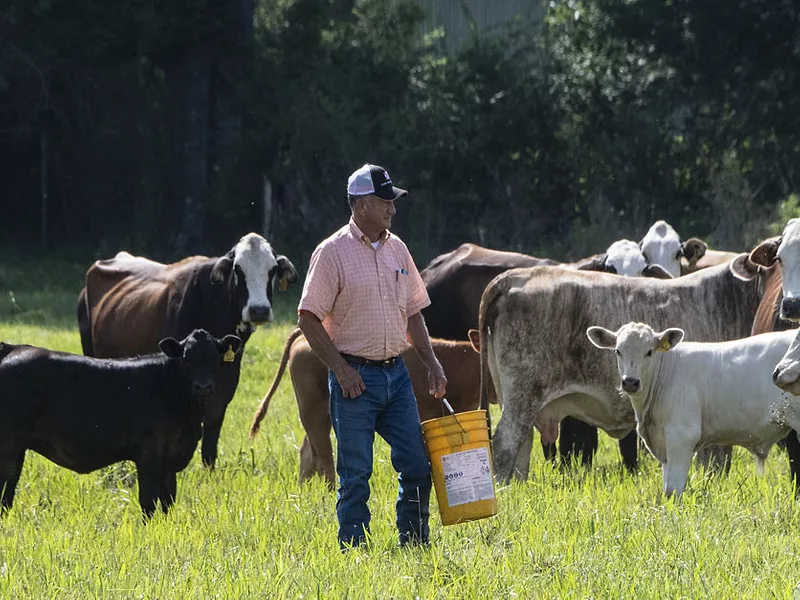
Robin Giles raises cattle, sheep and goats on land in the Texas Hill Country that’s been in his family for more than 130 years. He hasn’t seen a case of New World screwworm since 1972, but memories of the parasite have stuck with him.
“I remember rams that had no skin on top of their heads because they'd had a case of screwworms, and the screwworms had eaten all the flesh off the top of their skulls,” he said. “We’d get the screwworms killed, but then they'd never heal up, and there'd be bone, showing up right on the top of their heads.”
Most ranchers and veterinarians today have never come across a case of New World screwworm in their lines of work — the parasite was declared eradicated from the United States in 1966, according to USDA's Animal and Plant Health Inspection Service. Aside from a few outbreaks over the years, New World screwworm has been largely banished from the U.S.
But for those who can remember when the parasite was endemic, memories are vivid, and ranchers are concerned that the old days could return. Recent outbreaks in Panama and Mexico have raised fear in the livestock industry and resulted in a halt in livestock imports from Mexico.
A fly like no other
The New World screwworm fly has orange eyes, a metallic blue or green body, three dark stripes on its back and is slightly larger than a common house fly. During the 20th century, the pest was responsible for $100 million of damage (not adjusted for inflation) annually in the U.S., according to a report from the Texas Animal Health Commission. The commission estimates that the cost to eradicate NWS from the U.S. today, if it reappeared, would be around $1.27 billion.
It is a parasite remarkable for its gory appetite. Female screwworm flies are attracted to fresh wounds and are the only fly in the Western Hemisphere to lay eggs in a living animal, said Phillip Kaufman, professor and department head of entomology at Texas A&M University. The resulting larvae feed on living flesh of warm-blooded animals, unlike common blow flies.
 Phillip Kaufman (Texas A&M photo)
“Because they can have hundreds of [larvae] in a wound, and they're only eating the living tissue, they essentially create massive wounds,” Kaufman said. “They're going to kill the animal from the loss of tissue.”
For decades, the United States’ strategy for containing the devastating parasite has hinged on the Darién Gap, a 30-mile-wide land bridge between Panama and Colombia that connects North and South America. The strategy has been so successful that many had never even heard of it.
Cases of NWS in Panama began “exploding” in 2023, according to APHIS. Prior to this outbreak, an average of 25 cases were reported per year in Panama. In 2024 cases shot up to 6,500.
The parasite has since spread throughout Central America to Costa Rica, Belize, Nicaragua, Honduras, Guatemala and El Salvador, where NWS had previously been declared eradicated.
In November NWS was found in a cow at an inspection checkpoint in the southern Mexican state of Chiapas, near the Guatemalan border — the first positive case in Mexico since the early 1990s. USDA soon shut the Mexican-American border to live animal trade. The border since reopened and shut down again after additional cases were reported in Oaxaca and Veracruz.
It’s easy to be “in the know” about what’s happening in Washington, D.C. Sign up for a FREE month of Agri-Pulse news! Simply click here
For Alisa Ogden, a fifth-generation rancher from southeastern New Mexico, the turn of events was hard to believe.
“My first reaction was, ‘You got to be kidding me,’” she said. “Here we go again.”
Eradication of the parasite was made possible by breakthroughs at the Agricultural Research Service in decades before, when scientists discovered how to sterilize male flies using radiation in the first half of the 20th century. Because female screwworms mate only once in their lives, this presented an opportunity to disrupt the life cycles of the flies and eliminate them from areas where they’d been wreaking havoc for years.
The sterile insect technique involved dropping vast numbers — 500 million per week — of sterile flies from airplanes over southern parts of the U.S. Ogden told Agri-Pulse the drops are “imprinted” on her memory.
“They dropped it, and the box usually would hit the ground and break open, and the flies would fly off,” she said. “Well, the box hit the ground, and it didn’t break open. It was my job to go open the box. … You made sure your mouth was closed.”
Because of the sterile insect technique’s effectiveness, the last recorded case of screwworm in the Southwest was in 1982, according to the USDA. The only outbreak of NWS in the country since 1982 was in a population of Key deer in the Florida Keys during 2016-2017.
Giles said he remembers when screwworm was top of mind for every rancher in the South.
“When we had them, we just thought about them all the time,” he said. “And any time you saw where there was going to be a chance for screwworms, you did something about it.”
A generational gap
Because it’s been 43 years since the livestock industry has had to worry about the parasite, the topic has been largely “out of sight, out of mind,” said Lewis R. “Bud” Dinges, Texas state veterinarian and the executive director of the Texas Animal Health Commission.
 Lewis R. "Bud" Dinges (TAHC photo)
Christopher Womack, a veterinarian in San Angelo, Texas, said the U.S. has an issue of “generational ignorance” when it comes to preventing, treating and diagnosing screwworm.
“My colleagues don’t know about it, especially the younger colleagues,” Womack said. “There’s just damn few veterinarians that are in practice today that were in practice back when screwworms were endemic here.”
Womack was just old enough to catch the tail end of screwworm in Texas; he was seven years old in 1972 when the U.S. experienced its worst outbreak of NWS since 1966. That year, Texas had 90,000 cases of the parasite, a huge jump from just 444 the previous year, USDA reports.
“On our particular piece of property, we were calving, and I can remember roping calves and tying them down, and then Dad digging the screwworms out of the navel of those baby calves with a piece of baling wire,” Womack said.
The memory has stayed with him and it fuels his current efforts to raise awareness and action regarding NWS — along with knowledge of how eradication in the Southwest got its start.
In 1961 ranchers banded together to form the Southwest Animal Health Research Foundation, a nonprofit organization focused on raising money to build a sterile fly facility in the region, according to USDA. By the end of 1962, the organization had raised more than $1.8 million that went toward opening a sterile fly facility in Mission, Texas, that same year.
“If this thing becomes endemic again in the United States on my watch, and I didn’t do something about it … that’s dishonoring their efforts,” Womack said. “They expended time and treasure to get the thing eradicated, and we got to do a lot better than that.”
Screwworms in the 21st century
Eradication of the New World screwworm has saved ranchers over $900 million every year since, according to USDA estimates. Should screwworm become endemic in the U.S. again, it would be in a much different landscape than the last time, Dinges said.
“I've talked to ranchers at large ranches, and they had 30 or 40 cowboys that they sent out at daylight, that were out doctoring newborn calves all day long and any cattle that might have wounds or infestations of screwworms until dark,” Dinges said. “Those ranches don’t have those capabilities anymore — that ranch may have three or four cowboys on payroll full time now.”
Ranchers today face different resource constraints than 50 years ago. Current outbreaks in Central America and Mexico are also happening during a time of reductions in force across critical USDA agencies, including APHIS's Veterinary Services, as reported in May by Agri-Pulse.
Kevin Shea, former APHIS administrator, told Agri-Pulse the reduced workforce could leave the U.S. flatfooted in its response time to a screwworm outbreak.
“If APHIS has fewer people they can deploy — fewer veterinarians, animal health technicians — obviously, that delays things,” he said. “It delays the initial detection, the initial diagnosis and then the initial response.”
Coleman Locke, a rancher in southeast Texas, said he thinks the current situation “caught our USDA people maybe sleeping, so to speak.” Even still, as someone who doctored screwworm cases himself back in the 1960s, Locke said the current situation is not dire.
“If we have a major outbreak in the United States, then it’ll be time to panic,” he said. “But not yet.”
For more news, go to Agri-Pulse.com.

