
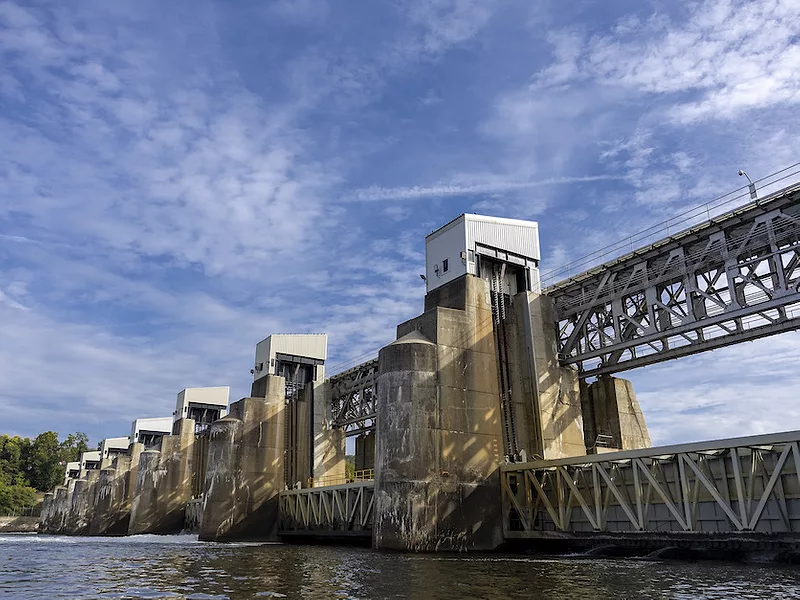
The U.S. Army Corps of Engineers is moving forward with plans to enhance inland waterway transportation through three main construction projects in 2025. None are on the Mississippi River, frustrating agricultural shippers eager to enhance that key waterway's infrastructure.
A work plan released by the Corps of Engineers laying out how it plans to use funding in the continuing resolution to the FY24 government funding bill Congress passed in March lists $1.8 billion in construction projects. It funds three waterway projects: Pennsylvania’s Montgomery Lock and Dam, Tennessee’s Chickamauga Lock and Illinois’ TJ O’Brien Lock and Dam.
However, some barging and agricultural interests are concerned that the decision to fund TJ O’Brien Lock and Dam may impede future timelines for a number of Mississippi River projects, including one that would add a new lock near Alton, Illinois.
Montgomery Lock and Dam along the upper Ohio River in Allegheny and Beaver counties in Pennsylvania receives $44 million to build a new 110-foot by 600-foot lock chamber. Meanwhile, $32.1 million will go toward a rebuild of Chickamauga Lock on the Tennessee River near Chattanooga.
A project to rehabilitate TJ O’Brien Lock and Dam, which sits along the Calumet River near Chicago and the entrance to Lake Michigan, will get $123.4 million. These efforts include embankment repairs, culvert replacements, vegetation removal and slope stabilization.
However Tracy Zea, president and CEO of Waterways Council, which represents barge shippers, told Agri-Pulse that TJ O'Brien has not been part of the framework laid out by the Corps in previous discussions and its inclusion is likely to disrupt timelines for construction of Lock and Dam 25, which Mississippi River grain shippers are eager to see completed.
 Tracy Zea (Photo: NACo)
“It’s going to make the next five years for inland waterways very difficult,” Zea said of the decision to fund the TJ O’Brien project, rather than others.
If the $120 million for TJ O’Brien had instead been put toward Chickamauga Lock or Montgomery Lock, Zea said those projects could have been either completed or nearly finished, which would have “significantly advanced the inland waterways program plan.” While Zea said the agricultural industry and the Corps had worked out a framework to ensure that Lock and Dam 25 could be “fully funded in a reasonable time manner,” the new work plan is likely to disrupt that.
He believes it now may take until 2029 to begin work on Lock and Dam 25, rather than 2027. The decision, he said, was made by an official at the Office of Management and Budget.
“We had a plan, everyone was executing the plan, and this one person just continues to ruin it,” Zea said.
A project adding a new lock at Kentucky Lock and Dam on the Tennessee River also failed to make its way into the work plan, a source of frustration for producers in the region, said Mike Steenhoek, executive director of the Soy Transportation Coalition.
“I think that there’s certainly an opportunity to do more,” Steenhoek said of Corps construction plans for inland waterways.
When it comes to coastal navigation projects, the work plan directs $264.1 million for the replacement of a lock at Sault Ste. Marie, Michigan, that connects Lake Superior to the other Great Lakes. It also proposes $21.2 million for deep draft navigation improvements at Charleston Harbor, $23 million for an erosion mitigation project in Maine, and $33.4 million for construction management at the Houston Ship Channel in Texas, among other projects.
“The work plan supports our coastal ports and inland waterways,” said Robin Colosimo, acting principal deputy assistant secretary of the Army, at a House Appropriations Committee hearing.
It’s easy to be “in the know” about what’s happening in Washington, D.C. Sign up for a FREE month of Agri-Pulse news! Simply click here
The continuing resolution had included $5.5 billion for operations and maintenance, $143 million for investigations and $368 million for flood control projects on the Mississippi River. The American Relief Act passed late last year also provided an additional $700 million to the agency’s construction account as well as $20 million for investigations and $50 for Mississippi River flood control projects, according to the Congressional Research Service.
Democrats have been critical of the Trump administration work plan. A press release from House Appropriations Committee Democrats claims the administration used continuing resolution language allowing it to prioritize certain projects to shift more than $250 million from Democratic states toward Republican states, including by shutting out California projects.
"The Trump administration should follow Congress’s intent to guide its investments,” House Appropriations Committee ranking member Rosa DeLauro, D-Conn., and member Marcy Kaptur, D-Ohio, said in a joint statement. "Instead, President Trump has unilaterally chosen to punish the people living in certain states — a historic and clear abuse of taxpayer dollars."
When pressed by Mike Levin, D-Calif., about the disparity at a hearing in May, Colosimo said the administration “made hard choices” when facing its $1.8 billion funding limit for this fiscal year.
“They wanted to prioritize life, safety, flooding and American prosperity,” Colosimo said of the administration work plan decisions.
For more news, go to Agri-Pulse.com.
.

