
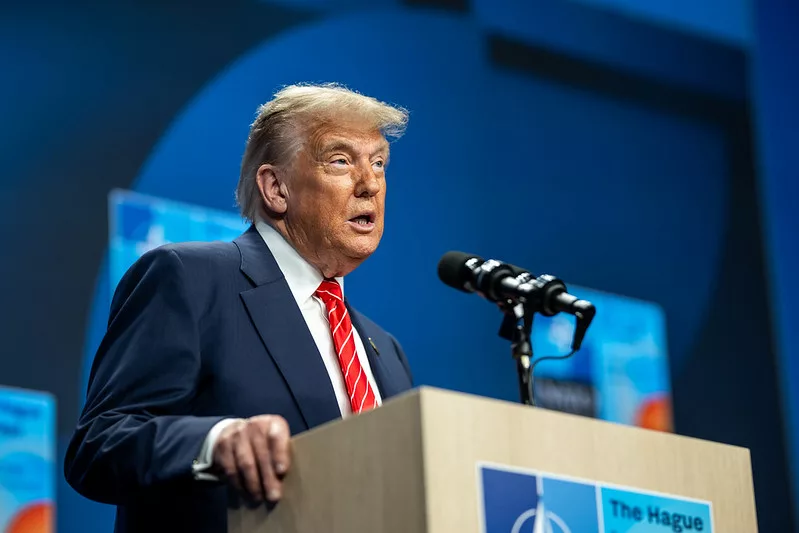
President Donald Trump and Commerce Secretary Howard Lutnick said on Thursday that the U.S. has signed an agreement with China to finalize the implementation of a tariff understanding secured earlier this month in London. Both also suggested that the U.S. could be closing in on an arrangement with India.
“We just signed with China,” Trump said during an event highlighting the GOP reconciliation bill under consideration in the Senate, adding, "We are starting to open up China."
But immediately following the interview Lutnick told Bloomberg TV that the president was referring to a deal to finalize the terms of the existing tariff détente.
“We got back together in London, and that deal was signed and sealed two days ago,” Lutnick said. He did not elaborate on the deal’s contents beyond China’s agreement to supply rare earths to the U.S. and the U.S. lifting ethane export restrictions to China, which have been previously reported.
A White House official clarified to Agri-Pulse that Trump's comments referred to an "additional understanding" for the "framework to implement the Geneva agreement," which both sides recommitted to in London. The official added that the additional understanding related to "export controls," but did not provide additional details.
An official from the Chinese embassy in Washington told Agri-Pulse they have "nothing to share."
However, Lutnick said that the administration is planning to unveil a raft of deals next week,
“The deals we’re going to announce are sort of the head of the class,” Lutnick said. Other countries, he said, would be grouped into “buckets.”
Countries will be able to negotiate further beyond July 9, Lutnick said, but said tariff rates will be set at that date, “and then off we’ll go.”
Trump singled out a deal with India out as a particular point of optimism during his remarks that touched on everything from the Federal Reserve – it “would be helpful if the Fed lowered interest rates – to U.S. Immigration and Customs Enforcement raids.
“We have one coming up maybe with India,” Trump said. “A very big one, where we’re going to open up India.”
Lutnick also touted recent progress with India, as well as the European Union.
The Commerce Secretary and former Cantor Fitzgerald CEO had previously characterized negotiations with Europe as “more than thorny,” but said he’d seen negotiations take a more positive turn in recent weeks.
“Europe has done an excellent job. They’re working hard,” Lutnick said. In a Truth Social post in May, Trump lamented the slow pace of talks and threatened to impose 50% duties on imports from the bloc.
Trump “motivated” EU negotiators with that post, Lutnick argued in Thursday’s interview.
“They came to the table then,” Lutnick said, adding “I’ve become optimistic.”
It’s easy to be “in the know” about what’s happening in Washington, D.C. Sign up for a FREE month of Agri-Pulse news! Simply click here
Lutnick reiterated his previous assertion that a deal with Europe would likely come at the tail end of U.S. negotiations, but he said this makes sense given the depth and complexity of the trade relationship.
Whether the EU can secure agreements that eliminates the 10% baseline tariff has been the subject of intense speculation in recent days. Lithuania’s President Gitanas Nausėda said in an interview with Politico EU that the bloc could at most “hope to be treated like the United Kingdom.”
Notably, the U.S. deal with the UK, while establishing tariff-rate quotas for U.S. beef and ethanol exports, left the 10% baseline tariffs on UK exports in place.
The comments strike a new tone from EU officials, who panned the UK-U.S. deal when it was initially announced.
Whether the EU will press ahead with its retaliatory measures if the U.S. maintains its 10% also remains to be seen – and may still need to be ironed out among European officials. President Ursula von der Leyen was slated to meet with European leaders on Thursday evening to discuss the progress of the talks and the possible EU responses, according to reports.
But if Trump administration lowers duties, it could undermine one of its arguments for quelling critics of the deficit raising provisions in the reconciliation bill.
The White House has made the potential revenue from U.S. tariffs a central part of its messaging around the One Big Beautiful Bill currently under consideration in Congress. An analysis of the bill from the White House Council of Economic Advisers published Wednesday lists tariff revenues that it says could be upwards of $2.5 trillion among the deficit reducing measure of Trump’s economic policies.
Both Trump and Lutnick also pointed to tariff revenues in their public comments on Thursday.
“This Big Beautiful Bill doesn’t count the $88 billion of tariff revenue we have received, and now we’re earning up to $30 billion a month in tariff revenues,” Lutnick said during his Bloomberg TV interview.
For more news, go to Agri-Pulse.com.

