
Senate Republicans are still working through a few major issues as they try to pass their reconciliation bill in time to make President Donald Trump’s July 4 deadline.
They cleared one hurdle Thursday when the Senate parliamentarian officially signed off on two key Agriculture Committee provisions. One imposes a cost-share requirement on states based on their error rates. The second cuts off benefits to immigrants who don’t have citizenship or permanent residency.
But now the main event: Perhaps the biggest remaining question is how the Senate Finance Committee will adjust its Medicaid proposals after the parliamentarian ruled against several provisions.
Among those was a proposal to cap provider taxes, which some Republicans have opposed. Instead, they have urged Senate leadership to follow the House’s proposal on provider taxes.
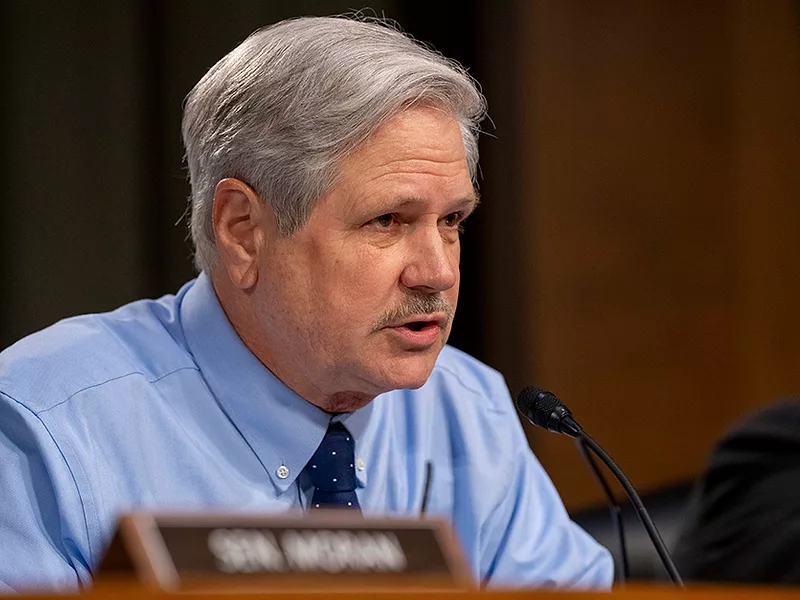
Senate leadership has been working on tweaks to the language in hopes it can gain approval the second time around. Following a conference meeting Thursday afternoon, Sen. John Hoeven, R-N.D., said the changes being considered are similar to the SNAP state cost-share fix and involve the timeframe for states to respond to the current provider tax freeze. This provision was also included in the House bill.
The Senate is still considering adding a stabilization fund for rural hospitals and a total dollar figure. But given the parliamentarian ruling, Sen. Josh Hawley, R-Mo., said it seems like Senate leadership is trying to determine “what direction exactly they want to go in.”
Meanwhile: Some 23 Democratic governors wrote to Congressional leaders warning that the SNAP provisions in the House and Senate reconciliation bills could mean some states will leave the program. This could lead to eligible participants losing access, and an increase in hunger, the governors say.
Warnock: Farm bill coalition at risk
Sen. Raphael Warnock, a Georgia Democrat who serves on the Senate Agriculture and Finance committees, says it’s a mistake for Republicans to use the partisan budget reconciliation process to pass more funding for farm programs.
“Farmers need a whole range of things that can only to be addressed in a farm bill, which is rightly done every five years in a bipartisan effort,” Warnock says on this week’s Agri-Pulse Newsmakers. “This piecemeal approach risks pulling apart the kind of coalition that you need to address things in addition to reference prices.”
He also says rural areas could be hit hard by Medicaid and SNAP funding cuts.
This week’s Newsmakers will be available today at Agri-Pulse.com.
More states go MAHA
Oklahoma is the latest state to seek a waiver from USDA to restrict certain food purchases through SNAP. Gov. Kevin Stitt says the state also is taking steps to remove artificial dyes from school and prison meals.
He was joined by Health Secretary Robert F. Kennedy Jr. for the announcement Thursday. USDA has approved six state SNAP waivers so far. Other states have also taken efforts to remove artificial food dyes and additives from school meals — or from shelves entirely.
It’s easy to be “in the know” about what’s happening in Washington, D.C. Sign up for a FREE month of Agri-Pulse news! Simply click here
Kennedy is expected to join Louisiana’s governor, Jeff Landry, today as he signs a bill that would restrict food dyes, require labeling for products containing one of several common food ingredients, and mandate restaurants give customers a notice if items are cooked in seed oils.
Cantwell: Make trade part of Middle East diplomacy
Sen. Maria Cantwell, D-Wash., is pushing for the U.S. to make trade a component of diplomatic solutions in the Middle East.
Cantwell told attendees at an event hosted by the Washington International Trade Association that she is planning a bill that will authorize negotiations on a Middle East trade deal.
“We need more diplomatic solutions for the region, and I think trade could be a part of that,” she said.
Such a deal, she said, would be based on previous efforts to launch a Middle East trade preference program and could prioritize technology and AI products. Eligible countries would have to join the Abraham Accords, normalize relations with Israel, coordinate on export controls, and support Gaza’s reconstruction and nuclear arms limits, she said.
Why it matters: At the same event, former U.S. Trade Representative Susan Schwab — who served under President George W. Bush — argued that U.S. agriculture benefits as much as any industry from more open digital trade. The cross-border transfer of data, for example, “has fundamental implications” for U.S. agriculture, and the sector suffers a “knock-on effect” from rising digital trade barriers, she said.
Take note: Trump and Commerce Secretary Howard Lutnick said Thursday the U.S. has signed an agreement with China finalizing a tariff understanding secured earlier in London. Both suggested the U.S. is closing in on a deal with India. Read our report here.
Ruling on Universal Service Fund expected today
The Supreme Court is expected today to rule on whether an $8 billion program that funds internet services for rural areas and schools is constitutional.
While the court has been releasing a bevy of rulings in recent days in preparation for its approaching summer recess, it has not yet weighed in on whether the Federal Communications Commission’s Universal Service Fund violates the Constitution's “nondelegation doctrine.”
The 5th Circuit Court of Appeals in New Orleans ruled last July that the USF’s funding mechanism was unconstitutional, breaking with the views of the 6th and 11th circuits. The FCC petitioned for Supreme Court review of the decision.
Colorado River negotiators weigh possible divorce
After months of challenging discussions over future management of the Colorado River, negotiators from the Upper and Lower basins are exploring the option of breaking up.
Both sides are currently considering a "conscious uncoupling,” which would allow the basins to put aside some longstanding legal disagreements and focus on ensuring a set amount of water gets released downstream from Lake Powell, said Colorado’s negotiator, Becky Mitchell.
“If done correctly, it should provide the opportunity for the Upper and Lower basins to manage themselves with the only real point of agreement being the [Lake] Powell release,” Mitchell said at an Upper Colorado River Commission meeting Thursday.
Take note: The seven states will now have until mid-November to signal to the Bureau of Reclamation whether they have reached a deal, said Scott Cameron, the Interior Department’s acting assistant secretary for water and science.
Final word
"Ranchers are selling off prized cattle to make ends meet. They’re buying hundreds of thousands of dollars’ worth of hay to survive the winter. Farmers are firing people when nothing is growing and they’re selling off land because they can’t keep it profitable.” — Becky Mitchell, Colorado’s representative on the Upper Colorado River Commission, speaking to the impact of water limitations in the Upper Basin.
Rebekah Alvey, Philip Brasher, Oliver Ward and Noah Wicks contributed to today’s Daybreak.
Fort more news, go to www.Agri-Pulse.com.


