
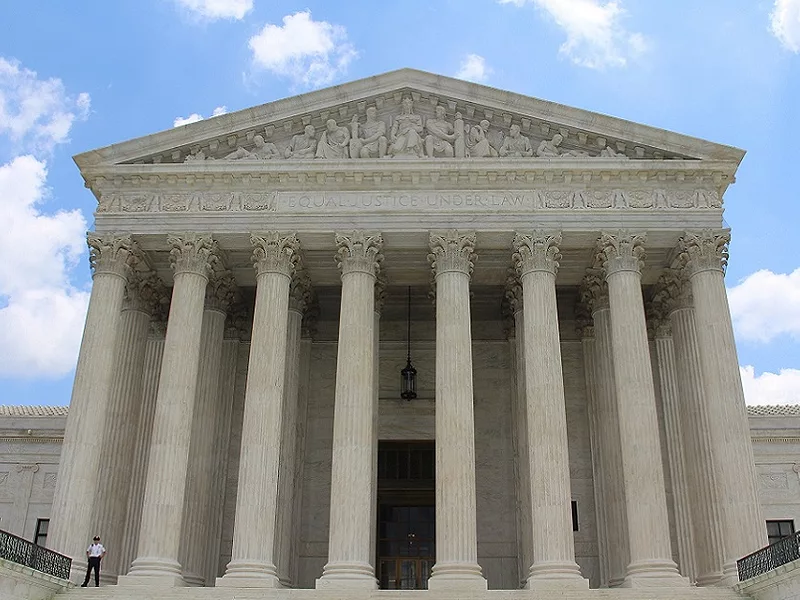
The Supreme Court is seeking input from the nation's top lawyer before deciding whether to take up a petition sought by Bayer on the reach of federal pesticide law.
In a brief order issued today, the high court invited the Office of the Solicitor General to express "the views of the United States" on the petition submitted by Bayer, which the Supreme Court is considering.
(In other Supreme Court news, the justices denied a petition filed by the Iowa Pork Producers Association over California's Proposition 12 law, which prohibits the sale of pork in the state that comes from sows housed in gestatation crates.)
The Bayer petition seeks review of a Missouri Court of Appeals decision that upheld a $1.25 million verdict against Bayer in a case brought by a man who claimed exposure to Roundup herbicide caused his non-Hodgkin lymphoma.
Bayer has been fighting lawsuits asserting those claims in state and federal courts, with mixed success. About 114,000 Roundup cases have either been settled or are "not eligible for various reasons” as of Jan. 31, according to Bayer's 2024 annual report, leaving about 67,000 awaiting action. The company spent about $10 billion to settle about 100,000 of those claims and has set aside $5.9 billion for future cases.
“We see this request as an encouraging step and look forward to hearing the views of the government on FIFRA’s federal preemption provision, which relies on language common to several federal laws that cover a number of industries,” Bayer CEO Bill Anderson said. “The security and affordability of the food supply depend on companies’ and farmers’ ability to rely on decisions made by responsible federal regulatory authorities. When courts permit companies to be punished under state law for following federal law, it makes companies like ours a prime target of the litigation industry and threatens farmers and innovations that patients and consumers need for their nutrition and health.”
A dozen ag groups backed the Bayer petition in an amicus brief submitted in May,, arguing that U.S. agriculture would face “devastation” without the use of the herbicide Roundup. CropLife America also supports the petition, as do the U.S. Chamber of Commerce, American Tort Reform Association, Product Liability Advisory Council, Washington Legal Foundation and Atlantic Legal Foundation.
Bayer has said it may get out of the glyphosate business altogether if it can’t resolve the Federal Insecticide, Fungicide, and Rodenticide Act preemption issue. It has pursued a multi-pronged strategy, fighting individual cases in state and federal courts and also working – along with numerous commodity groups – to persuade state legislatures to pass bills shielding manufacturers from failure-to-warn lawsuits.
It’s easy to be “in the know” about what’s happening in Washington, D.C. Sign up for a FREE month of Agri-Pulse news! Simply click here
"There needs to be a reasonably final closure" to the litigation, Bayer CEO Bill Anderson told Agri-Pulse last month. "It’s not a solution to solve some of them, and then it just keeps going. We have to put this behind us. And so we're working on ways to do that."
Bayer is arguing that a split in federal appeals courts warrants review of the question of whether FIFRA preempts state law requiring manufacturers to warn consumers of the risks of using products such as pesticides.
The 3rd Circuit Court of Appeals ruled last year in Bayer’s favor, creating the split. The ag groups, including the American Farm Bureau Federation and American Soybean Association, among others, argue in their brief that the conclusions of the Missouri Court of Appeals and 9th and 11th federal circuit courts of appeals are wrong.
The Environmental Protection Agency has consistently found that glyphosate is safe to use, the brief says.
“EPA has concluded on multiple occasions over the past 50 years that glyphosate does not pose a cancer risk,” the groups say. “Numerous international regulatory authorities and health organizations have agreed, including assessments by the European Union, Canada, Australia, Germany, and New Zealand.”
The groups don’t mention the major driver behind the lawsuits against Bayer – the International Agency for Research on Cancer’s 2015 finding that glyphosate probably is carcinogenic in humans. Bayer has called that finding an “outlier.”
“A state requirement to include a cancer warning on a glyphosate label would not only direct the manufacturer to label the product differently from EPA’s findings, but also to make a false and misleading statement on the label given EPA’s repeated findings that glyphosate is noncarcinogenic,” the ag groups contend.
“Such a label is the result of plaintiff’s failure-to-warn claim in Missouri,” they say in their amicus brief.
CropLife America, in its amicus brief, says the potential for “astronomical verdicts puts enormous financial pressure on the pesticide industry. The legal and financial crisis facing the manufacturers of products that EPA has found safe and effective for widespread use calls for immediate review.”
More than 90% of corn, cotton, soybeans, sugarbeets, and canola “are produced using … glyphosate-tolerant seeds,” the ag groups say, warning that “any restriction to glyphosate threatens to increase the costs to farmers, prices to consumers, and the availability of some foods. Without access to glyphosate, crop losses will inevitably occur, leading to further supply chain disruptions, food shortages, and higher consumer prices.”
For more news, go to www.Agri-Pulse.com.

