
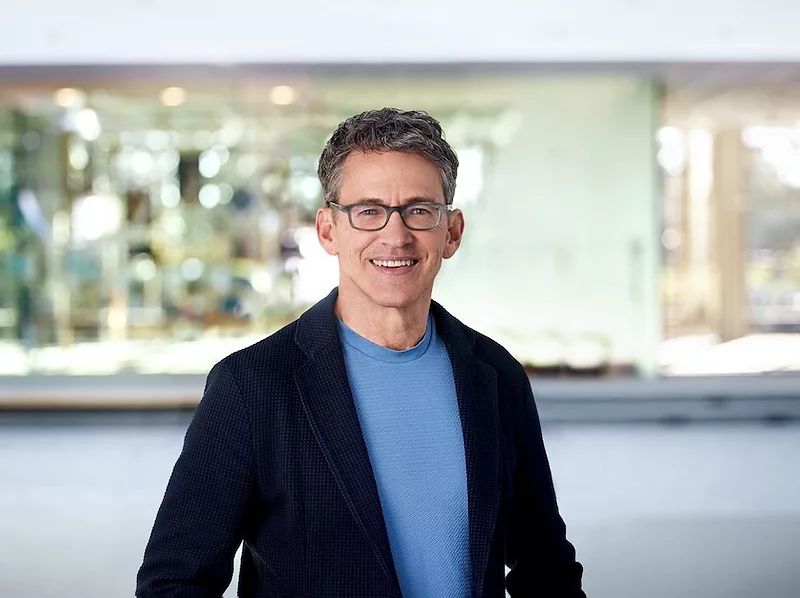
Editor's note: Bayer CEO Bill Anderson sat down with News Editor Steve Davies after speaking about sustainable agriculture with industry representatives recently in Washington. What follows are lightly edited excerpts of that conversation, which includes discussion of glyphosate, the active ingredient in Roundup, and the "Make America Healthy Again" movement.
Agri-Pulse: If I could start off with a basic question, based on what you announced just a few days ago about reorganizing and the German production facilities, I just want to clarify whether you're getting completely out of the generic pesticide business.
Bill Anderson: It's not like the generic pharmaceutical business. Many crop protection products are mixes of different active ingredients (AIs). So, for example, you might have one active ingredient in a mix in a formulation that is proprietary, and a couple others that are generic. We're basically trying to stop producing most of the generic AIs. So we may still supply the blend, and that blend may include a proprietary AI plus one or two generic AIs. We're saying, instead of producing those generic AIs, we'll probably buy them from generic makers, because we we're just not cost-competitive on a number of the AIs that are generic.
A-P: There was some discussion of the Meanses – Calley and Casey – and RFK Jr., and what they've said about pesticides. How do you fight back, or how do you counter that narrative?
BA: We have regulatory agencies like the EPA in the U.S., the European Food Safety Authority and many, many others. The Japanese are extremely meticulous about what goes in their food supply. The New Zealanders and the Australians are extremely meticulous about what goes in their food supply. I can say for something like glyphosate that's been studied for 50 years by all of the regulatory bodies in the world, every single one of them has come to the same conclusion; I think we can be very confident in that finding.
A-P: Are you confident that the Supreme Court is going to take up your petition out of the Missouri Court of Appeals on the preemption issue?
BA: I would say that there's a very strong reason why they should, which is that we have different circuit courts of appeals with very different opinions on this, and that really can't last. That's not a stable situation, and it leads to great legal ambiguity. So for example, can we still make glyphosate in the U.S.? If we take the 9th and 11th circuit rulings, I would say I'm not sure we can produce glyphosate, or, frankly, launch any new active ingredients in the U.S., because the lesson from those would be, can you meet all the requirements of the regulator? You can do everything both legally and ethically required, and you can still end up in a legal quagmire, the cost of which far exceeds any potential profits from a crop protection product. I think this is a really important issue for the Supreme Court, and it has to do with the future of farming, the future of innovation from America in the whole agriculture field.
And just to put a point on it, I mean, we have the first novel herbicide that's been produced in more than three decades that we are preparing for launch, and it's not clear that we'll be able to launch it in the U.S. under this legal ambiguity. It doesn't seem like a very smart plan, because U.S. agriculture is important, but other countries’ agriculture areas have grown remarkably, like Brazil, China, for example, and we don't face these kind of legal quagmires in those countries. [Note: Anderson said he expects that herbicide to be ready for commercial launch in 2028.]
A-P: It just seems like you're kind of up against a gauntlet of skepticism about government regulators in general, that they don't have people's best interests at heart.
BA: I think that that really fails the common-sense test. You have hundreds of scientists who dedicate their entire careers to working for relatively low compensation at a U.S. agency or an EU agency or a Japanese agency, and in all my experience, they tend to be very mission-driven people. Their mission being, for example, at the EPA, to protect the American people from unwarranted hazards and risks of all sorts. And so the idea that we can't trust these people, but oh, we can trust groups that are backed by opaque financial sources, which certainly include the litigation industry, no doubt. I mean, the litigation industry is a $600 billion business now in the U.S.
We have a code of conduct that's basically condition of employment for every Bayer employee, including me, which is that we will conduct open and transparent dialogue with all key stakeholders, which includes regulators, governments. We are more than happy to share our data, to have public dialogue about all of this. We are beyond confident that in the light of day, our facts stand on their own. And in fact, when you look at the lawsuits, the trials, in those trials where we are able to present the entire evidence set, we inevitably win, but often we're blocked from doing that by judges that have different ideas about evidence standards.
A-P: Have you had any meetings with federal officials, with the White House about these issues, with the MAHA Commission or anything like that?
BA: We haven't been asked for input from the MAHA Commission. We certainly support the goal of improving the health of Americans. And there's no question that the American diet needs to be healthier. We've made ourselves available and we will continue to do that. I think the country needs to avoid turning our backs on the decades of scientific process and evaluation that's been conducted. In the case of glyphosate, you have a unanimity across regulatory bodies around the world that's fairly rare. We have a lot more confidence in that unanimous regulatory science over the views of internet influencers.
A-P: Will ag innovation come from the big players in the industry, or smaller startups? Is it a mix?
BA: All of the above. You know, the bigger companies have some really essential research and development activities that can't be replicated by the smaller companies, particularly in the ability to scale up seeds or, frankly, to come up with a novel AI. I don't see that happening from a small company. The resources and the timelines that are required to create a novel active ingredient in crop protection, it just doesn't lend itself to a small company. For seed R&D, I think there can be some important biotech advances that can be from small companies. So there's a lot of small companies working on the nitrogen fixation topic, but most of those, I suspect, will end up partnering with a large company in order to actually bring that innovation to market, if they're able to make a breakthrough scientifically, because you know what it takes to deliver seeds to the world is a pretty massive scale issue.
A-P: Getting back to glyphosate: On the whole lawsuit landscape, are you kind of betting on getting either a legislative or a court solution to the preemption issue, so that you don't have to worry about these lawsuits? I think it's approximately 67,000 cases that are out there.
BA: We have to pursue every option to contain this. It’s a raging kind of wound on the company. That money that we ought to be spending in researching the next breakthrough in agriculture is going to trial lawyers, and so that's why we have an approach that's working on legislation, executive action, courts – both at the appellate courts and including the Supreme Court. And we're also examining various structural options, and it's probably some combination of those things to resolve it.
A-P: When you mention structural options, I was wondering if there are any discussions going on to try to take care of the remaining bunch of lawsuits out there. You had a big settlement a few years back, about 10 billion bucks. Are you considering some ways to get the bulk of [the remaining lawsuits] taken care of?
BA: There needs to be a reasonably final closure. It’s not a solution to solve some of them, and then it just keeps going. We have to put this behind us. And so we're working on ways to do that. Now, that being said, if there is a way to settle certain cases at a reasonable cost, then we will always consider that. We've always been open to that, but in general, we're looking for something with a degree of finality. This can't continue. It's too damaging to our mission.
A-P: On dicamba, is there any consideration being given to just not producing that? There have been a couple of court decisions that have not gone your way in the past. You're going through a whole season for the first time of not being able to sell that.
BA: We stand by the farmers. That's our most important constituency in agriculture, and we hear from them that they desperately need options in crop protection and particularly, for example, in the southeastern United States. Their main options for glyphosate-resistant weeds are 2,4-D and dicamba. The challenge is that, if you've got, for example, cotton, 2,4-D is a no-go. A tiny amount of 2,4-D in an adjacent field can wipe out a cotton crop.
Agriculture is not monolithic. The needs of soy farmers in Indiana are not the same as the needs of soy farmers in Georgia. We believe that the right answer is a reapproval of dicamba. It's not a major business factor for us going forward – the actual dicamba sales – but the fact that farmers ought to have options remains.
A-P: Quick one. Short-stature corn. When's that going to be coming out?
BA: The breeding version is already in the fields, commercially in the U.S., in Italy and Spain, it's been hugely successful. It’s way oversubscribed now. The big unlock comes with the biotech version, because the germplasm catalog, if you will, is too narrow to support a massive rollout. To go out broad, you need broad genetics, which means you need to achieve your short stature with a biotech gene trait. The biotech gene trait is coming in 2027. That’s when it’ll really take off, because then we can apply that biotech trait to pretty much our whole genetic catalog. I'm not an expert on this, but call it five to seven years from now, you drive through the cornfields of America, you're going to see a very different look.
Cut through the clutter! We deliver the news you need to stay informed about farm, food and rural issues. Sign up for a FREE month of Agri-Pulse here.
For more news, go to Agri-Pulse.com.

