
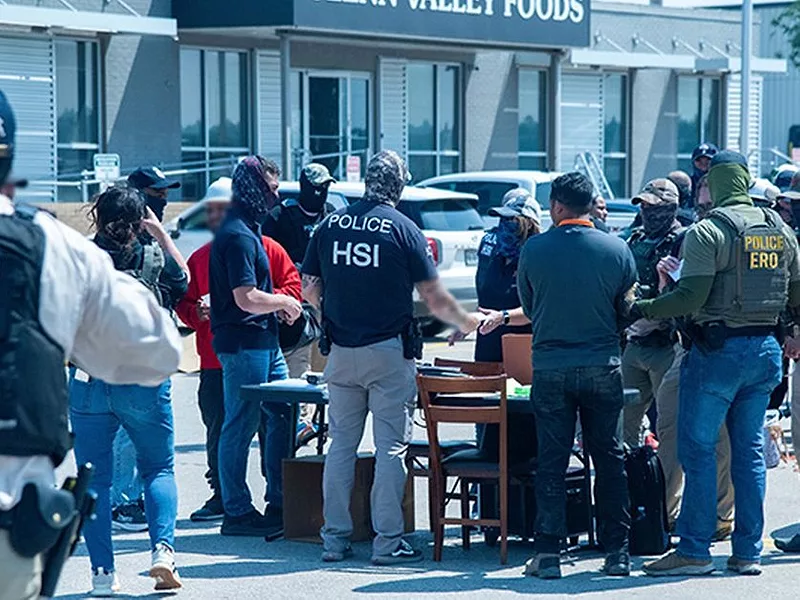
For 15 years, Gary Rohwer thought he was operating with legal workers at his plant in Omaha, which produces Gary’s QuickSteaks and other meaty fare for distribution nationwide.
Then on June 10, Immigration and Customs Enforcement agents raided the plant and took half of his approximately 150-person workforce away.
“I thought everything was fine, and I thought all my employees were legal, and all of a sudden I get raided, and I find out that half of them are illegal, and I had no idea,” Rohwer told Agri-Pulse.
ICE told him he was a victim of identity theft, which angered Rohwer. “I said, yeah, I'm a victim because of your nonperformance, and your not being able to give me the correct program to screen these people,” Rohwer said.
ICE has hit some ag worksites since President Donald Trump was elected partly on a platform of deporting millions of migrants. Although Trump and spokespeople insisted the administration is going after violent criminals, some of the raids have swept in workers who are not wanted on criminal charges, striking fear into farmworkers and spurring the industry to call again for a permanent solution to the workforce problem.
Trump himself has floated the idea a few times of allowing longtime workers at farm and food establishments to remain after some type of check is performed.
“We’re going to work on some kind of temporary pass where people pay taxes where the farmer can have a little control as opposed to you walk in and take everyone away," Trump said recently.
“What we are going to do something for farmers where we can let the farmer sort of be in charge,” Trump said. “The farmer knows. He's not going to hire a murderer. When you go into a farm and he's had someone with him for nine years – which is hard work to do and a lot of people aren't going to do it – and you end up destroying a farmer because you took all of the people away, it’s a problem.”
Agriculture is particularly dependent on undocumented workers, who make up around 40% of the workforce.
It’s easy to be “in the know” about what’s happening in Washington, D.C. Sign up for a FREE month of Agri-Pulse news! Simply click here
The H-2A guest worker program fills some of the need but not enough. In 2024, about 380,000 people entered the country as H-2A workers – about 17% of the total workforce of approximately 2.1 million, according to the American Farm Bureau Federation, relying on USDA data.
Those who use H-2A can safely assume their workforce is legal, says Chris Schulte, an attorney with Fisher Phillips who represents the National Council of Agricultural Employers.
People who come in on H-2A visas “have already jumped through so many hoops to even get here to be working in the first place,” Schulte says. “They're like 1 million percent legal.”
But in year-round sectors such as dairy farming and meatpacking, both of which have advocated to be allowed to use H-2A, problems can crop up through their use of E-verify.
A popular ag labor reform bill that many farm groups have rallied around, the Farm Workforce Modernization Act, would mandate the use of E-verify in agriculture.
 Chris Schulte (Photo: Fisher Phillips)
For now, use of the government database is voluntary, although more employers are using it every year, according to DHS. About 88,000 employers were enrolled last year, and that number should be eclipsed this year, with nearly 49,000 enrolled as of June 30.
But while E-verify works well with the information it contains, it cannot defeat identity theft. An immigration defense lawyer who's represented the meatpacking industry since the 1990s tells Agri-Pulse that for verifying Social Security numbers and alien registration numbers the error rate "is pretty darn low.”
However, smugglers of unauthorized workers have discovered they can “spoof” the system, he said. They just need the identity details of someone who is a U.S. citizen or permanent resident alien, either sold willingly or stolen.
The network of smugglers figured a way around E-verify by using identify theft, the lawyer said. “Then it comes down to a basic law of economics,” he says. “A false identity costs approximately $1,000 on the black market, and so the question becomes, does an unauthorized alien have access to a job that would be worth spending that much money to obtain?”
Meatpacking can be a relatively lucrative option for a job that does not require special skills and is both indoors and year-round, he said. It also can offer some promise of upward mobility.
For Rohwer, the raid came as a shock. His plant is now operating at about one-third capacity, he said. “When this raid happened, we got overwhelmed with Hispanics coming from other meat processing companies that always wanted to work for my company,” he said. “So we basically don't have any problem with applicants. But the problem is, it takes time to train them, and so we're going to be probably three weeks at least before we get back to 100%.”
“They're basically all Hispanic, because the Americans, the whites, they don't want to do the work,” he said.
ICE said in response to questions that of the “more than 70 illegal aliens” who were removed or detained, three were returned to Mexico, and “three illegal aliens from Guatemala were transferred to Alexandria, Louisiana, in preparation for their future removal.”
One of the Guatemalans “has a final order of removal issued in 2019, one has been removed from the U.S. on four previous occasions, and another has three DUI and one illegal reentry conviction,” DHS said.
All the workers detained were working with stolen identities, DHS said.
“The false narrative that these are just hardworking immigrants looking for the American dream is ludicrous,” said Mark Zito, special agent in charge of Homeland Security Investigations Kansas City, which covers Omaha.
“These crimes have lasting effects,” Zito said. “There are real victims here, people who are often left to deal with financial instability, damaged credit and years of frustration trying to restore their identities, not to mention the harm that is done to legitimate businesses who often believe they are hiring legal workers.”
Rohwer called the whole situation “sad.”
“If there’s no Hispanics, let me tell you, there'll be no meat processing industry,” he says. “They're part of the workforce in this country, and they have a place in this country.”
For more news, go to Agri-Pulse.com.

