
-snap-wic-grocery-shopping-food-cpi.webp?height=700&t=1760638169&width=800)
Last-minute changes to the Senate’s reconciliation bill would give states with the highest SNAP error rates two additional years before having to help pay for the program. But even scaled back from the House version, and with the new timeline, anti-hunger groups say the policy shift will be disastrous for states and SNAP participants.
Senate passage of the bill Tuesday followed weeks of negotiations and over 24 hours of floor consideration to win over Republicans while keeping the bill compliant with the Byrd rule. House GOP leaders are pushing for that chamber to clear the Senate bill as soon as Wednesday.
The House and Senate versions of the bill each include a provision requiring states to cover a portion of SNAP benefits for the first time. The full extent of the cost-share is determined by the state SNAP error rate, or the rate of under- and overpayments.
Unlike the House proposal, the Senate version would not place a cost-share on states with error rates below 6%. States with rates above that, however, would be responsible for between 5% and 15% of SNAP costs. Initially the Senate parliamentarian ruled against this provision, arguing that it did not give states adequate time to adjust to the new costs. This was later rectified by allowing states to base their cost-share on either fiscal year 2025 or 2026 error rates starting in 2028.
Senators representing Alaska, particularly Republican Lisa Murkowski, were hesitant about using the error rates as a basis for the state cost share because her state has been exceptionally high. In fiscal 2023 Alaska’s error rate was over 60%, and in FY24 it was over 24%.
To address some of these concerns, the final bill includes a carve-out for states with some of the highest SNAP error rates. The implementation timeline would be increased to two years for states with error rates higher than about 13.33%.
Based on FY24 SNAP error rates, the provision would delay implementation for Alaska, the District of Columbia, Florida, Georgia, Maryland, Massachusetts, New Jersey, New Mexico, New York and Oregon.
The Senate Agriculture Committee's ranking member, Amy Klobuchar, D-Minn., offered an amendment to block the provision, but it failed with four Democrats joining Republicans to oppose it.
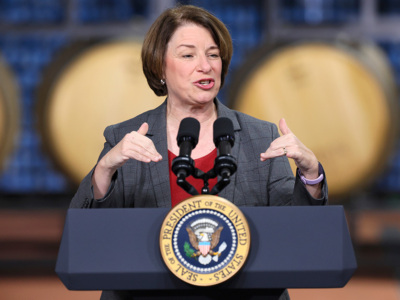 Sen. Amy Klobuchar (AP Photo/Adam Bettcher)Klobuchar said the state cost-share requirement would shift billions in SNAP to the states that they can’t pay for. But the whole reason Republicans used to justify this policy was to incentivize states with the highest error rates to take action, she said.
Klobuchar called the late-night change “the biggest hypocrisy” of the bill and said it rewards states with the highest error rates while leaving states already trying their best with hefty new costs.
“So, the message to the country and the nation’s governors from Republican senators is this: Raise your error rates,” Klobuchar said.
Senate Agriculture Committee Chair John Boozman, R-Ark., argued that the provision gives states with extremely high error rates time to adjust. “This is not going to be onerous at all,” Boozman said. “What we’ll be doing then is capturing dollars that are being wasted now … and putting those to good use.”
 Sen. John Boozman (AP Photo/Alex Brandon)
Anti-hunger groups, Democratic governors and others argue the cost share is unprecedented and that some states could opt out of SNAP altogether.
“It is very clear that at least some Republican senators recognized how harmful this provision would be to their state,” said Katie Bergh, a food assistance senior policy analyst at the Center on Budget and Policy Priorities.
States with error rates in the middle will be stuck with bills of tens or hundreds of billions of dollars starting in 2028 and will have to make “painful trade-offs” to prevent cuts to SNAP, Bergh said.
Error rates are often unintentional mistakes by state eligibility workers or participants filling out forms, she said. States can hire more staff, invest in training or upgrade technology, but those measures cost money.
It’s easy to be “in the know” about what’s happening in Washington, D.C. Sign up for a FREE month of Agri-Pulse news! Simply click here
At the same time, the Senate bill also maintains a House provision that increases the state administrative cost-share from 50% to 75%. This means states will have less federal support to invest in strategies to lower their error rates, Bergh said.
Bergh also said that states have relatively little time to make adjustments under the Senate bill. Although it allows states to base their cost-share rate on either fiscal 2025 or 2026 error rates for 2028, states are already nine months into FY25, she said. Meanwhile, the Senate bill also includes changes to work requirements.
“I think the combination of all of these policies is that states are going to be really struggling with fewer resources and additional demands on their limited capacity to bring their error rate down,” Bergh said. “It’s kind of setting the states up to fail.”
State error rates can also fluctuate year to year, which could now mean the difference of millions of dollars. USDA typically publishes the official error rates at the end of June, just months before the beginning of the fiscal year, making it more challenging for states to effectively plan their budgets.
USDA already has some incentives or controls to encourage states to lower error rates. Those with error rates at a level above the national average two years in a row must pay a financial penalty to USDA. They also have the option of investing 50% of the penalty to improve SNAP administration.
This penalty system would continue even with the new state cost-share in place, Bergh said.
The final Senate bill replicates many of the House SNAP provisions, with a few tweaks. It also expands the age range for individuals to complete work requirements. Able-bodied parents of children 14 or older would also be subject to work requirements. The current age is 18, but the House version would have affected parents with children as young as 7.
The Senate also adopted a provision requiring all future updates to the Thrifty Food Plan be cost-neutral, with annual adjustments for inflation. Senators also maintained a ban on immigrants getting SNAP benefits unless they are citizens or have permanent residency. In order to pass the Byrd rule, the Senate expanded an exemption for Cuban immigrants to those from Haiti, Micronesia, the Marshall Islands and Palau.
One small but notable omission in the Senate bill is a House provision that would have lowered the tolerance threshold for what counts as an error in the USDA’s error rate calculation. The House bill would have defined the threshold from $57 in either over- or underpayment to $0.
Medicaid provider tax provision clears
The final Senate bill also included a cap on provider taxes that states use to qualify for federal Medicaid funding, which has helped rural hospitals operating on tight margins.
While the House bill implemented a similar freeze on provider taxes, it did not go as far as the Senate version. As the chamber considered the bill, moderate House Republicans urged colleagues to avoid steeper cuts to Medicaid and threatened to oppose the bill.
To soften the impact of the provider tax change on rural hospitals, the Senate included a stabilizing fund of $50 billion over five years.
“That is going to be a help to our rural communities, our rural hospitals, in our communities, that is going to be very key,” said Murkowski after the final vote.
Sen. Josh Hawley, R-Mo., a critic of the provider tax change, said the addition of the rural hospital fund was a “tremendous victory” for his state.
On Monday, Sen. Roger Marshall, R-Kan., said about 60% of the roughly 1,400 critical access hospitals across the country are “underwater.” But he felt confident a fund of $25 billion would be enough to make those whole. The fund was ultimately doubled to $50 billion.
The hospital fund would exist for five years. The Medicaid policy changes would be permanent.
For more news, go to Agri-Pulse.com.

