
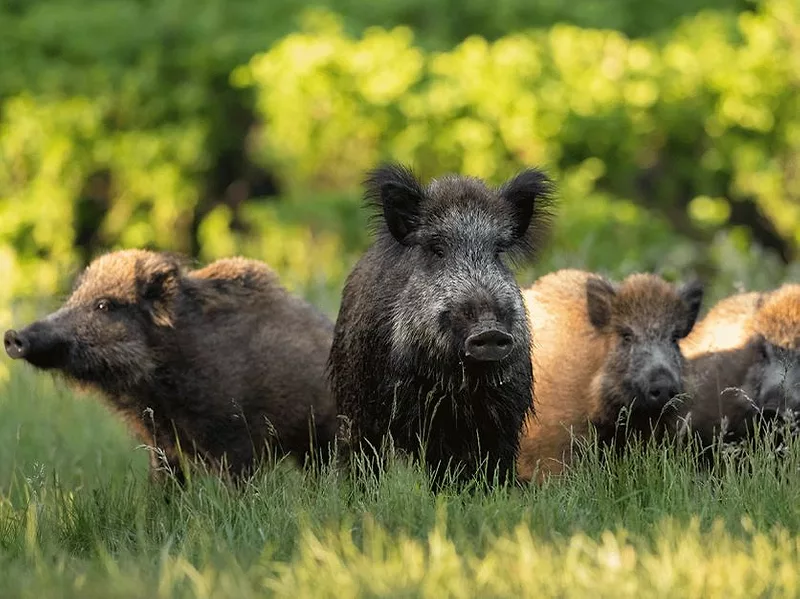
Programs combatting animal diseases and feral swine got a funding boost in President Donald Trump's sweeping reconciliation bill that included $66 billion in new money for farm programs.
Some $105 million, or $15 million a year through fiscal 2031, is earmarked for the Feral Swine Eradication and Control Pilot Program, which the 2018 farm bill established to help control the six million feral hogs that roam, root and ravage their way across more than 30 states.
Another $233 million a year from FY26 through FY30 funds animal health programs, with $153 million a year for the National Animal Vaccine Bank. The National Animal Disease Preparedness and Response Program gets $70 million a year, and $10 million goes to the National Animal Health Laboratory Network. Animal health funding would drop to $75 million a year in FY31.
Kevin Shea, former Animal and Plant Health Inspection Service (APHIS) administrator, told Agri-Pulse the feral swine program affects animal health more than many realize.
Feral swine "are almost like an offensive line in football,” Shea said. “They just go out together and can mow down corn and fields. … Maybe equal to that is, they’re full of disease.”
A feral hog invasion
Feral hogs are descended from swine brought to the Americas by 16th- century settlers. Today, these pests are the descendants of escaped domesticated pigs, Eurasian wild boars and crossbreeds of the two, according to APHIS.
Concentrated mostly across the South and Southeast, the hogs have crept as far north as Montana, though their Northern presence is limited by cold temperatures. Notably, all but one county in California has reported cases of feral hogs in the last year.
But no state comes close to matching Texas’ level of feral hog occupation. Of its 254 counties, all but four saw feral swine in 2024, says APHIS.
 Sid Miller (Texas Department of Agriculture photo)
Recent estimates show the state has about 2.6 million feral hogs, but Texas Commissioner of Agriculture Sid Miller told Agri-Pulse the actual population is higher, and likely as much as 30% higher than when the 2018 farm bill was passed. This surge is due to good weather, increased harvests and rapid hog reproduction, Miller said.
“They're just devastating to our crops and our livelihood,” Miller said. “It's one more peril that agriculture has to face. … We got plenty of those without adding to it.”
Feral swine cause about $2.5 billion in agricultural damage nationally each year. Miller said feral hogs are responsible for “well over” $500 million worth of damage in the Lone Star state alone. Damage includes dug-up crop fields, increased veterinary costs, livestock deaths and injuries, decreased water quality and erosion.
“You can plant a hundred-acre field of corn, and next morning, you can go there, and the hogs have been down every row and ate every corn seed, peanut seed or sorghum seed,” Miller said.
On the other end of the feral hog spectrum is Kentucky, a state with fewer than 10,000 hogs. It hopes to join the 12 states declared eradicated of the invasive species in the next five to seven years, according to Terri Brunjes, a wildlife biologist at the Kentucky Department of Fish and Wildlife Resources.
Brunjes told Agri-Pulse that all feral swine in Kentucky are the result of people releasing pigs into the wild for hunting. To combat this, Kentucky passed a law in 2024 banning the hunting of wild pigs within its borders, following in the footsteps of Kansas, Nebraska and New York.
Interested in more news on farm programs, trade and rural issues? Sign up for a four-week free trial to Agri-Pulse. You’ll receive our content - absolutely free - during the trial period.
“If you remove the incentives to release pigs, people aren't going to bring them in,” Brunjes said.
Because feral hogs tend to displace other wildlife, such as turkeys and deer, eradicating them improves hunting conditions for other game, Brunjes said. The state also relies heavily on the Squeal on Pigs platform to report feral hog sightings.
‘Everything but the kitchen sink’
Jointly implemented by APHIS and the Natural Resources Conservation Service, the 2018 Farm Bill allocated $75 million to the Feral Swine Eradication and Control Pilot Program, split evenly between APHIS and the NRCS. APHIS employs multiple strategies for handling the invasive species in the states struggling most with feral swine, Shea said.
APHIS tactics include surveillance, aerial gunning, ground shooting and trapping. The NRCS primarily provides resources to restore ecological areas marred by the hogs.
During the first round of the pilot program, NRCS reports that 20 projects were run in 10 states: Alabama, Arkansas, Florida, Georgia, Louisiana, Mississippi, Oklahoma, North Carolina, South Carolina and Texas. Second-round projects covered select counties in Alabama, Hawaii, Missouri, Mississippi, North Carolina, Oklahoma, South Carolina and Texas.
For producers most impacted by feral swine, they’ll take all the help they can get. Miller told Agri-Pulse that addressing the feral swine issue will require throwing “everything but the kitchen sink” at the problem.
“The more tools we have, the better,” he said.
During Phase I projects in Texas, direct control methods (aerial and ground shooting) eliminated 50,053 hogs, while trapping caught 6,182 hogs, according to data from Texas Farm Bureau. Damage avoided during this phase of the project was estimated to be worth over $10.1 million. The cost per pig removed via direct control methods was estimated to be $62.38.
During the second round of additional projects in Texas, 2,843 hogs were eliminated through direct control methods and 1,270 were trapped.
In addition to traditional shooting and trapping tactics, some new tools have appeared in recent years. Texas, for example, is also using two new baits to control feral hogs, Miller said. Kaput, a toxicant registered in Texas in February 2024, works as a blood thinner to reduce populations, and HogStop, a contraceptive bait, serves to control population growth by reducing hog fertility.
Though baits were not widely used previously, Shea said there is certainly demand for them looking to the future.
“We can't shoot ourselves out of this,” Shea said, “and we probably can't trap ourselves out of it. … We do need more tools, for sure.”
Tracy Tomascik, TFB associate director for commodity and regulatory activities, said his organization welcomed the renewed program funding, calling it a “big step” for Texas.
Reducing feral hog numbers has positive impacts that go beyond a producer’s profitability, Tomascik said. Controlling populations of this invasive species can improve water quality and decrease ecological degradation.
“That's a win-win for not only the individual, but for the state and for the country,” he said.
For more news, go to Agri-Pulse.com.

