
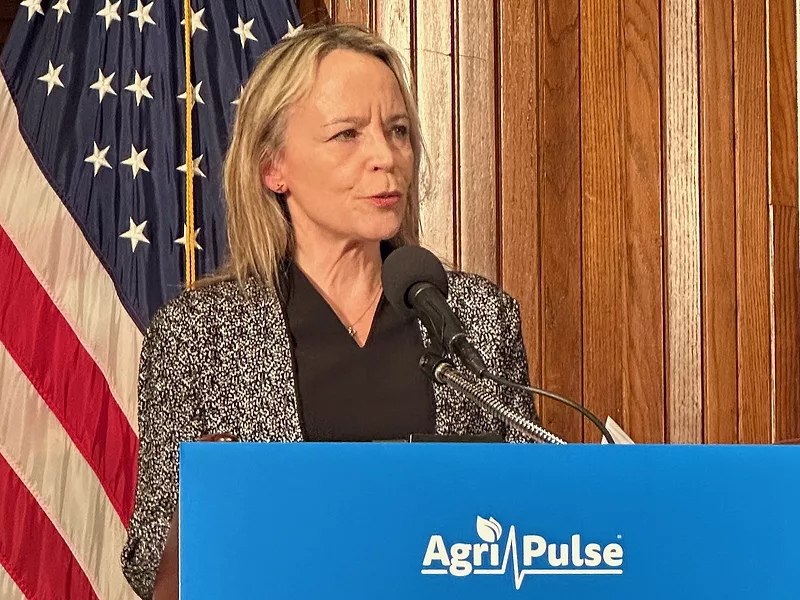
Julie Callahan, a nine-year veteran of the Office of the U.S. Trade Representative, has been nominated by President Donald Trump to serve as the agency's chief agricultural negotiator.
Callahan has been working at the agency since 2016, holding multiple positions in the Agricultural Affairs office. She has been serving as the assistant USTR for agricultural affairs and commodity policy since April 2020, according to her LinkedIn profile.
USTR did not respond immediately to a request for comment. The nomination went to the Senate Finance Committee on Wednesday, according to Congress.gov., with the White House announcing the nomination on Thursday morning.
Agricultural industry groups had been pressing the administration to swiftly fill the position. A July 8 letter to the president from more than 40 trade associations called for Trump to “expeditiously” nominate a candidate for the position to ensure agricultural issues are prioritized in ongoing trade negotiations.
If confirmed, Callahan would join the administration as it seeks to cut deals with more than a dozen of the U.S.’ largest trading partners and pries open new markets for U.S. agriculture. Agriculture has featured in both an early pact with the United Kingdom, and a recent agreement with Indonesia, and officials have indicated that they intend for ag to feature in any framework moving forward.
But the political sensitivities of agriculture in foreign capitals mean negotiations are sure to be fraught.
“All the easy stuff has been done in agricultural trade liberalization a long time ago,” former Chief Agricultural Negotiator Gregg Dowd said earlier this year. “This is tough sledding.”
In an interview with Agri-Pulse at the publication’s annual Ag and Food Policy Summit earlier this year, Callahan argued that the Trump administration was focused on rethinking U.S. trade policy and open to examining new ways of doing things. She argued that broad free trade agreements that liberalize markets across a broad swathe of products may not be suitable for every trading partner.
Broad FTAs, she pointed out, are slow to negotiate. This administration is looking to make “immediately visible” progress, she said.
Like what you see on the Agri-Pulse website? See even more ag and rural policy news when you sign up for a four-week free trial Agri-Pulse subscription.
“There's a focus on, ‘how can we do things just differently,’ and it doesn't have to look the same as what everyone's used to,” Callahan said during the summit. “That's why we're taking a look at, ‘should it be a sectoral agreement? Should it be a very narrow agreement to resolve a particular issue.’”
The idea of pursuing narrower, sector-specific agreements is not a new one, and has received increased attention in recent years. A year-long USTR study into supply chain resiliency published at the beginning of 2025 touted the merits of sectoral-specific deals and a more tailored approach to U.S. trade policymaking that addressed the needs of individual sectors.
“I would say absolutely, there's opportunities for ag-specific negotiations,” Callahan said.
Trump’s USTR, Jamieson Greer, has also previously expressed support for sectoral deals.
Callahan is also a strong advocate of reforming the World Trade Organization to bring it “back to being an organization of relevance,” she said at the Agri-Pulse summit. Accordingly, she has also endorsed pursuing more plurilateral agreements at the organization with like-minded countries to break the paralysis.
The position has sat vacant since President Joe Biden's pick, Doug McKalip, retired before Trump took office.
Multiple people familiar with discussions had told Agri-Pulse in April that the America First Policy Institute’s Doug Hoelscher had been considered for the role.
Watch Callahan's speech on trade policy at the Agri-Pulse Ag & Food Policy Summit here.
For more news, go to Agri-Pulse.com.

